


September 4, 2026
Doctors Call for Lighting Metrics That Go Beyond CCT
Researchers argue spectrum and flicker deserve more attention in lighting specifications
A cool-white LED bulb and an old-school incandescent one can carry similar lumen output claims and fit into the same socket, yet produce meaningfully different spectra, a gap that has little to do with how efficient either one is.
That's the subject of a new Ideas and Opinions piece in Annals of Internal Medicine, in which Oregon Health & Science University researchers Kevin Winthrop, MD, and Dong-wouk Park, MD, argue that the global switch to LED lighting has been evaluated almost entirely on watts saved. Rarely, they contend, has anyone examined what the spectrum itself is doing to the people living under it.
The piece isn't a study. It presents no new data, no trial, no measurement of a single fixture or patient. It's an argument for why that research should exist, built from a review of physiology, a handful of clinical trials in adjacent fields, and a case for better lighting metrics.

Beyond the Kelvin Number
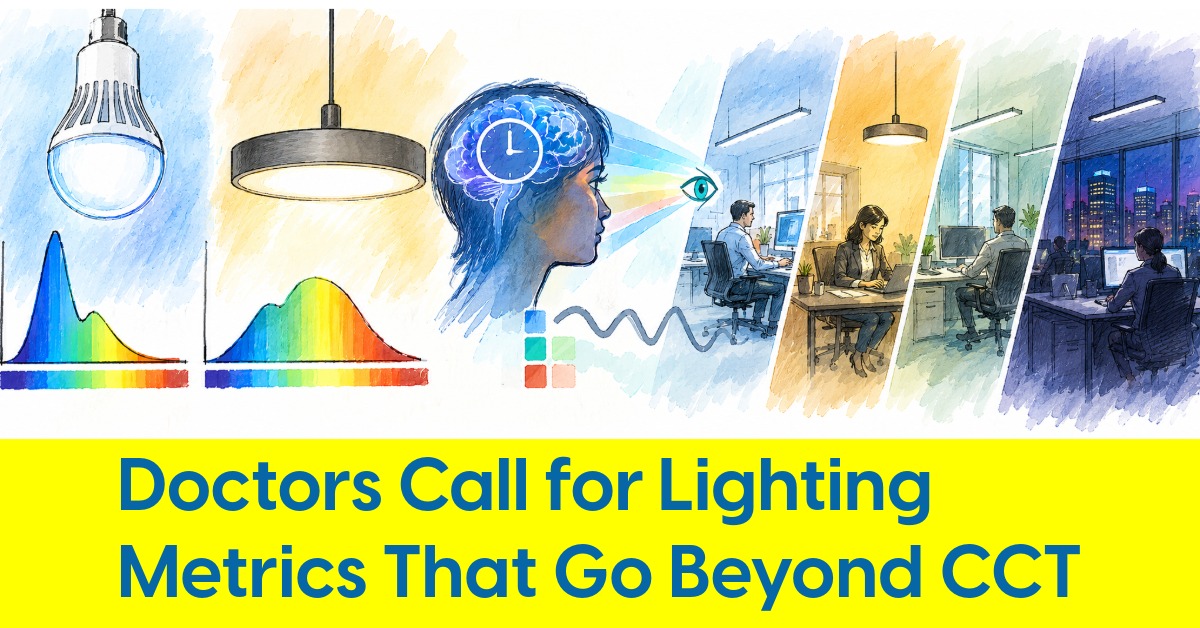
The authors' central argument is that color temperature, the kelvin rating printed on nearly every lighting spec sheet, is a poor stand-in for biological exposure. Their accompanying figure, which they describe as schematic and not drawn to scale, illustrates the point using a cool-white LED in the 5000 to 6500 K range: output concentrated near 450 nanometers, a dip across the melanopic band (roughly 470 to 490 nm) that drives circadian signaling, and negligible output past 700 nm.
Daylight and incandescent sources carry that longer-wavelength content by default. The figure's broader claim, that CCT alone doesn't capture this, is the piece's throughline rather than a claim about any specific bulb rating. That distinction matters for anyone who specifies fixtures for a living.
The piece frames LED exposure as having three separate axes worth tracking rather than one:
- Excess short-wavelength output
- Deficiency at the red and near-infrared end
- Temporal light modulation, meaning flicker driven by driver design rather than by the diode itself
None is consistently conveyed by CCT alone, and all three remain unevenly represented in everyday product specifications.
The Evidence, Held at Arm's Length
Park and Winthrop are careful, almost pointedly so, to separate plausibility from proof. They cite the well-known 2016 American Medical Association warning about blue-rich LEDs disrupting circadian rhythm and melatonin production, and a handful of clinical results in narrower contexts: a professional guideline supporting red or near-infrared light for oral mucositis during cancer treatment, a small triple-blind ICU trial reporting shorter hospital stays after photobiomodulation, and the LIGHTSITE III trial, an industry-sponsored study that led to FDA marketing authorization for a red-light device treating age-related macular degeneration. A separate randomized trial found repeated low-level red light reduced myopia progression in Chinese children.
None of that adds up to evidence that ordinary LED lighting harms the general population, and the authors say so directly. What it adds up to, in their telling, is biological plausibility strong enough to justify research before narrow-spectrum lighting becomes, in their words, an effectively irreversible global default.
Who Gets the Longest Exposure
The equity argument is where the piece sharpens. The populations most likely to sit under LED light for the longest uninterrupted stretches, patients in intensive care, nursing home residents, schoolchildren in underresourced districts, third-shift workers, tenants in subsidized housing, are also the populations with the least control over what's installed above them. Inexpensive fixtures, the authors argue, though they don't present data to demonstrate it, may also be the most spectrally narrow.
For lighting people, that reframes a spec decision as something closer to a public health question, whether or not the fixture manufacturer ever thought of it that way.
What the Authors Are Asking For
The piece stops well short of proposing a mandate. Park and Winthrop call for federal funding of longitudinal and mechanistic studies, and for standards bodies to develop metrics that go beyond kelvin: a minimum red or near-infrared content ratio, a melanopic-to-photopic exposure ratio for evening use, and some accounting for temporal modulation. They single out hospitals, schools, and care facilities as priority research settings, precisely because those buildings combine high exposure with low occupant autonomy.
Whether any standards body picks up that framework is an open question the article doesn't answer. It's an opinion piece from two physicians, not a clinical consensus or a professional society recommendation, and it lands at a moment when melanopic metrics and circadian-tuned lighting are already working their way into spec conversations. What it offers that conversation is a published argument, not new proof.