


October 14, 2026
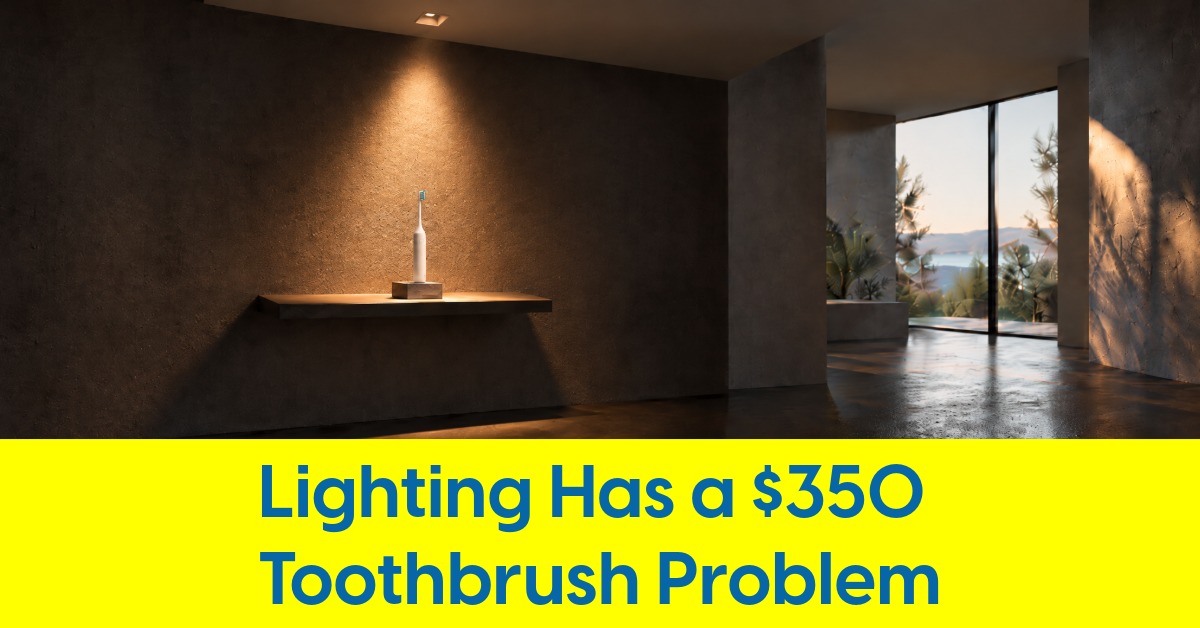
Lighting Has a $350 Toothbrush Problem
Author: Al Uszynski
A debate in my dentist's office over Oral-B and Philips Sonicare made me wonder how lighting sounds from the other side of the chair
I went into my last cleaning with an ulterior motive. I'd been eyeing premium electric toothbrushes, the ones that climb to $350 while a perfectly decent electric model costs $30, and I wanted to know what justified that kind of money for something I mostly use half-awake.
It's a fair question to put to someone with their hands in your mouth, and my hygienist, Lesley, took it seriously, walking me through the features that matter most. Then the dentist walked in. Within a minute I was a captive audience, reclined, bibbed and mouth propped open, to a spirited Oral-B versus Philips Sonicare debate between two people who work on teeth for a living and still couldn't agree on how best to do it.
Some of it landed. When the conversation turned to pressure sensors, I paid attention. I'm a hard brusher, and my gums know it. A brush with an LED ring that glows when I press too hard solves a problem I actually have. Other features left me cold. An RGB display is lovely engineering, but I couldn't picture a single morning when my teeth would be cleaner because the handle lit up in full color.
I left with clean teeth, no decision, and an uncomfortable thought on the drive home: in our industry, we're the dentists.
Lighting people argue with genuine passion about glare, color fidelity, beam spread, flicker and the last ten percent of a dimming curve, while the client is just hoping the space looks warm. And we have the very same price gap. A competent downlight can be had for $30; an architectural one can run $350 or more. Round numbers, real gap. The question was never whether the expensive one is better. It often is. The question is who it's better for.
What struck me in the chair was that I never sorted the toothbrush into "cheap" or "premium." I sorted it feature by feature. Pressure sensor: worth paying for. Display: not for me. The flagship brush is a bundle, and bundles blend things that solve problems with things that signal status. Light fixtures are no different.

In fairness to the premium product
Much of what the premium fixture buys is real; it's just hard to see. Glare you never notice because it isn't there. Dimming that glides to nothing instead of snapping off at 10 percent. Color that holds steady across 200 fixtures instead of drifting like a mismatched fan of paint chips. Drivers and thermal design that still work in year eight. The best lighting is the kind occupants never think about, which makes its value a lot like good dental care: it shows up as problems that never happen. That's lighting's pressure sensor, and it is very hard to sell an absence.
But expertise has a side effect. Once you've learned to see a scalloped wall wash or a faintly green fixture, you can't unsee it, and the line between a standard and a preference starts to blur.
What matters is whether the occupant benefits, noticed or not. Lighting qualities tend to fall into three groups:
- What people see outright. A room that looks warm and inviting, and faces that look like faces.
- What works beneath awareness. No diner can name the glare control, but they linger over dessert.
- What does little of consequence in that particular room. The finish no one will see on a 14-foot ceiling, the tunable white in a storage room, the app-configurable feature set once at commissioning and never touched again.
That third category is where lighting keeps its color displays.
The trouble is that from inside the profession, all three feel equally urgent. Some expert preferences are standards. Some are simply preferences wearing a lab coat.
Where the analogy breaks
With the toothbrush, I'm the buyer, the user and the one who lives with the result. If I pick the $30 brush, that's a rational choice and the consequences are mine. But buildings don't always work that way.
On most commercial projects, the person who pays is rarely the person who benefits. The developer funds the project, the designer specifies, the contractor proposes substitutions, and the tenant lives under the result for 15 years. The one person who would feel the difference seldom gets a vote.
Lighting is also judged with the lights off. A client can run a hand across marble and walk the white oak. A well-designed recessed fixture is meant to disappear, so on a schedule it reads as interchangeable hardware. Renderings don't show glare. Spreadsheets don't flicker.
And lighting arrives late. By the time the fixture package comes up, earlier trades have eaten the contingency, and a $350 line item sitting next to a $30 "or equal" looks like free money to a contractor on a deadline. Same aperture size, same CCT, same lumens on paper. In the room, it may be a different optic, a different color quality and a dimmer that misbehaves at dinner. Not always. Often enough.
So the $30 downlight frequently doesn't win because someone weighed the tradeoff the way I weighed the display against the pressure sensor. It wins because the person who would have noticed wasn't part of the decision.
The lighting expert's real job
If that’s the problem, the expert’s job has two halves, and the first makes the second possible.
The first is knowing when good enough is good enough. We sell a small, two-zone conference room a sleek six-scene keypad: Presentation, Video Call, Meeting and three more. A month later, everyone uses two buttons: whichever scene sits at the top, and off. The owner doesn’t see sophistication. They see five buttons they paid for and never touched, and they remember them the next time a premium line item crosses their desk.
The second is making the premium visible to the people who decide. That means mockups instead of spec sheets, and lifecycle cost instead of unit cost: the replacement labor, the callbacks, the warranty claims, what it takes to pull a hundred disappointing fixtures out of a finished ceiling. Manufacturers and reps have a part to play, because selling specifications and demonstrating value aren't the same thing. Sometimes the customer doesn't need more education about the premium product. Sometimes the premium product needs to make a better case for itself.
The pressure sensor made that case to me, almost by accident. Nobody in that office told me the expensive brush was simply better. Someone pointed to the one feature that answered a problem I already knew I had, and suddenly the price had a reason attached. That's the job: find the problem the person signing the check already feels, and attach the premium to it.
I still haven’t bought a toothbrush, and that’s fine. It’s my mouth and my money.
But lying back in that chair, I’d been staring at the answer the whole time: an 8-cell parabolic 1'x4' recessed fixture, louvers and all, now running TLED lamps. My dentist runs a thriving, long-established practice in a fancy glass building, and I’d bet nobody asked him about that retrofit, and that he didn’t ask either. The building owner paid for it. Lesley works under it all day. His patients spend their appointments looking straight up into it. In his chair, he’s the expert. Under his ceiling, he’s me.
Which leaves me wondering: on your last project, who was in the chair?