


October 9, 2026
Newark LED Retrofit Cut Violent Crime, Then Faded
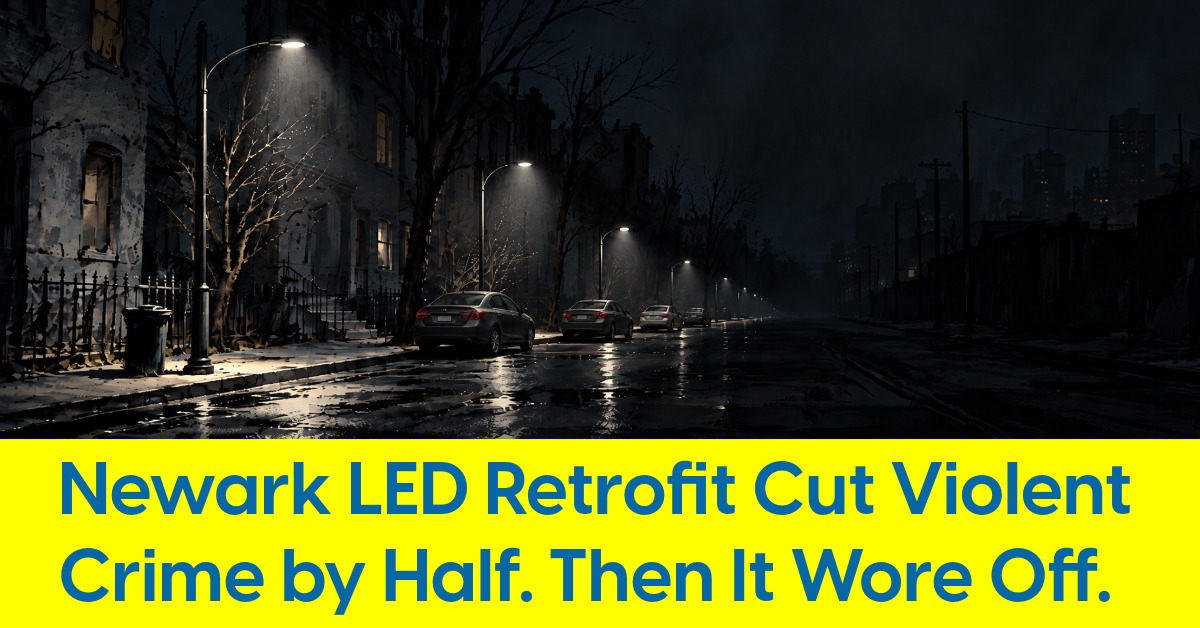
Nighttime outdoor violence fell 46% early but lost significance within two years
We read thousands of lighting headlines a year at Inside Lighting, and one story repeats across the U.S. and Canada with remarkable consistency. A city council, county commission or town board looks at a crime problem and reaches for the same tool: more light. Brighter poles in the park. LED retrofits on the troubled corridor. Light towers in the parking lot.
Given that track record, it’s no surprise the public treats light and safety as a matched pair. What gets studied far less often is what happens after the ribbon cutting. A Rutgers-led research team just did that, and the answer comes with a shelf life.
1,419 Cobra Heads in Newark
The study, published Sept. 24 in the Journal of Quantitative Criminology, follows a program run by Rutgers’ Newark Public Safety Collaborative and the utility PSE&G. Between 2019 and 2021, crews swapped 1,419 cobra-head high-pressure sodium (HPS) fixtures for LED, prioritizing street segments with histories of violent crime, mostly in Newark’s South, West and Central wards.
Lead author Alejandro Giménez-Santana’s team then tracked reported crime within 200 feet of every pole, day by day, comparing replaced poles with unreplaced poles nearby. The 200-foot radius came from the photometric coverage of the new fixtures.

Six Good Months
The early numbers were striking. Nighttime outdoor violent crime near the new LEDs fell about 46% in the first two quarters after installation, driven mostly by aggravated assaults. Crime did not slide around the corner to darker blocks or shift into daylight hours. Indoor nighttime violence, which streetlights shouldn’t touch, showed no matching drop, strengthening the case that the light did the work.
Then the effect wore off. Over a full year, the reduction averaged 35%. Over two years, it shrank to a statistically insignificant 15%, and the quarterly data show a spike in violent crime about 21 months after replacement, again led by aggravated assaults. Nighttime property crime never moved meaningfully, though burglaries dipped temporarily.
In absolute terms, the researchers calculated 34 fewer crimes across all replaced poles during those first six months. For the people on those blocks, that matters. For the utility, crime was never the business case. The paper itself credits LED with roughly a 15-year life against 4 to 6 years for HPS, at about half the energy. Six months of fewer assaults is a bonus on a retrofit cities typically justify on the electric bill and the bucket truck schedule.
Why the Crime Drop Didn't Last
The authors offer several explanations. Offenders may simply adapt. Crime magnets such as corner stores and bodegas stay put no matter how well the sidewalk is lit. Their conclusion is unusually candid for a paper that found a real effect: lighting, they write, should not be treated as a “silver bullet.”
Lighting people will notice something else. The paper reports no illuminance measurements, before or after. It treats “enhanced” lighting as a given because LEDs are known to be brighter than HPS. Its photometric evidence amounts to a single coverage diagram, which appears to show a 4000K, Type III cobra head at a 27-foot mounting height. The study also did not track outages or damage, and the authors acknowledge it. Community stakeholders reported, anecdotally, that some upgraded lights may have been deliberately broken to keep certain spots dark.
That leaves a possibility the data cannot rule out. Part of the fade may be a maintenance story nobody measured. A deterrent that depends on light only works while the light is actually on the street.
Philadelphia’s Shorter Clock
Newark’s results sit beside a much larger study. University of Pennsylvania researchers led by John MacDonald, with Aaron Chalfin among the co-authors, evaluated the first 10 months of Philadelphia’s LED conversion, covering 34,374 upgraded streetlights. They found outdoor nighttime street crime fell 15% and outdoor nighttime gun violence fell 21%. Ten months, though, falls inside the window where Newark still looked good. Philadelphia can speak to scale, but only Newark has a two-year look.
Chalfin has urged caution before. Discussing his New York public housing experiment, among the most cited pro-lighting studies, he told CNN in 2022 that lighting is “not magic that always works in all circumstances.” Bill McGeeney of the Pennsylvania Outdoor Lighting Council told The Philadelphia Inquirer in 2024 he wanted to see “a follow-up on this 10 years down the line.” Newark offers two years, and the two-year answer is a statistical shrug.
What the Industry Should Take From It
For manufacturers, municipalities, utilities and specifiers, the two studies offer rigorous support for what many LED retrofit pitches already suggest, at least in the first months. Newark adds that a crime-reduction promise built on lumens alone carries a short warranty.
The more durable lesson may be about measurement and maintenance. If cities want to claim safety benefits from lighting, someone has to verify the light on the street and keep verifying it. For lighting people, Newark settles whether light can move the crime numbers. The harder question is how long a city is prepared to keep paying attention after it does.