



October 14, 2026
Far-UVC LEDs Set New Wireless Data Record
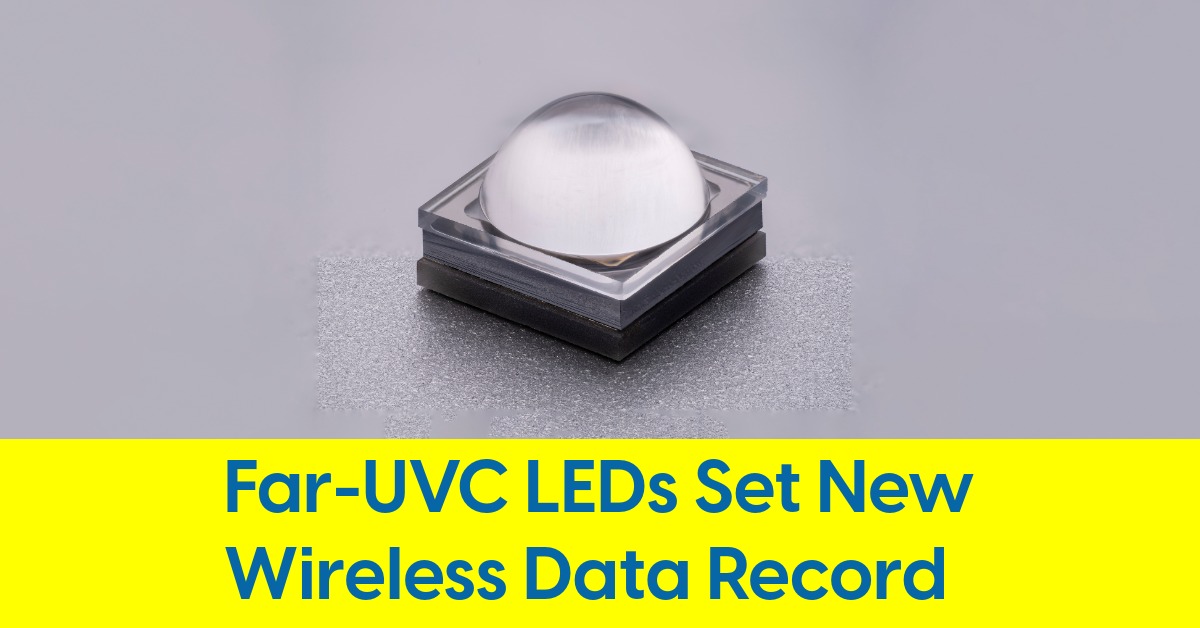
Berlin researchers achieve 1.5 Gbps transmission using invisible ultraviolet light
Thirty centimeters is about the length of a footlong sub. It is also the distance over which a Berlin research institute and two British universities just set a data record, using light most people cannot see and most lighting people associate with killing germs.
Ferdinand-Braun-Institut (FBH) in Berlin said on September 30 that far-UVC LEDs it developed carried data at up to 1.5 gigabits per second, a record for wireless optical communication below 235 nanometers. Researchers at the University of Strathclyde’s Institute of Photonics and the University of Cambridge’s LiFi Research and Development Centre built and tested the link, which ran line of sight under ordinary room lighting. The work sits under TITAN, a UK telecom research hub led by Cambridge and funded by the Engineering and Physical Sciences Research Council.

Why the Sun Matters to the Pitch
The commercial argument rests on a quirk of the atmosphere. Ozone absorbs nearly all solar UVC before it reaches the ground, so a receiver tuned to those wavelengths sees almost no background glare outdoors. Visible and infrared links fight the sun constantly, which is why they often depend on precisely aimed lasers.
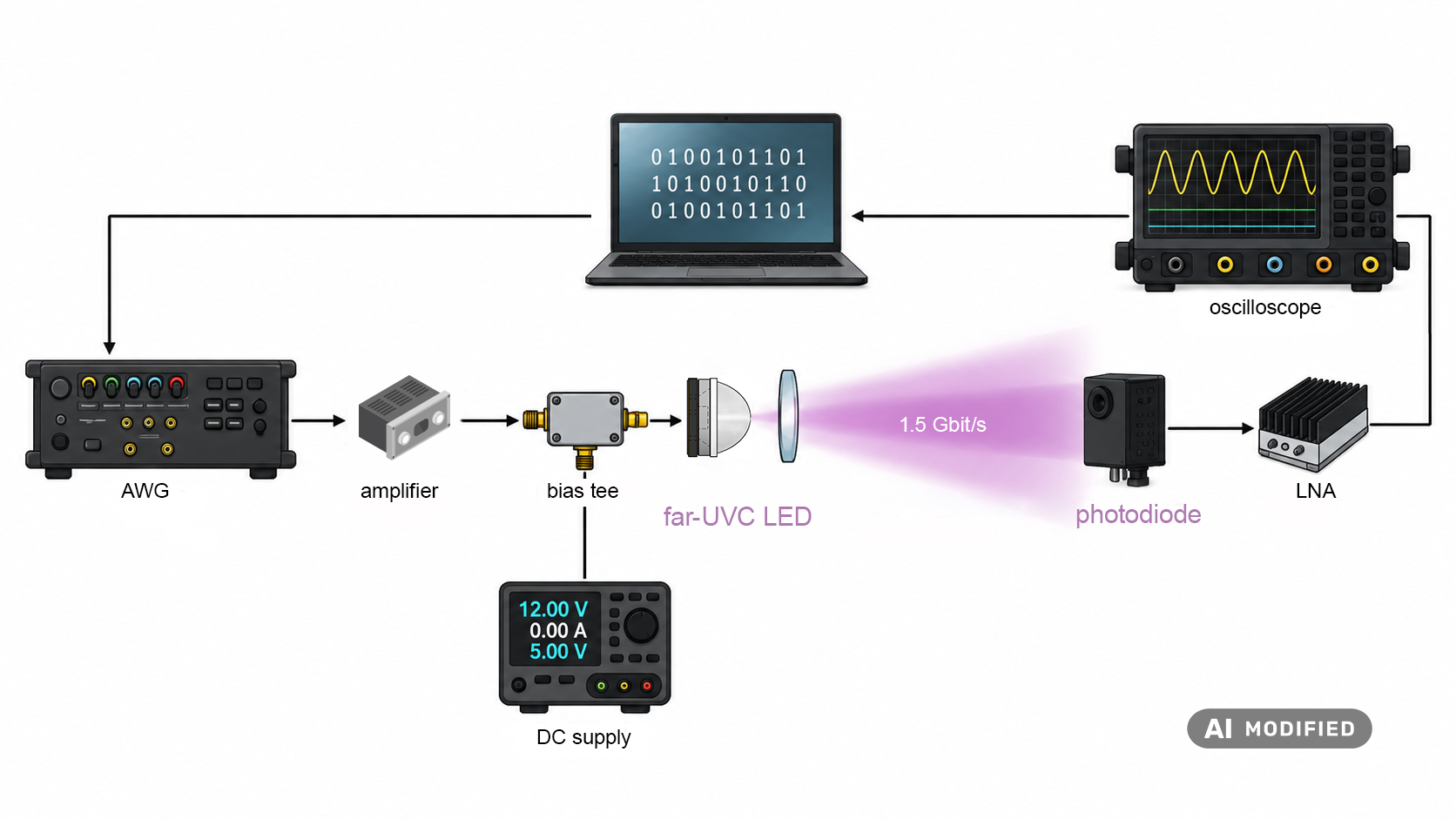
Above: A modulated LED transmits data generated by the computer to a photodiode at a rate of 1.5 gigabits per second. The received signal is amplified and analyzed by an oscilloscope. Image credit: Ferdinand-Braun-Institut
FBH’s contribution is engineering. Its team split each LED’s emitting surface into many small segments, lowering capacitance and raising current density so the device can switch faster. Faster switching means more bits per second from a part designed for communication, rather than one borrowed from a disinfection catalog.
The Fine Print Worth Reading
The record is drawn on a narrow line. In December 2025, the same Strathclyde and Cambridge groups, with the same lead author, Hichem Zimi, reported in Optics Express that a commercial 235 nm LED from Silanna moved 1 gigabit per second over 2 meters and half that over 10 meters. A 255 nm part reached 30 meters, a limit set by the size of the lab.
Read together, the two results suggest FBH’s gain is modulation speed, while distance remains unsettled. The earlier paper named output power, beam spread, and weak receiver sensitivity at short wavelengths as the binding constraints. FBH says its next step is testing longer ranges and non-line-of-sight links, which rely on air molecules scattering short-wavelength light around obstacles.
What Lighting People Should Watch
Safety is the quiet selling point. The International Commission on Non-Ionizing Radiation Protection sets the exposure limit at 235 nm more than four times higher than at 270 nm, which is why far-UVC gets pitched for occupied spaces. “Safer” still means within limits, and specifiers will want those numbers on any spec sheet that makes the claim.
The target markets named so far are drones, autonomous vehicles, robotics, and connected industrial machinery, all sectors crowded with radio traffic. None sits squarely in the luminaire business today. Still, manufacturers already selling far-UVC disinfection fixtures may eventually confront an awkward product question: if the emitter overhead can also talk, who owns the network?