



October 7, 2026
Blue Light Has Another Nobel Prize Moment
From LEDs to neurons, blue light keeps adding to its scientific résumé
Twelve years ago, the Nobel Prize in Physics went to three scientists who finally coaxed bright blue light out of a semiconductor. This week, the Nobel Prize in Physiology or Medicine went to three others who found out what blue light can do inside a nerve cell.
On October 5, the Nobel Assembly awarded the 2026 medicine prize to Karl Deisseroth of Stanford University and the Howard Hughes Medical Institute, Peter Hegemann of Humboldt University of Berlin and Georg Nagel of the University of Würzburg. The award recognizes their work on light-gated ion channels and a technique called optogenetics.
None of this involves a luminaire. For an industry that spends its days impacted by wavelength, though, it is worth a few minutes.

A Switch Borrowed From Algae
The discovery began with a simple question. Hegemann wanted to know how Chlamydomonas, a single-celled alga, manages to swim toward light. In the early 2000s, he and Nagel identified a protein on the alga's surface, channelrhodopsin, that opens like a gate when blue light hits it. Charged particles rush through and create an electrical impulse. Place that protein in another cell, and that cell becomes light sensitive too.
Deisseroth took the next step. He inserted the gene for channelrhodopsin into rat nerve cells and showed in 2005 that blue light could make them fire. By 2007, the same switch worked in the brains of living mice.
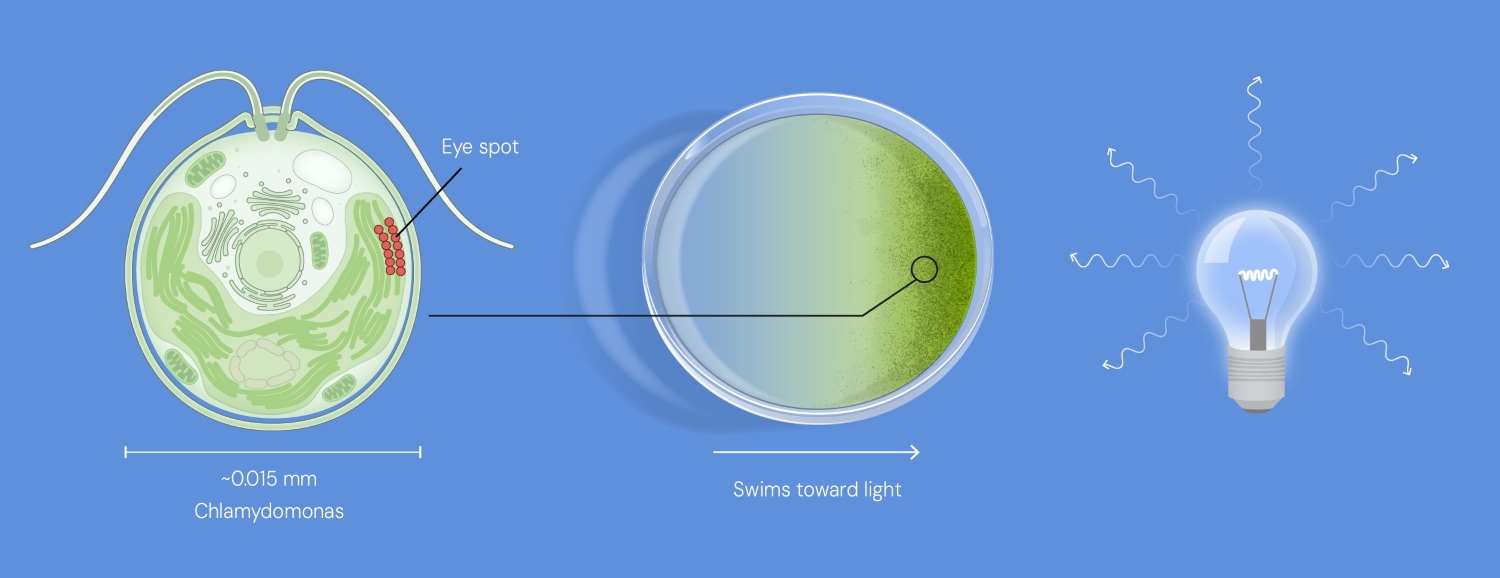
Image courtesy of the Nobel Assembly at Karolinska Institutet
Why Scientists Care
Before optogenetics, researchers could map which brain areas seemed linked to which functions, but they struggled to prove cause and effect. A light-controlled switch changed that. Scientists can now turn specific nerve cells on and watch what happens. According to the Nobel committee, this has revealed circuits tied to memory, emotion and behavior.
The committee also noted that researchers are using the method in clinical attempts to restore sight in people with visual impairment. That work remains experimental, and the announcement claims nothing beyond the attempt.
Where the Lighting Connection Ends
Optogenetics is a neuroscience tool. The prize does not validate claims about circadian lighting, human-centric products or the health benefits of any fixture on a spec sheet, and marketing it that way would earn some well-deserved skepticism.
The real connection is narrower and more interesting. The LED era taught this industry that light involves more than lumens, because wavelength, intensity and timing all change what light does. This prize rewards scientists who used those same variables, at microscopic scale, to control a living cell with precision.
There is also a symmetry here. The 2014 physics prize went to Isamu Akasaki, Hiroshi Amano and Shuji Nakamura for the blue LED, the breakthrough that made white LED lighting practical. The protein honored this week responds to blue light. The two prizes involve unrelated science, but they share a color.
A Color With Range
For years, blue light has given the lighting business headaches: glare complaints, health hazard headlines and spec debates over color temperature. Stockholm has now honored it twice, once for how to make it and once for what it can switch on.
Lighting people are unlikely to be selling into neuroscience labs anytime soon. They can still appreciate that the most argued-about wavelength in their catalogs keeps turning up in places nobody expected.