


October 15, 2026
6½ Things We’re Watching as Signify Reports Earnings
Third-quarter results arrive October 23 with margins, countries and OEM under close scrutiny
Four months ago, CEO As Tempelman stood in Eindhoven and sorted the world’s largest lighting company into two piles. Build businesses would receive investment. Harvest businesses would be managed for cash. On October 23, Signify reports third-quarter results, its first full quarter since that Capital Markets Day. It is the first real chance to measure the plan against numbers instead of slides.
Some of the June choices were crisp. Others were left deliberately soft. Conventional lighting, OEM and commoditized manufacturing all landed under the heading “all options open,” a phrase that reads to us like a plan to evaluate now and decide later. Whether any of those later decisions involve a spinoff or a sale is a question management has been careful not to answer. Announcing an intent to sell before a buyer appears rarely improves the price.

Two weeks after the Capital Markets Day, Tempelman sat down with the Dutch financial daily Het Financieele Dagblad and was more candid than he had been on the investor stage. According to the paper, he is reversing a fair number of decisions made under his predecessor, Eric Rondolat. He also told the FD that Signify had held the commercial reins somewhat too tight.
He said he is open to selling the traditional lighting businesses, though only at the right price, and was clear that he did not take the job to destroy value. The headline carried the bigger idea. Translated from Dutch, Tempelman said Signify wants to become “more than just a lighting company,” because that market has zero growth.
That echoes what he told Inside Lighting in June about entering adjacent markets through acquisitions. A CEO who calls his core market flat while unwinding his predecessor’s choices is preparing shareholders for a different kind of company. The third-quarter report is the next chance to see how quickly that preparation turns into action.
Here are 6½ things we’re watching heading into the report:
1. The Q3 Bar Is Specific, and Low
Analyst consensus compiled by Signify on October 8 expects third-quarter sales of €1.374 billion ($1.54 billion), a comparable sales decline of 3.0%. Adjusted EBITA, the company’s preferred measure of operating profit, is forecast at €113 million ($127 million), an 8.2% margin. Net income is expected at €46 million ($52 million), or €0.39 per share.
Every segment is forecast to shrink on a comparable basis. Professional, the largest at €914 million ($1.02 billion), is projected down 2.3%. Conventional, the business Signify seems to be steering toward its end, is expected to fall 16.2%. Anything resembling growth would be the surprise.
The full-year guidance may matter more than the quarter. Signify has guided to an adjusted EBITA margin between 7.5% and 8.5% for 2026, and consensus sits at 7.6%, barely above the floor. If management holds the full range, analysts will ask whether the upper half is still realistic. If it narrows the range downward, that is the first formal admission that 2026 is a reset year.
2. The Recovery Runs Through Costs
The analyst forecasts tell a story the company would rather not headline. Sales stay essentially flat from 2026 through 2028 at about €5.45 billion ($6.10 billion) a year. Comparable sales growth is forecast at negative 0.9% in 2027 and positive 0.1% in 2028. Even so, net income climbs from €134 million ($150 million) in 2026 to €189 million ($212 million) in 2027, and earnings per share rise about 39%, from €1.11 to €1.54.
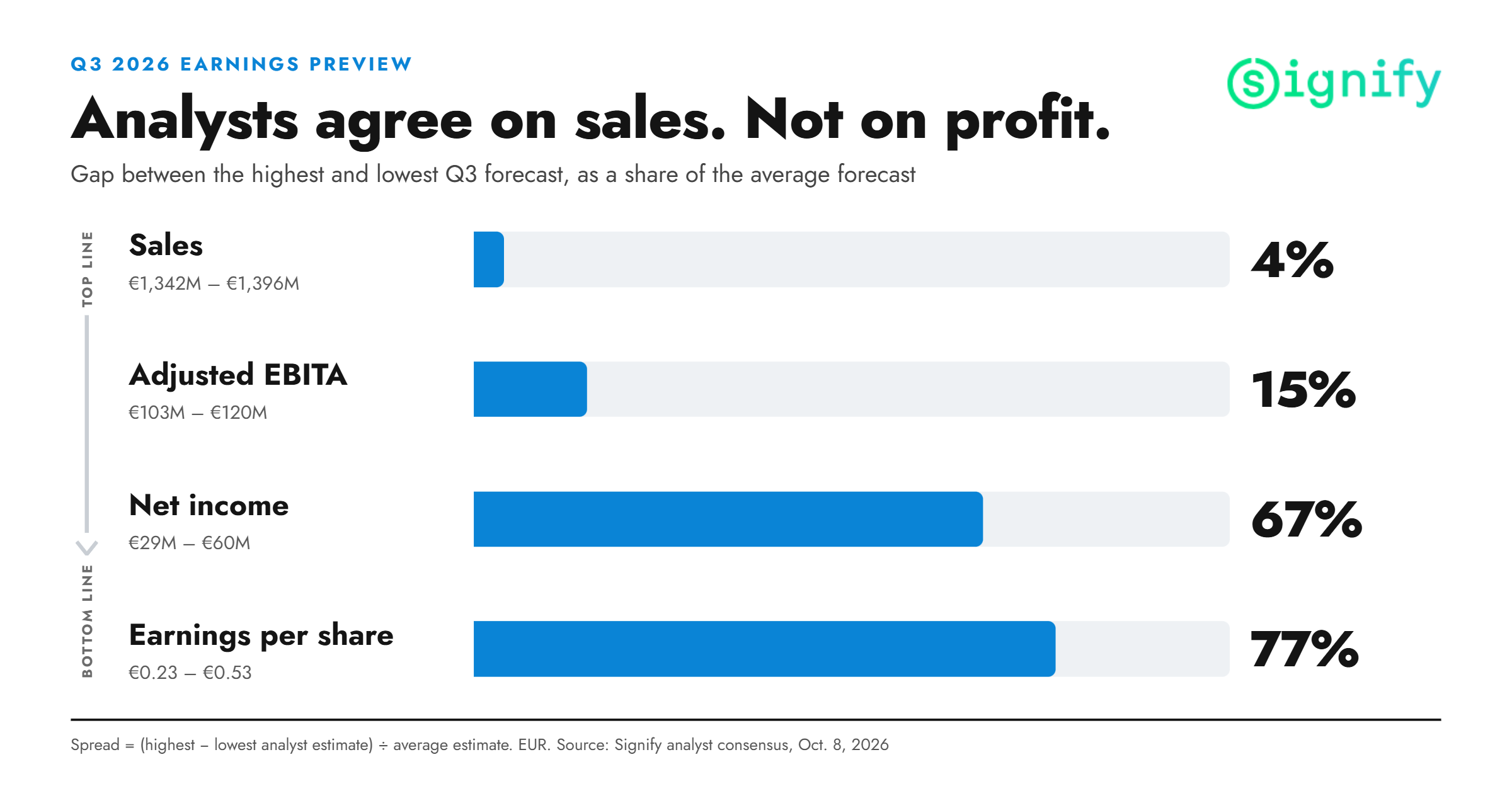
Percentages show the gap between analysts’ highest and lowest forecasts, relative to the average forecast. They measure disagreement, not expected increases or decreases.
The lift comes from the expense side. Restructuring and incidental charges are forecast to fall from €122 million ($137 million) to €71 million ($80 million), while the adjusted EBITA margin edges up from 7.6% to 8.0%. Analysts are modeling a leaner Signify that sells roughly the same amount of product.
That leaves the 2029 target exposed. Signify promised an adjusted EBITA margin of about 10%. The consensus sheet stops at 2028, where the average forecast is 8.4% and the most optimistic analyst reaches 9.7%. Closing the remaining distance in a single year would require either a demand recovery nobody is forecasting or another round of cost cutting nobody has announced.
3. OEM Splits the Analysts, and Xitanium Gets a New Name
No segment divides analysts more. Third-quarter forecasts for OEM, the components business that sells LED drivers and modules to other luminaire makers, range from flat to a 12% decline, the widest spread on the sheet. The average calls for sales of €88 million ($99 million) and adjusted EBITA of €4 million ($4.5 million), a 4.2% margin. The most pessimistic fourth-quarter forecast puts OEM profit at roughly zero.
At the Capital Markets Day, OEM sat under the “all options open” heading, and Tempelman described three paths to us in June: keep it, partner, or divest. Then in July, the day before its second-quarter report, Signify elevated Xitanium from a product family to a standalone, Signify-endorsed brand. The change starts with LED drivers in August and extends to more OEM lines through 2027. The company presented the move as simplification.
Our read, which is analysis and not reporting, is that a standalone brand also makes a partnership or carve-out cleaner to execute. A business with its own name is easier to value, easier to present to a buyer and easier to separate from its parent. North American readers will also want to know whether Advance, the driver brand most U.S. specifiers and distributors know, eventually follows the same path. Both are questions worth putting to management on October 23.
4. The Country Retreat Has Started
Signify will sell its professional lighting business in Austria entirely through partners starting January 1, 2027, expanding its work with ELEKTRON Austria GmbH. It is the first concrete step in the plan to shrink direct presence from 55 countries to 35.
The model matches what Tempelman described in June. Customers in the departing countries can still buy Signify products, but through distributors and partners rather than company sales teams. Capital and management attention move to the markets that generate real returns, with North America at the top of that list.
Expect more of these, and expect them to arrive quietly, through trade press and partner announcements rather than earnings calls. Twenty countries is a long list, and smaller European markets are the obvious candidates. We will be tracking each one. On October 23, the question is whether management offers a timetable.
5. The Workforce Has Already Shrunk
Signify ended June with 25,866 full-time employees, down from 29,456 a year earlier. That is a reduction of about 3,600 people, or more than 12%, in twelve months.
The 900 job cuts tied to the €180 million ($202 million) cost program announced in January explain only a fraction of that decline. The company attributes much of the rest to fewer factory workers as production volumes fell, along with seasonal effects and reorganizations.
In practical terms, Signify’s manufacturing operation is contracting before any formal Harvest exit has been announced. The third-quarter report is expected to include an updated headcount. Another steep drop would suggest the factory contraction is continuing, and it would make an eventual decision on commoditized manufacturing look more like confirmation than change.
6. Philips Hue Opens the Gates
Consumer is the first growth priority in the Build portfolio, but the forecasts have not caught up. Analysts expect Consumer comparable sales to decline 1.1% in the third quarter and 1.4% for the full year, before returning to modest growth of 0.6% in 2027.
Signify, meanwhile, has been moving. At IFA in Berlin in September, the company announced a partnership with Nanoleaf that brings the smart-panel maker’s wall panels into the Hue ecosystem. It came alongside AI automations triggered by natural-language commands, Sonos integration and Hue Cloud backup. Less than a year earlier, the two companies settled a patent lawsuit Signify had filed against Nanoleaf in federal court in New York. This move fits the Capital Markets Day goal of putting more Hue devices in every household, as Hue dispels an old stereotype of being a closed system.
Hue also raised prices in July on numerous products, mainly items that had been on the market for more than a year. The fourth quarter will test those decisions. Consensus expects Consumer sales of €370 million ($414 million) in the holiday quarter at an 11.9% margin. A miss there would hit the business Signify has asked investors to believe in first.
6½. Klite, the Unfinished Item
Klite, the large Chinese LED manufacturer in which Signify holds a 51% stake, earns the half because so little of it is visible. The minority shareholders, who own the remaining 49%, have sued, alleging that Signify must buy an initial 16.33% stake from them. Signify disputes the claim and has recognized no liability.
If Signify wants to reduce its exposure to commoditized manufacturing, Klite may be the hardest piece to move. A pending fight over who must buy what, and at what price, complicates any sale or partnership. We found no update since July, so any change in disclosure on October 23 deserves attention.
What the Market Is Already Pricing In
The market delivered its verdict on the June plan quickly. Signify shares suffered their biggest drop ever after the Capital Markets Day, as investors absorbed a dividend cut and a forecast of barely any growth through 2029.
Analysts remain divided. Barclays analyst Rajesh Patki reaffirmed a Sell rating on October 5 with a €12.30 price target, about 14% below this morning’s €14.25 share price. J.P. Morgan kept a Hold rating on October 6. Goldman Sachs rated the stock a Hold in August with an €18 target. Shares sit just above their 52-week low of €13.80, set on July 28.
Tempelman has told Inside Lighting and the Dutch press he wants Signify to become more than a lighting company. On October 23, lighting people will get a clearer look at how much of the lighting company he plans to keep along the way.