


October 5, 2026
New Research Challenges Dim-To-Warm Assumptions
A controlled study finds warmer dimming is not universally preferred
Dim-to-warm has become one of the easier upgrades to sell in lighting. A downlight that slides toward amber as it dims echoes the old incandescent lamp, flatters a hotel lobby, and gives a specifier something to say in a design meeting. Whether occupants actually want it has received far less scrutiny than the products themselves.
A new study in LEUKOS, the journal of the Illuminating Engineering Society (IES), offers a partial answer. Crispin Rock and Wenye Hu of the University of Sydney's School of Architecture, Design and Planning published "Dim-to-Warm Lighting: An Experimental Analysis of Preference and Perceived Naturalness" on September 29. Their conclusion is narrower than a marketing department might like, and more useful.

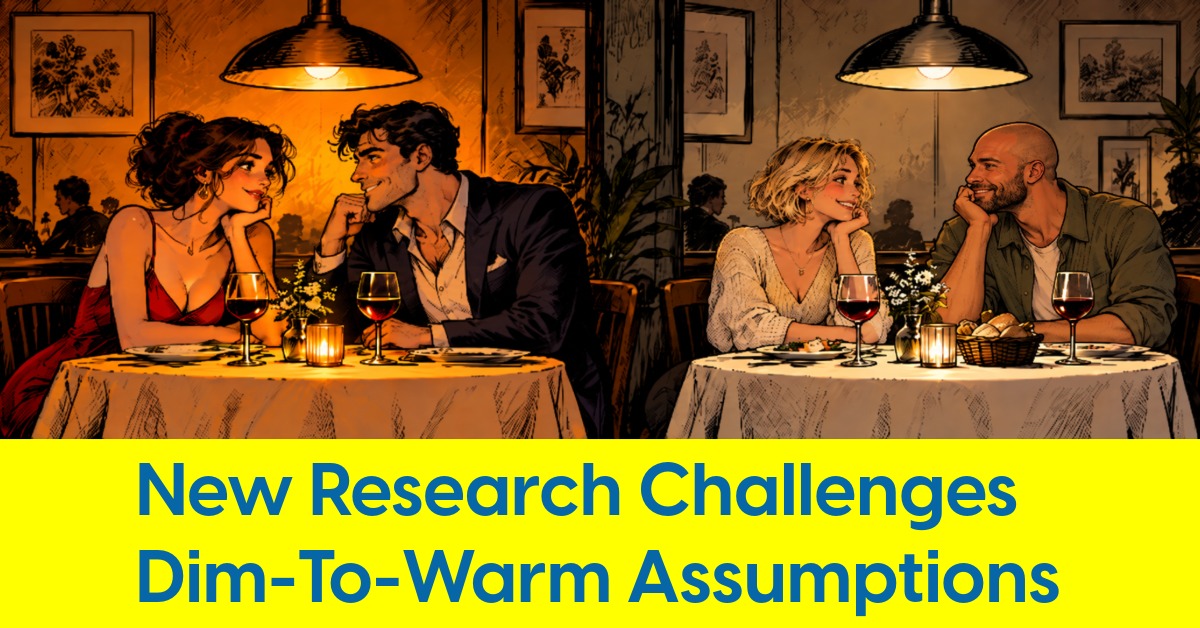
Thirty participants rated dimming sequences for preference and naturalness after a voice prompt told them to imagine either an office or a home, bar, or restaurant. Each sequence began at a color temperature the participant had chosen, then dimmed to 2% of its starting level while shifting warmer, cooler, or not at all.
In the office scenario, every color shift lost. Constant CCT was rated more preferable and more natural than a shift in either direction. In the social scenario, a modest warm shift, for example 3250 K falling to 2300 K, scored about the same as no shift. Larger warm shifts, and any move toward cooler light, generally fared worse.
So dim-to-warm held its own in restaurants and living rooms without outscoring ordinary dimming. The authors describe it as equally preferred there. In the office, it dragged ratings down.
Read the Fine Print
The limitations matter. Participants were staff and students from the same architecture school, seated at a white booth or inside a bare white room. "Home" and "office" existed only as verbal prompts. To hit precise chromaticities, the test luminaires ran on red, green, and blue channels alone, which the authors acknowledge compromised color rendering. Ratings came seconds after dimming, before eyes had fully adapted.
The authors themselves call for field research. Their results also join decades of mixed findings on the Kruithof curve, the 1941 notion that dim light should be warm, which several later studies failed to confirm. This is a well-controlled data point in a long-running argument.
What It Means at Spec Time
The practical reading is about application. Dim-to-warm in hospitality and residential spaces looks defensible, particularly with a gentle curve. In workplaces, the case thins considerably. The paper also notes there is still no performance standard for dim-to-warm, and a 2020 U.S. Department of Energy stress test found wide variation in how far and how fast products shift. One commercial downlight the researchers measured drifted noticeably greener than a halogen lamp at low output.
Occupants live with whatever curve gets approved during submittals, long after the project team moves on. For lighting people, the better question at spec time is which dim-to-warm, in which room, and for whom.