


September 8, 2026
5½ Details Hiding Behind LSI’s Record Revenue
Margins, tariffs, and other disclosures reveal nuances to the growth story
LSI Industries closed fiscal 2026 with a headline growth story: record revenue, a Display Solutions segment doing most of the heavy lifting, and a leverage number that moved in the wrong direction along the way. Quarterly earnings releases and the press coverage built around them carried most of that narrative throughout the year, and they did their job. But those releases are built for speed, not depth. The 10-K is where a company has to say more, in more precise terms, whether it wants to or not.
LSI filed its fiscal 2026 10-K on September 3, and it runs 114 pages. We went through all of it. What follows are five-and-a-half things that don't surface in a quarterly release and that lighting people may have otherwise missed entirely.
1. Lighting Is Shrinking as a Share of Revenue, But It's the Better Business
Strip away the topline narrative and the segment math gets uncomfortable for anyone assuming Display Solutions is simply the superior business. Lighting posted a 12.3% operating margin in fiscal 2026 ($32.7 million on $266.2 million in net sales). Display Solutions ran 7.5% ($31.8 million on $423.2 million). Per dollar of sales, Lighting is still the more profitable half of the company.
It is not getting treated that way in the capital budget. Lighting segment capex fell from $3.555 million in fiscal 2024 to $1.883 million in fiscal 2025, recovering only slightly to $2.192 million in fiscal 2026, down roughly 38% from where it started. Display capex nearly doubled over the same period, from $1.386 million to $2.852 million. Companywide R&D spending, meanwhile, declined in absolute dollars from $3.5 million to $3.1 million even as total revenue grew almost 50%.
That is not an accident of the market. It reads as a deliberate allocation choice: run Lighting as the mature, cash generative half of the business and point growth capital at Display. The open question is what happens if Lighting ever needs fresh product investment to keep defending national accounts against better funded competitors.

2. LSI Is Unusually Blunt About Lighting Agent Risk
Every 10-K carries a risk factors section, and language like this is standard fare there, companies are required to spell out what could hurt the business.
What's less standard is a lighting manufacturer walking through the mechanics in this much detail. The public posture on a rep change is often a LinkedIn post about an exciting new partnership. LSI's risk factors section lays out something more specific: sales in an affected territory "will likely fall," disruption "may take several months," and the replacement agency may never attain the prior agency's sales volume.
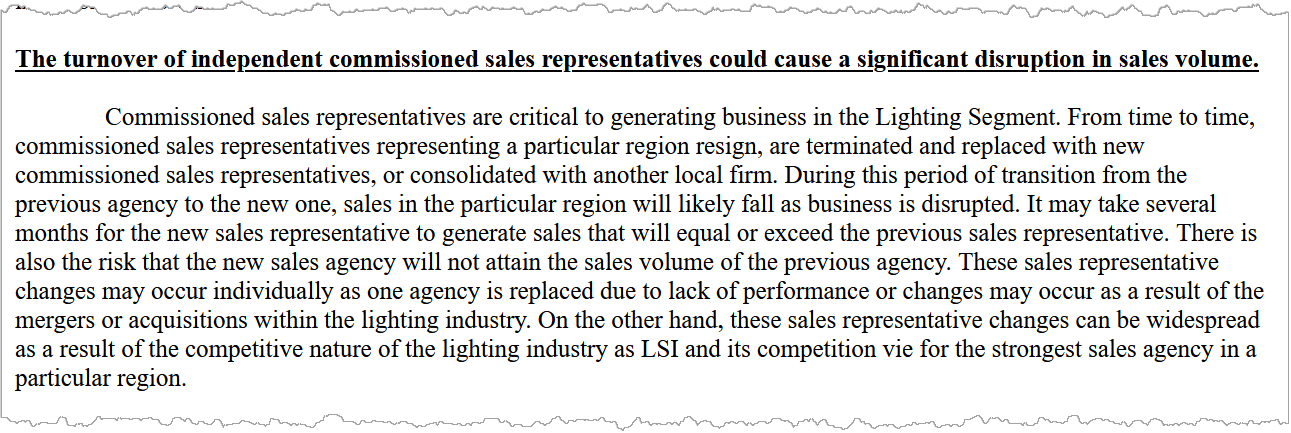
This is worth filing away for reasons beyond LSI. It is a citable, on the record acknowledgment from a publicly traded lighting manufacturer that agency turnover is a real commercial risk and possible growth impediment for all lighting manufacturers that utilize independent lighting reps.
3. How Tariffs Have Raised Lighting Prices
Most companies write tariff risk in the conditional tense: this could happen, this might affect us. LSI's filing skips the hedge. "The Company's Lighting Segment has implemented price increases with customers to offset raw material price increases, rising transportation costs, and to mitigate the impact of trade tariffs." Past tense. Action taken.
There is a nuance worth sitting with alongside that admission. LSI describes its lighting products as "American made fixtures," and the assembly and engineering largely are. But the bill of materials includes LEDs, power supplies, sensors, aluminum castings, wire harnesses and optics sourced from a range of suppliers, including foreign ones. "American made" describes where the fixture comes together, not where every component started.
And there is no cushion to absorb the difference. LSI discloses that only about 7% of consolidated net sales occur outside the United States. Nearly the entire tariff burden on imported inputs has nowhere to go but into domestic pricing. For an industry that has spent eighteen months watching tariff policy lurch in one direction and then another, this is a named manufacturer confirming actual pass through pricing in a document filed with the SEC, which is a meaningfully stronger source than the usual industry contact on background.
4. Lighting and Display Often Operate in Different Channels
The two segments do not just have different margins and different capital treatment. They often sell through entirely different architectures. Lighting moves primarily through manufacturers' representatives and distributors, split between project driven, preferred vendor business and standard products through stocking distributors. Display Solutions sells direct, tied to multi year, multi site national rollout programs executed by LSI's own sales force.
As Display becomes the larger half of the company, LSI is increasingly organized around a direct sales, national account model, while Lighting still runs on the agent and distributor structure that item three just described as fragile in transition. LSI talks about cross selling and being a single source provider. Those are two fundamentally different go to market systems bolted together under one ticker. Whether the company ever pushes more lighting volume through its direct national account relationships, and whether that creates friction with the rep network, is a fair question for the next earnings call.
5. Royston Is Now Half of LSI's Balance Sheet, on 11% of This Year's Revenue
Royston — the major retail fixture and display manufacturer LSI acquired earlier this year — contributed just 11% of LSI's fiscal 2026 consolidated net sales, having been owned for a little over three months following its March 24 close. Include goodwill and acquired intangibles, and Royston accounts for 50% of LSI's total consolidated assets as of June 30.
The purchase price tells you what LSI actually bought:
- Of the $338.2 million paid for Royston, $179.9 million was allocated to acquired intangible assets.
- LSI says $144 million, roughly 43% of the entire purchase price, went to customer relationships carrying a 20 year useful life.
- Technology assets were valued at $12.2 million.
LSI can now leverage Royston across both Display and Lighting. It paid for embedded relationships with large chains running multi year display rollout programs, which is about as quantitative a confirmation of a "sticky, program driven business" thesis as a filing ever offers.
5½. The One Number That Should Worry You Least
Despite the scale of the Royston bet and LSI's broader concentration in national accounts across grocery, refueling and Quick Service Restaurant (QSR) chains, no single customer or program accounted for 10% or more of consolidated net sales in fiscal 2026, 2025 or 2024. No customer crossed 10% of accounts receivable either.
LSI just made its largest, most concentrated bet yet on relationship driven business, and it still managed to spread that exposure across enough customers that none of them holds real leverage over the company. It is the reassuring flip side of everything item five just raised.