


August 19, 2026
50% Canadian Tariff Paused as Trade Talks Continue
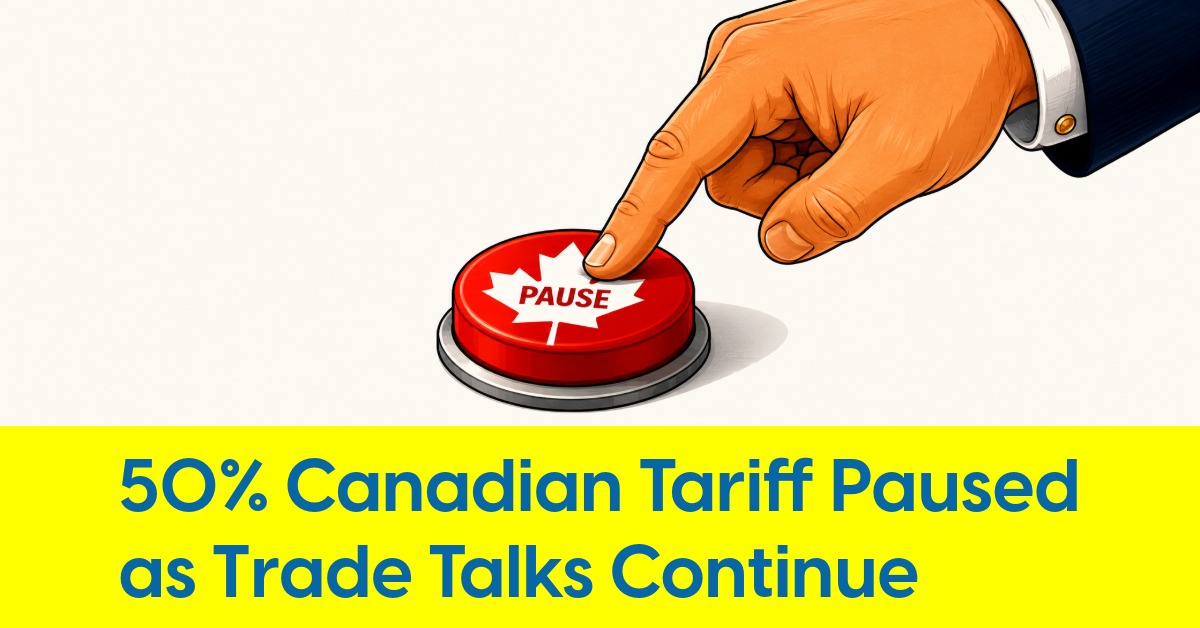
Eighteen months of shifting duties have normalized supply chain uncertainty
The 50 percent tariff on certain Canadian lighting fixtures and components was supposed to take effect Wednesday morning. Instead, it took a three-day timeout, announced Tuesday night not through a Federal Register notice but on Truth Social, where President Trump wrote that Canada and the United States have reached an agreement "subject to the finalization of documents," and floated the resurrection of the Keystone XL pipeline for good measure.
Prime Minister Mark Carney's office described the same moment more cautiously. In a statement dated Tuesday, Carney said substantial progress had been made in trade talks but that important work remained, and that Washington had agreed to postpone the 50 percent tariff under Section 338 of the Tariff Act of 1930 until the end of the day on August 21.
| Tariff Code | Product Description |
|---|---|
| 9405.11.60 | Chandeliers and other electric ceiling or wall lighting fixtures, of base metal (other than brass), designed for use solely with LED sources |
| 9405.11.80 | Chandeliers and other electric ceiling or wall lighting fixtures, not of base metal, designed for use solely with LED sources |
| 9405.42.60 | Electric lamps and lighting fixtures nesoi, of base metal (other than brass), not photovoltaic, designed for use solely with LED sources |
| 9405.42.84 | Electric lamps and lighting fixtures nesoi, not of base metal, not photovoltaic, designed for use solely with LED sources |
| 9405.99.40 | Parts of lamps, lighting fixtures, illuminated signs and the like, not of glass, plastics or brass |
For lighting people, the distinction between "we have a deal" and "we have postponed the deadline" is not a small one. Among the many product categories swept into the tariff were decorative and architectural LED fixtures, plus non-brass parts, drivers, and housings — a slice that reaches deep into Canada's design-forward manufacturing base.
A number of well known lighting companies, most of them architectural, operate out of Quebec, Ontario, and British Columbia, and were staring down a duty that stripped away USMCA protection entirely, layered on top of the Section 232 metals tariffs already baked into landed-cost models.

None of this arrives as a surprise pattern to anyone who has been importing lighting products or components over the last eighteen months. Tariffs have gone up, come down, applied globally, then applied selectively, taken effect on schedule, then been paused days or hours before the deadline. Forecasting landed costs against that backdrop has become its own discipline, and this week's postponement fits neatly into a rhythm the industry already recognizes.
Three days buys breathing room, not resolution. Contracts written against a Wednesday deadline do not simply reset because the deadline moved to Friday. Import schedules, project bids, and distributor inventory decisions made in July assumed a tariff that arrived on schedule, then didn't, then might again by the weekend.
There is also the matter of legal authority. Section 338 carries no built-in requirement for investigation or consultation before tariffs are announced, which is likely why it was chosen for speed. But as Toronto’s Globe and Mail has reported, the provision has never been tested in court, and the administration is taking that risk months after the Supreme Court struck down its use of a different emergency-powers law. That question doesn't disappear because a pause was announced on social media.
For lighting people, the question this week is not whether the tariff arrives Friday, was never real, or gets rewritten entirely once documents are finalized. It is how many procurement decisions get made in the meantime based on a deadline that has already proven negotiable.