


July 21, 2026
What Lighting People Need to Know About New Canada Tariffs
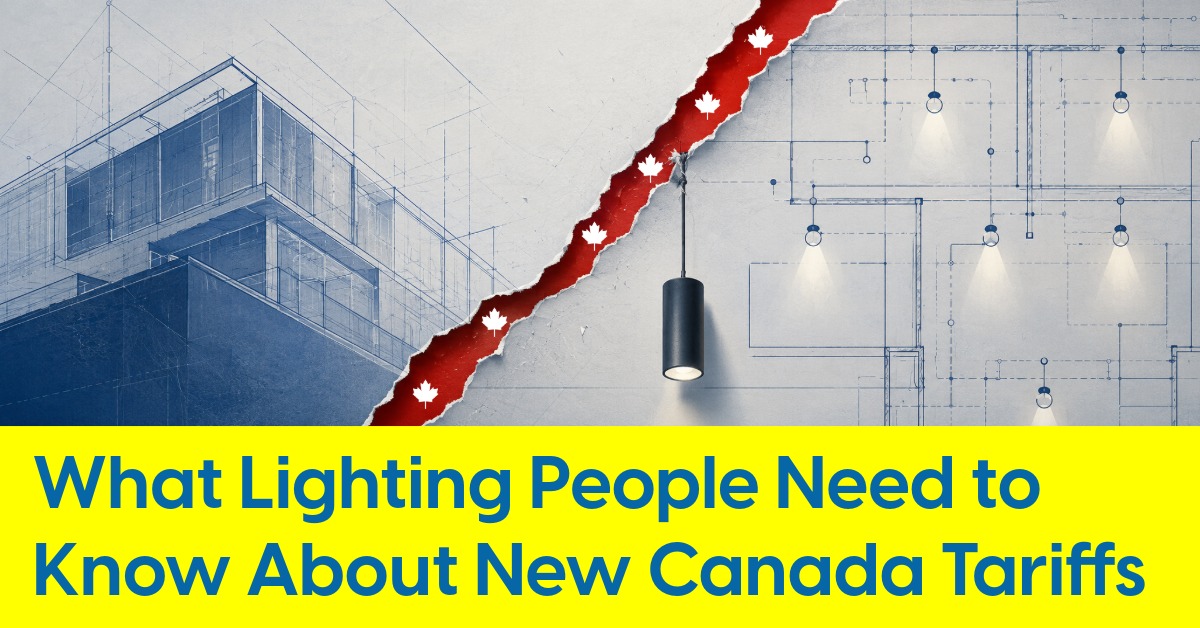
Canadian-made lighting products face a new 50% duty beginning August 19
President Trump's new 50% tariffs on Canadian goods arrived on Monday wrapped in headlines about dairy quotas, whiskey shelves, and auto plants. Buried inside one of the proclamations is a narrower category that has nothing to do with cars or cheese: decorative and architectural LED lighting fixtures, plus the parts that go into them.
That matters because Canada is not a bit player in architectural lighting. It is home to a concentrated cluster of design-forward manufacturers, many in Quebec and the Toronto area, with others scattered across British Columbia, that supply the specification-grade fixtures U.S. architects and lighting designers put on their boards. LMPG's Fluxwerx and Lumenpulse brands, Beta Calco, Axis Lighting, Lumenwerx, Liteline, Cooledge, 3G Lighting, Kuzco, and Eureka Lighting (part of the Acuity family) all operate north of the border. So do Lumec and Ledalite, both part of Signify. None of them make headlines in a story about auto tariffs. All of them are now exposed. Some have U.S. contingency plans, some do not.

What Is Actually Covered
The tariff language is specific. It applies to chandeliers and ceiling or wall fixtures "designed for use solely with LED sources," and only when they are not of brass. Non-brass base metal fixtures and non-metal fixtures both appear in the annex.
The specificity cuts both ways, raising a couple of open questions:
- Brass fixtures do not, at least not under any 9405 line we found in the two annexes reviewed, which raises the question of whether brass decorative fixtures escape this particular duty entirely.
- It also raises a socket-level wrinkle: fixtures with a standard E26 base, interchangeable with incandescent and CFL lamps, arguably don't meet 'solely' LED at all, unlike integral LED-engine designs.
| Tariff Code | Product Description |
|---|---|
| 9405.11.60 | Chandeliers and other electric ceiling or wall lighting fixtures, of base metal (other than brass), designed for use solely with LED sources |
| 9405.11.80 | Chandeliers and other electric ceiling or wall lighting fixtures, not of base metal, designed for use solely with LED sources |
| 9405.42.60 | Electric lamps and lighting fixtures nesoi, of base metal (other than brass), not photovoltaic, designed for use solely with LED sources |
| 9405.42.84 | Electric lamps and lighting fixtures nesoi, not of base metal, not photovoltaic, designed for use solely with LED sources |
| 9405.99.40 | Parts of lamps, lighting fixtures, illuminated signs and the like, not of glass, plastics or brass |
A separate line covers lighting parts, drivers, housings, and hardware, that are not made of glass, plastics, or brass, which reaches further into the supply chain than the fixture headline suggests.
There is no USMCA relief. Fixtures and parts that would normally cross the border duty-free under the trade agreement lose that protection under this proclamation. The additional 50% takes effect August 19, layered on top of whatever duties already apply.
A Tariff Environment Lighting Already Knows
None of this is happening in a vacuum. Steel and aluminum imports, materials that show up constantly in poles, housings, and structural components, have carried a 50% Section 232 tariff since mid-2025, a rate that survived even the Supreme Court's February ruling against the administration's broader IEEPA tariff authority.
Lighting importers have spent more than a year adjusting landed-cost models around that metal imports reality. The new Canadian fixture tariff does not replace that exposure. It stacks on top of it for anyone sourcing finished LED products from Canadian plants.
What to Watch
The legal ground under the new tariffs is not settled. Section 338 of the Tariff Act of 1930, the authority President Trump invoked, had not been used since 1949, and trade lawyers have argued it was effectively superseded by statutes Congress passed in 1962 and 1974. Legal challenges are widely expected. A court injunction before August 19 could delay or unwind the fixture tariff before it ever reaches an invoice.
For now, lighting people sourcing from Canadian manufacturers have a narrow window to sort out which fixtures and parts actually fall under the specific tariff codes, whether the brass carve-out holds up, and how the added cost gets absorbed or passed through projects already in motion.