


August 12, 2026
Massachusetts Bill Sets 3000K Ceiling For Public Outdoor Lighting
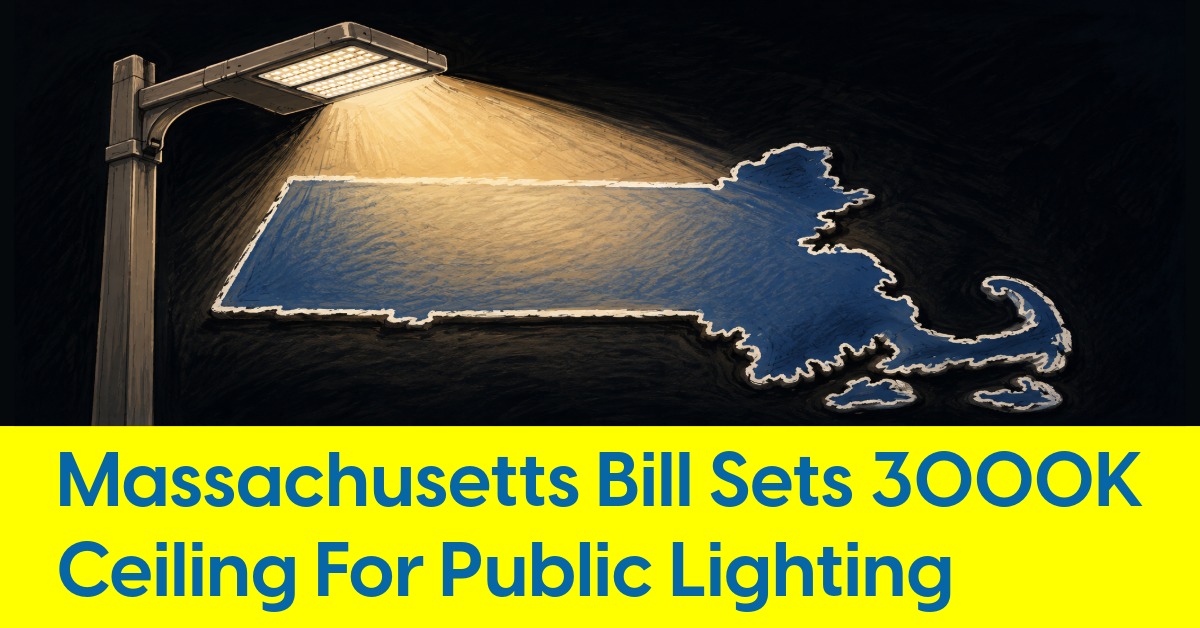
Proposed legislation ties illuminance, fixture counts and uplight performance to new thresholds
The Commonwealth of Massachusetts has spent decades racking up championship victories. Its legislature is now championing a different kind of win: a 3000 Kelvin ceiling and a full-shielding mandate on every new public outdoor fixture in the state.
Massachusetts is moving toward a strict set of technical requirements proposed for publicly funded outdoor lighting: a 3,000K color temperature ceiling, full-shielding requirements for most roadway and parking applications, illuminance limits tied to industry standards, and a directive that roadway fixture counts not exceed what's actually necessary.
None of it is law yet. The bill remains in legislative limbo, and the specifics matter more to manufacturers, reps, specifiers and DOT people than the political process getting it there.

What Lighting People Need to Know
The legislation, filed as H.3494 and reworked into S.3145, would bar state or municipal funds from being used to install or operate new permanent outdoor fixtures unless they meet five core conditions:
- A 3000K CCT ceiling. Fixtures installed for any purpose could not exceed a correlated color temperature (CCT) of 3000 Kelvin, with exemptions written in for demonstrated public safety needs, decorative façade or landscape lighting, and athletic field illumination.
- Full shielding for most applications. Roadway, parking-lot and building-mounted fixtures would generally need to meet a U0 uplight rating, the IES standard for zero light emitted above the horizontal plane, unless they qualify as ornamental fixtures or light tunnels and underpasses.
- Illuminance capped at what's necessary. Maintained illuminance couldn't exceed levels required for the intended purpose, with DOER weighing IES and industry standards when setting caps. Higher levels are allowed with a demonstrated safety need, and local ordinances setting lower illuminance levels would override the state standard, so the ceiling can vary by municipality.
- No more roadway luminaires than necessary. DOER would determine fixture counts in consultation with MassDOT and the Executive Office of Public Safety and Security, weighing criteria from the Federal Highway Administration and the IES rather than existing pole counts or spacing. For manufacturers, that's a shift from "replace what's there" to "justify what's there."
- A new utility rate for sub-25W fixtures. The Department of Public Utilities would have to develop an unmetered electric rate specifically for roadway and parking-lot luminaires drawing less than 25 watts, a provision spelled out in the bill text rather than left to inference.
The bill sets the framework, but exact lux/footcandle targets and fixture-spacing formulas come later, in regulations due by January 1, 2027. A date that, by pure coincidence, falls somewhere around Week 16 of what Patriots fans will insist is an inevitable march back to a repeat AFC Championship.
One detail matters more to the supply side than the headline numbers: none of this is retroactive. A previously installed fixture that's destroyed, damaged, inoperative or simply needs standard maintenance can be replaced without triggering the new requirements. This is a new-installation standard, not a retrofit mandate.
Where the Bill Stands
The Senate passed its version, S.3145, on July 1, adopted two floor amendments, and reprinted it as S.3162. The House advanced closely related language through its environmental bond bill in mid-June.
Because the Senate's bond bill didn't carry the same lighting provisions, a conference committee now has to reconcile the two before anything reaches the governor's desk, a process that could extend well into the fall.
Massachusetts Isn't Alone
Massachusetts would join a small but growing group of states putting statutory limits on publicly funded outdoor lighting. I
- llinois's SB 3037, passed 54-0 in that chamber's Senate, uses nearly identical language, restricting new fixtures purchased or rented with state funds and capping CCT at 3,000K, the closest structural match to the Massachusetts approach.
- Maine went further and actually enacted its version, LD 1934, which took effect this year with the same 3,000K ceiling, full shielding for higher-output fixtures, and its own set of DOT and historic-lighting carve-outs.
- New York's pending statewide bill takes the opposite approach: no CCT limit at all, but a mandate covering private and residential lighting, not just publicly funded projects, making it broader in scope but less prescriptive on color.
Massachusetts isn't merely debating warmer streetlights. It's weighing rules that touch CCT selection, BUG and uplight performance, illuminance targets, fixture counts and the utility economics of low-wattage roadway lighting, all at once. For manufacturers building spec sheets and reps pitching municipal projects, that's a lighting story first and a political one second.