


September 30, 2026
Inside Leviton’s Surprisingly Deep Lighting Operation
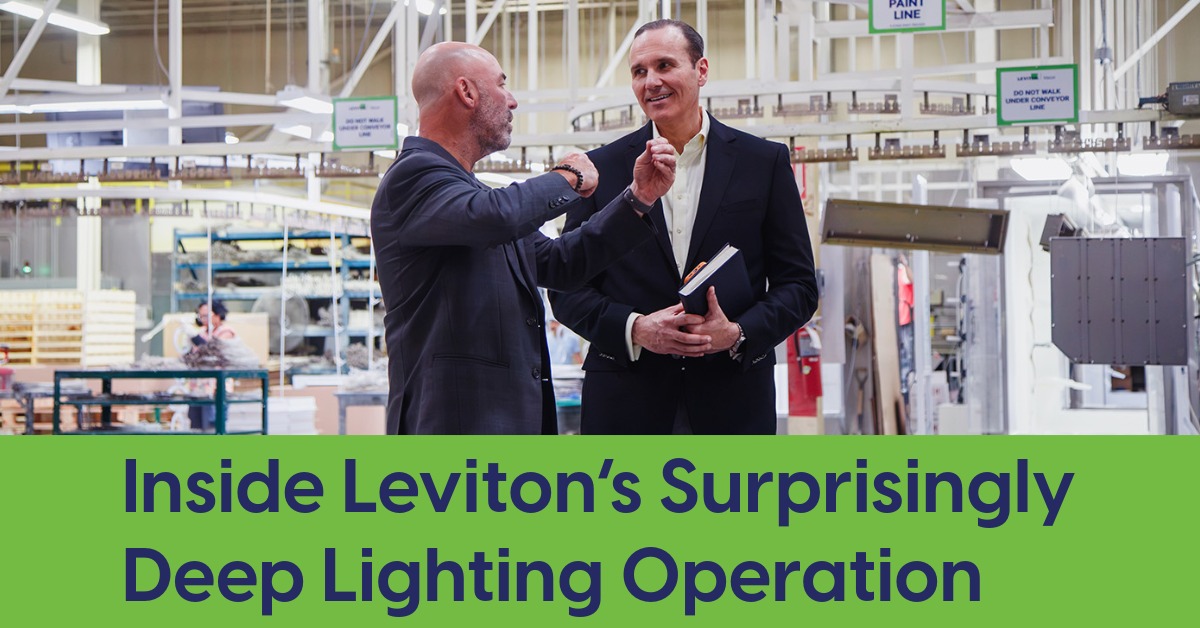
Pierre Legare and Al Uszynski tour the paint line, part of a notably clean and orderly factory floor where forming, welding, finishing and assembly are tightly integrated under one roof.
Certolux and Visioneering pair brand autonomy with manufacturing scale and corporate backing
A surgical suite does not forgive a lighting fixture with open seams. Neither does a behavioral health unit, where the wrong hardware can become a ligature risk. And a 100-foot linear run across an open ceiling leaves nowhere to hide if the housings wander, the joints show or the line is anything less than straight as an arrow.
These are not applications where “close enough” is a viable spec. They are applications where the fixture itself has to perform exactly as intended.
That is the world Certolux and Visioneering, the Leviton-owned lighting brands, build for. Inside Lighting recently toured the operation and found a manufacturing footprint much larger, and considerably more automated, than we expected going in.

Certolux
Specialty lighting for high-stakes environments. Medical, cleanroom, vandal-resistant, hazardous location. Certified, not just compliant.

Visioneering
Premium architectural lighting. Performance, wireless controls, wellness integration. Commercial pricing, architectural quality.
What the Factory Actually Controls
The rundown from Pierre Legare, Executive Vice President, starts with a basic observation about how most of the industry works: buy housings from one supplier, electronics from another, assemble the result, hope nothing upstream slips. Visioneering and Certolux take raw coil steel through stamping, bending, welding, painting, lensing, and testing inside a single, roughly 200,000-square-foot operation staffed by close to 200 employees.
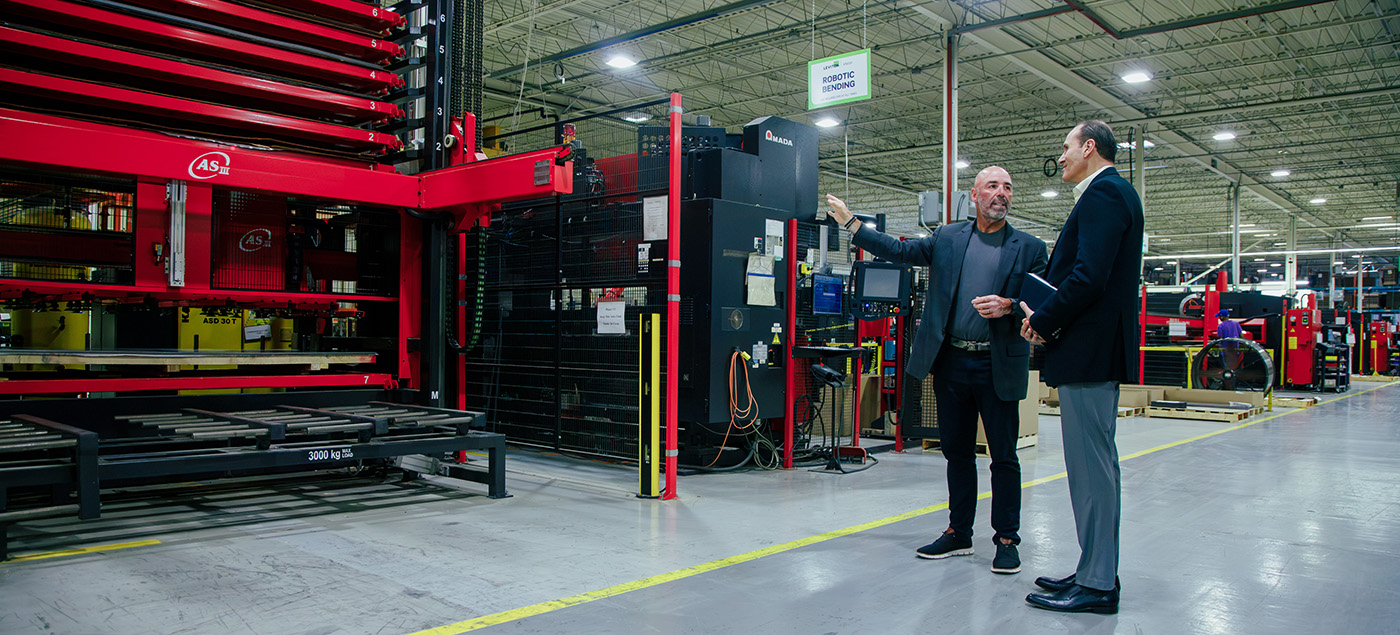
Pierre Legare shows Inside Lighting’s Al Uszynski the robotic bending operation, part of a highly automated 200,000-square-foot factory that keeps much of its metal fabrication in-house.
"A promise date is a promise kept," Legare said. Control the whole process, and there is no outside vendor left to blame when a deadline gets tight.
The bending equipment on the floor illustrates the point. A single machine, fitted with 64 individually controlled fingers, takes a flat sheet of steel and forms it into a one-piece fixture body in one pass, no spot welds joining separate panels, no end caps sealing the gaps other manufacturers leave behind. Where a five-piece housing depends on every seam holding, a one-piece body has none to fail.
The Weld That Has to Be Perfect Every Time
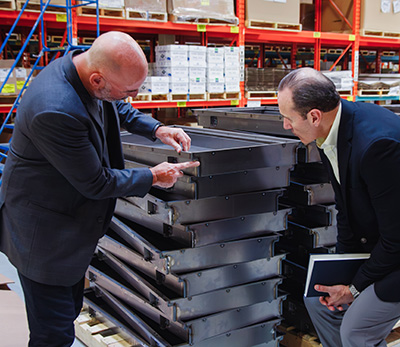
Pierre Legare shows Inside Lighting’s Al Uszynski a fixture corner. Automated welding handles repeatable seams, while skilled manual welders address details where harsh-environment fixtures leave no room for gaps.
That one-piece construction only matters if the final seal is just as solid, which is where the company's robotic welding line comes in. The equipment traces back to a specific bottleneck: during the pandemic, welder availability could not keep pace with a surge in temporary hospital demand, and Leviton funded a robotic welding center in response.
The payoff is precision that does not depend on an individual welder's hand that day. A robotic seam weld requires no post-grinding, the step Legare identified as the real point of failure in manual welds. "When you grind a weld, you're taking away the very thing that creates the seal," he said. Work that once took a week now takes a day, with a seam that, according to the tour, is designed to hold under sustained positive or negative pressure without weakening over time. Notably, staff on the floor declined to produce an intentionally flawed weld for a side-by-side comparison. They would not put their name on anything they were not proud of, which is its own kind of quality claim.
“In 75 years, we've faced recessions, crises, pandemics, and constant change. We've grown two brands, served two countries, and adapted to an industry that never stands still. Through every challenge, our focus has remained the same: helping our agents and customers succeed. That commitment continues to drive every decision we make today.”
— Pierre Legare, Executive Vice President
Certified, Not Just Compliant
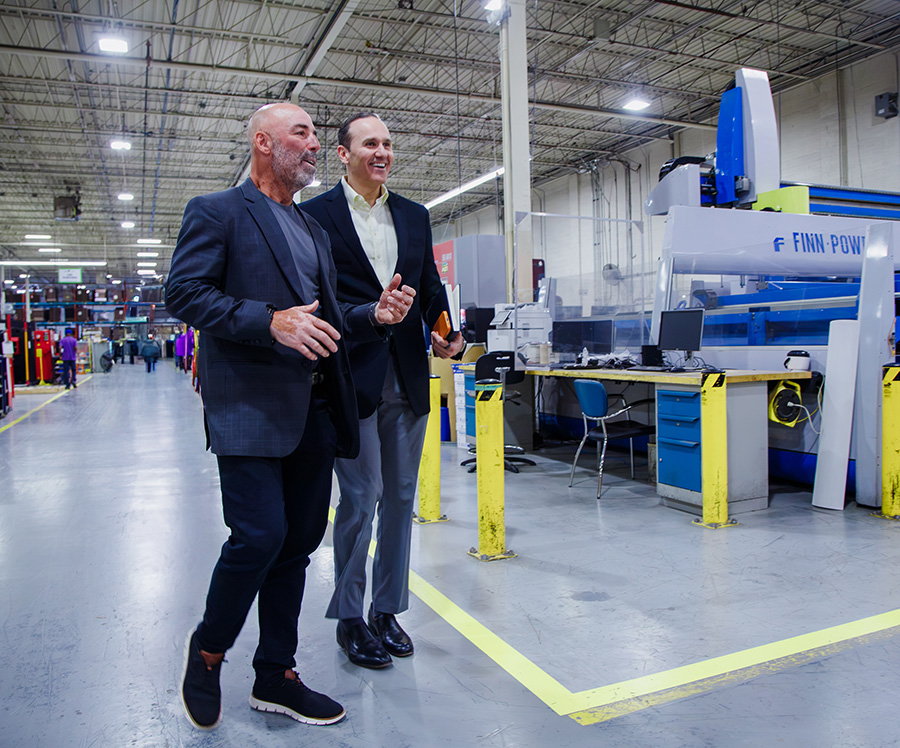
Pierre Legare walks Al Uszynski through the roughly 200,000-square-foot Toronto operation, where highly automated equipment handles much of the forming and fabrication work in-house.
Certolux built certification into its name, and Legare made the case that the word choice on a spec sheet is not incidental. NSF and ISO listings are common enough across the industry. Legare pointed to a narrower, harder to obtain approval as well: New York's Office of Mental Health ligature-resistance certification, granted only after a sample fixture is submitted and tested directly, a process he described as difficult to pass.
His broader argument is aimed at how spec sheets get written industry-wide. Third-party certification is a specific, checkable claim. Language like "meets" or "complies with" is not the same thing, and in high-stakes applications, Legare argued, specifiers should know exactly which one they are reading before they commit.
Built to Scale Without Becoming a Boutique
None of this comes at the cost of speed. The company runs a QuickShip program with 24-hour, three-day, and ten-day fulfillment tiers depending on configuration, supported by cross-trained assembly lines that shift between hard-tooled runs and one-off custom orders without shutting down production. Drivers are programmed in-house rather than installed as generic stock components, giving the company control over output specifications on a per-order basis, a step Legare said costs more but keeps turnaround measured in days rather than weeks.
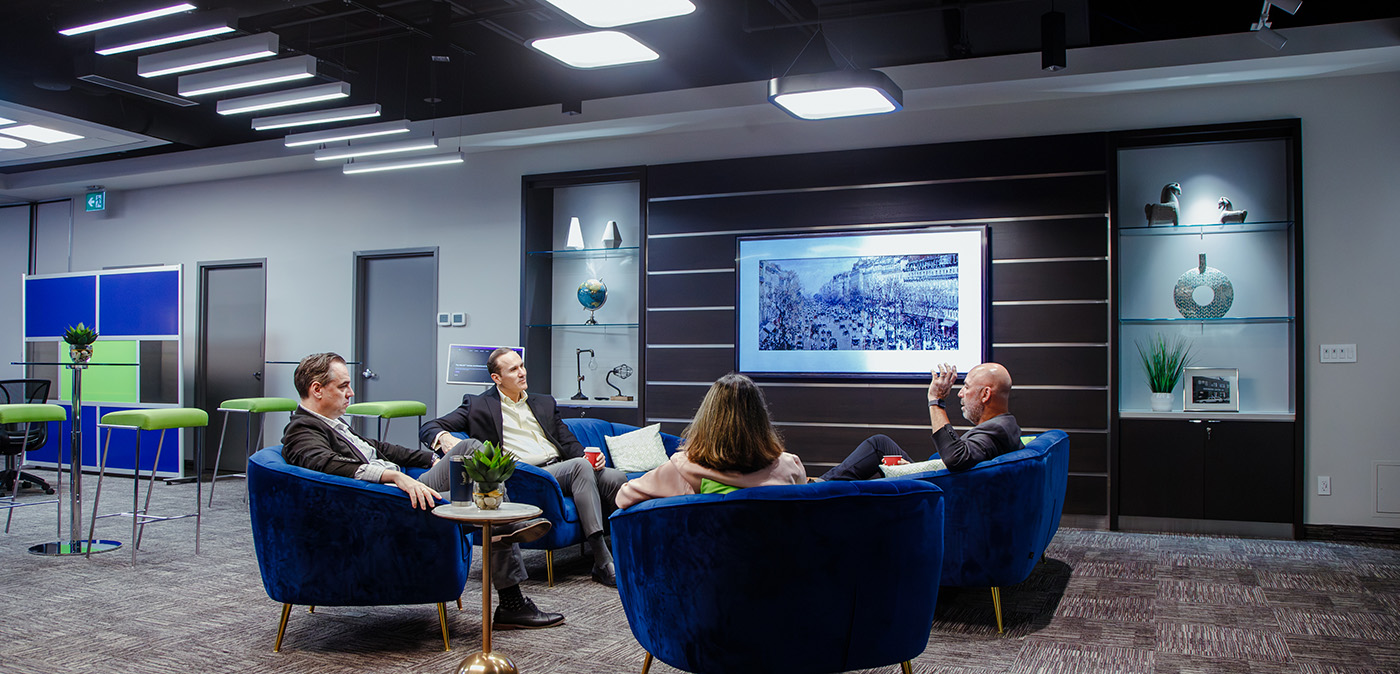
From left, Troy McCartan, Al Uszynski, Annarissa Francis and Pierre Legare discuss the Certolux and Visioneering brands in the company's training center
"Commercially built to scale, commercially priced to compete," is how Legare summarized the philosophy, describing an operation designed to serve healthcare, laboratories, warehousing and fulfillment centers, schools, and office and property management projects without treating any one of them as a specialty exception.
A Retrofit That Leaves the Ceiling Alone
Visioneering’s fixture-in-fixture retrofit approach reuses existing seismically anchored housings rather than removing them, a detail aimed squarely at older buildings where disturbing the plenum risks disturbing asbestos along with it. It is a narrower pitch than a new product launch, but a practical one for anyone who has priced out what tearing infrastructure out actually costs.
Autonomy, Backed by Scale
Leviton acquired the two brands in 2019, and day-to-day operations have changed little since. Most of the major equipment on the floor predates the acquisition. The robotic welder stands out as the clear exception, capital Leviton committed when a pandemic-era bottleneck demanded it. The brands continue to operate with the independence of the family businesses they started as, backed now by a parent large enough to fund major equipment on short notice. It is a North American manufacturing model, drawing on domestic supply chains across the continent to avoid the delays that come with offshore sourcing.
For lighting people, the real test of a factory like this is not what it looks like on a tour. It is what happens when a deadline, a gasket or a tariff, gets pushed to its limit.
Note: Inside Lighting’s tour of the Leviton, Certolux, and Visioneering manufacturing facility was supported by a commercial partnership with Leviton. While this feature is commercially sponsored, all reporting, facility observations, and highlights reflect our firsthand visit to the Toronto plant.