


July 29, 2026
What Construction Economists See Coming Next
The construction forecast has two stories, and lighting people need to know which one they're in
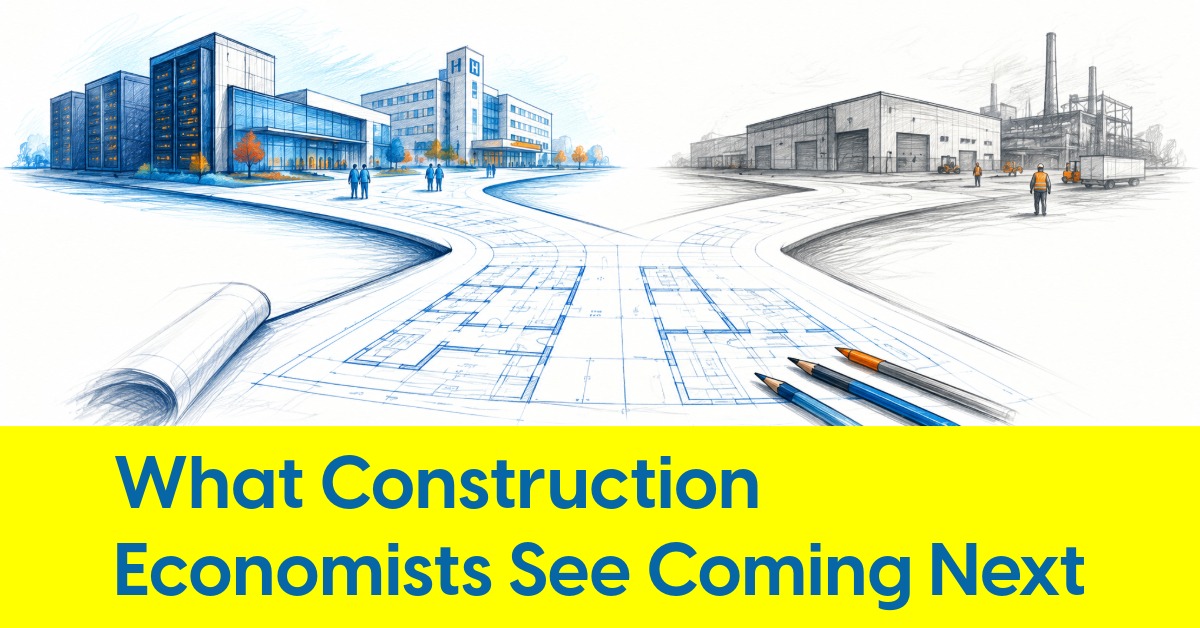
Ask twelve construction economists for their outlook and you typically get twelve versions of the same number, clustered close enough to average into something useful. The 2026 AIA Consensus Construction Forecast doesn't work that way. It reads like two separate reports stapled together: one describing a market in retreat, the other describing a market on fire. Both are accurate. Neither is the whole picture.
For lighting executives trying to plan projects, inventory, staffing, and specification strategy for the next 18 months, understanding which story applies to their customer base matters more than the topline number.
A K-Shaped Market, Not a Recovery
The panel's headline figure, a 0.3 percent decline in nonresidential building spending for 2026, sounds like a rounding error. It is not. As recently as January, the same panelists forecast 1.0 percent growth. Six months of data, including a sharp spending drop through the first five months of the year, pushed the consensus into negative territory. The 2027 outlook improved over the same period, from 2.2 percent to 3.0 percent, which tells its own story: economists are not simply gloomier. They are more convinced that the market has split into distinct lanes, some accelerating and some still falling, rather than converging toward a shared middle.
That is the definition of a K-shaped economy, and it shows up everywhere in this forecast. Manufacturing is down double digits. Data centers are up more than 30 percent. Averaging those numbers produces a forecast that describes neither sector accurately, and treating the consensus figure as a proxy for "how construction is doing" will mislead anyone making purchasing or staffing decisions based on it.

The Data Center Illusion
Commercial construction looks healthy in the aggregate: 4.8 percent growth in 2026, 5.8 percent in 2027. Strip out data centers and the picture inverts. The panel's own analysis notes that commercial spending excluding data centers would show roughly a 1 percent decline in 2026 and barely 1 percent growth in 2027.
For lighting manufacturers and reps, that distinction is the whole ballgame. A hot commercial number driven almost entirely by hyperscale campuses does not translate into broader retail, office, or hospitality demand. Data centers are a real and growing category, one requiring high-spec, power-dense fixtures and controls systems built for continuous operation. But they are not evidence of a healthy commercial construction market. They are evidence of one very large, very specific customer segment absorbing most of the growth while everything else treads water or sinks.
Manufacturing's Comedown
The steepest downgrade in the report belongs to manufacturing, now projected to fall 11.6 percent in 2026 after a 6.7 percent decline in 2025, with another 0.6 percent drop forecast for 2027. That reads like collapse. It is closer to normalization. Manufacturing construction peaked in 2024 on the back of CHIPS Act and Inflation Reduction Act funding that pulled semiconductor and EV plant construction forward. Spending remains high by historical standards even after two years of decline.
Tariff uncertainty compounds the slowdown. A multiyear capital project is difficult to greenlight when the cost basis for imported equipment and materials could shift midconstruction. Lighting suppliers heavily exposed to industrial and high-bay product lines should read this as a plateau off an unusually tall peak, not a sector in freefall, and plan accordingly rather than panicking off the headline percentage.
Where the Reliable Work Lives
Institutional spending, the category that includes health care, education, and public buildings, is the closest thing this forecast offers to stability. It rose 2.8 percent in 2026 and is expected to add another 2.7 percent in 2027, continuing a steady climb that began in 2025. Health care specifically strengthens through the forecast window, from 2.6 percent to 4.4 percent, driven by an aging population that shows no sign of reversing.
This is not glamorous work. It rarely generates headlines the way a hyperscale data center does. But for specifiers and reps building a book of business less dependent on interest-rate sensitivity, institutional and public-funded projects, along with the steadier growth in amusement and recreation construction, represent the more dependable half of the K.
Office Finds a Different Answer Than Last Year
A year ago, this forecast surprised nmany by showing office construction growing. That optimism has faded. Panelists now expect traditional office spending to decline again in 2026, with another drop forecast for 2027, even as return-to-office trends pull some workers back into physical space. Warehouse construction, meanwhile, continues unwinding the pandemic-era logistics boom, with one more year of contraction expected before a modest rebound.
It should be noted that the conclusion above was provided by AIA, but the supporting data suggests otherwise: the consensus actually calls for a single-digit increase in office spending. We alerted AIA to this apparent contradiction and had not heard back as of press time.
What to Watch
Oil prices, tariffs, and geopolitical risk now share the stage with interest rates as forces shaping this outlook, a broader set of concerns than a year ago. For lighting companies, the practical takeaway is not to bet on the market. It is to bet on the segment. The winners in this forecast are specific, identifiable, and unevenly distributed. The losers are too.