


July 24, 2026
Signify's Second Half of 2026 Gets Harder
Since its 2016 spin-off from Philips, Signify has never reported lower operating profitability
One month after Signify's chief executive stood in Eindhoven and told investors his company would define what it wanted to be, the numbers arrived to test that promise.
As Tempelman, six months into his first full fiscal year running the world's largest lighting company, confirmed the full-year guidance even as comparable sales growth came in at -3.6% and quarterly profitability fell to its lowest point on record. On the earnings call, a Morgan Stanley analyst posed the question directly: the arithmetic behind that guidance, he noted, required a strong second half finish Signify has managed only once in five years.
That gap, between the confidence in the release and some of the implied skepticism on the call, is the story of this quarter more than any single line item.
Signify shares fell 10% during intraday trading to €14.39, touching their lowest level in seven years.
The Numbers, Briefly
Second-quarter sales came in at €1,332 million ($1,518 million), down from €1,418 million ($1,616 million) a year earlier. Comparable sales growth was -3.6%, a steeper decline than the -1.4% posted in the same period last year. Adjusted EBITA margin fell to 6.1%, from 7.8%, the weakest of the five quarters Signify has now reported, trailing even the 6.5% posted in the softer-than-usual first quarter of this year.
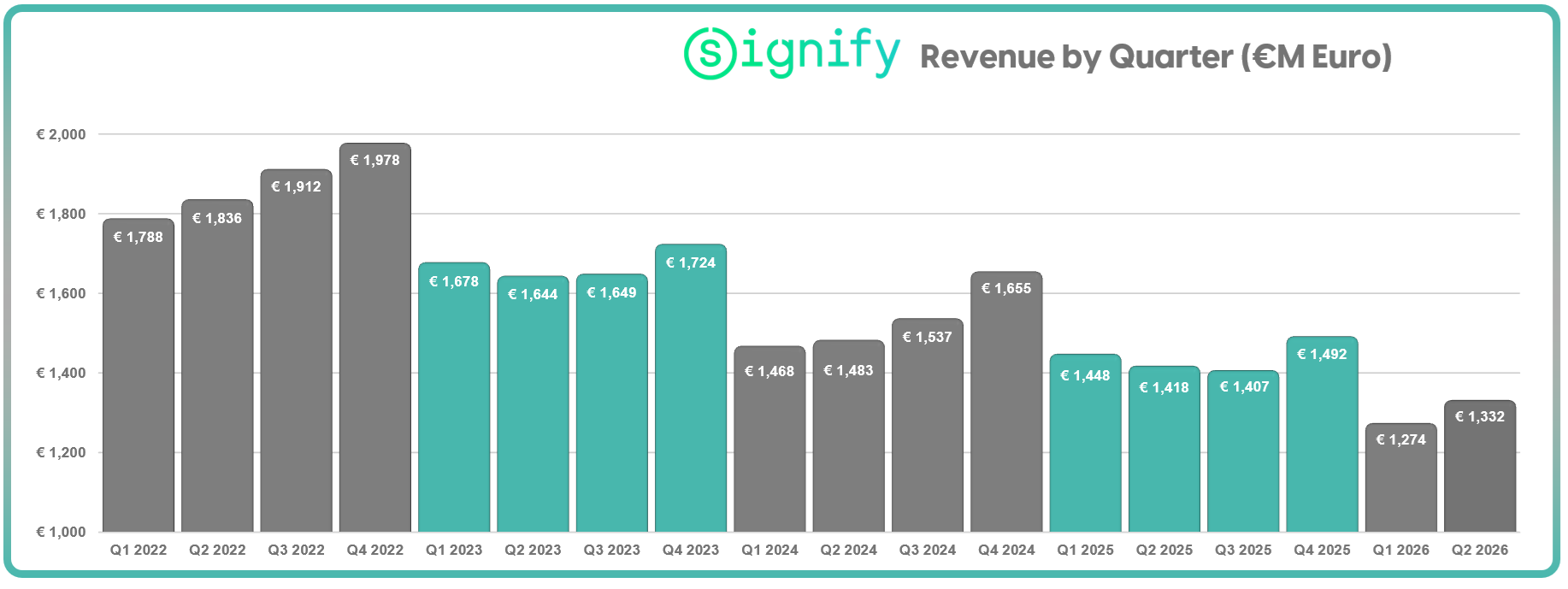
Net income dropped to €17 million ($19 million) from €57 million ($65 million), pulled down largely by €31 million ($35 million) in restructuring costs tied to the €180 million ($205 million) cost-reduction program launched in January. Headcount fell to 25,866 full-time employees, down from 29,456 a year ago, though the sequential drop from the 26,008 reported in the first quarter was modest, a sign that the heaviest cuts have likely already landed.
Zoom out further and the first half of 2026 stands alone. The 6.5% and 6.1% margins Signify posted in the first two quarters of this year are the two lowest in the company's history as a standalone business, a ten-year public record that includes the pandemic's initial shock and the input-cost spikes of 2022 and 2023. Nothing in that stretch, not COVID, not the supply chain crunch, produced a worse quarter than the one Signify just reported.
A Promise Tested Early
Signify reaffirmed its full-year guidance of a 7.5% to 8.5% adjusted EBITA margin and free cash flow of 6.5% to 7.5% of sales, unchanged from the targets set at the start of the year. The company's own materials pointed to strong internal engagement behind the strategy Tempelman unveiled at June's Capital Markets Day, where he sorted the portfolio into businesses meant to grow and businesses meant to be managed for cash, a framework he called "Build and Harvest."
Not everyone outside the building was as reassured.
Morgan Stanley's Max Yates raised the point directly, and politely: hitting even the low end of guidance requires the second half to deliver roughly 60% of full-year earnings before interest, taxes and amortization, something Signify has done "once in 5 years," following what he described as a run of past disappointments.

Above: Signify's Adjusted EBITA margin over the first two quarters of 2026 marks its lowest levels since the company spun off from Philips in 2016.
Chief Financial Officer Željko Kosanović answered with three levers: normal seasonal strengthening in the top line, gross-margin resilience through pricing and cost management, and a growing contribution from the cost-reduction program. Management's case is now on the record. So is the analyst's apparent doubt. Neither side resolved it on the call.

Where the Margin Actually Broke
The erosion traces mostly to one place. Consumer's adjusted EBITA margin collapsed to 3.0% from 7.4%, with profit falling to €9 million ($10 million) from €22 million ($25 million). Kosanović told analysts that roughly 80% of that decline came from Klite, the Chinese lamps manufacturing unit in which Signify holds a 51% stake, where component shortages and input-cost inflation combined to squeeze margins in a business he called structural rather than temporary. The remaining piece, a gap between what retailers were selling in and what consumers were actually buying, he described as transitory.
Tempelman also walked back a call he made in the spring. In April he predicted retailer destocking of connected products would converge by the second quarter. It didn't, on his own admission, convergence has been "slower than we expected." Retail stock levels now sit at eight to ten weeks, which he characterized as on or below normal, a real concession that his earlier read of the channel was off.
The View From North America
For lighting people answering to a Denver, Cleveland, or Dallas office, the quarter split cleanly along one line.
Professional project business (which is primarily driven by Cooper Lighting and Genlyte Solutions) in the U.S. kept growing and continued to outperform the broader market, offsetting the stock-and-flow softness Signify described across most of Europe, one of the few unambiguous bright spots in an otherwise mixed report. OEM told a different story: sales fell in both the U.S. and Europe during the quarter, while Asia Pacific held up better, adding a wrinkle to an already uneven business.
Currency did its own quiet damage. The U.S. dollar accounted for 41% of Signify's second-quarter sales exposure, and its depreciation drove nearly all of the -2.5% currency hit to sales and a -0.5% drag on adjusted EBITA margin.
Layered on top is an unresolved tariff question. Following a February ruling that the International Emergency Economic Powers Act didn't authorize the tariffs it had been used to impose, Signify is now filing for refunds through a phased U.S. Customs process, with the third phase expected by the end of July. Management said the amount and timing remain uncertain and confirmed none of it is built into guidance, a detail worth watching given how much of Signify's import and manufacturing footprint touches this market.
The Question Mark Called OEM
OEM sales fell 12.0% in the quarter, a second consecutive double-digit decline. Tempelman waved off the number as noise rather than signal, calling the business "a bit volatile quarter-to-quarter" and cautioning analysts against extrapolating from one quarter. That framing sits uneasily next to what Signify told investors three weeks earlier at its Capital Markets Day, where OEM was placed squarely in the Harvest portfolio with, in the company's own words, all options open, including a possible partnership or outright sale.
Lighting people can assess both facts without Inside Lighting deciding which one wins. A business that management describes as noisy on an earnings call is simultaneously under active strategic review as a possible candidate for exit.
Loose Legal Threads
Two legal matters are worth a mention rather than a headline:
A Connecticut appellate court vacated a $41.9 million warehouse-injury judgment against Signify in May, prompting the company to reverse the related legal provision. The plaintiff petitioned the Connecticut Supreme Court for review on July 22, so the matter isn't fully closed.
Separately, the minority shareholders in Klite, who hold the other 49% of the joint venture already dragging on Consumer margins, filed suit during the first half alleging Signify is contractually obligated to buy an initial 16.33% stake in the unit. Signify disputes the claim and has recognized no liability.
Both matters are early and unresolved, but the Klite litigation lands in the same business unit already carrying the weight of the margin story, adding a governance overhang to what has so far been a manufacturing-cost problem.
What Comes Next
For lighting people watching from the distributor and specifier side of the business, the second half of 2026 will answer a fairly simple question: does the strategy Tempelman spent June explaining translate into the margin recovery he spent July defending. Signify reports third-quarter results on October 23, a date that now functions as a natural checkpoint for whether Tuesday's guidance was a forecast or a hope.