


June 23, 2026
Signify Delivers Its Verdict: Build Here, Harvest There
New CEO As Tempelman outlines investment and portfolio priorities through 2029
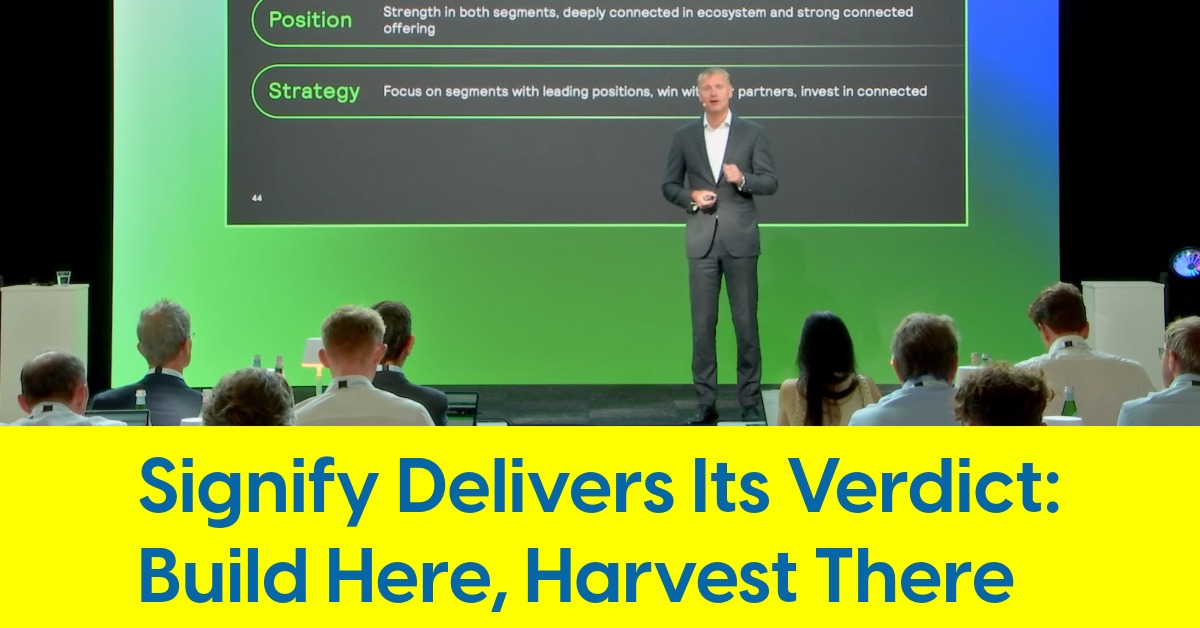
Nine months after taking the CEO chair at the world's largest lighting company, Chief Executive As Tempelman walked into Signify's Eindhoven headquarters on Tuesday and kept his promise.
The occasion was Signify's Capital Markets Day, the company's first in five and a half years. Heading in, some corners of the industry were watching for blockbusters: a major divestiture, a dramatic channel consolidation, a headline-grabbing portfolio exit. None of that arrived. What Tempelman delivered instead was something more methodical, and arguably more useful for a company in Signify's position: a portfolio sorting exercise framed in deliberately plain language, and a financial roadmap built around targets that will define how investors judge him through 2029.
For a company that spent recent years posting revenue declines, "more focused and better performing" carries real weight. Seismic moves aren't always the best remedy. Twenty smaller decisions made consistently can do more work than one dramatic announcement that scrambles the organization. Tempelman seems to understand which kind of moment this is.
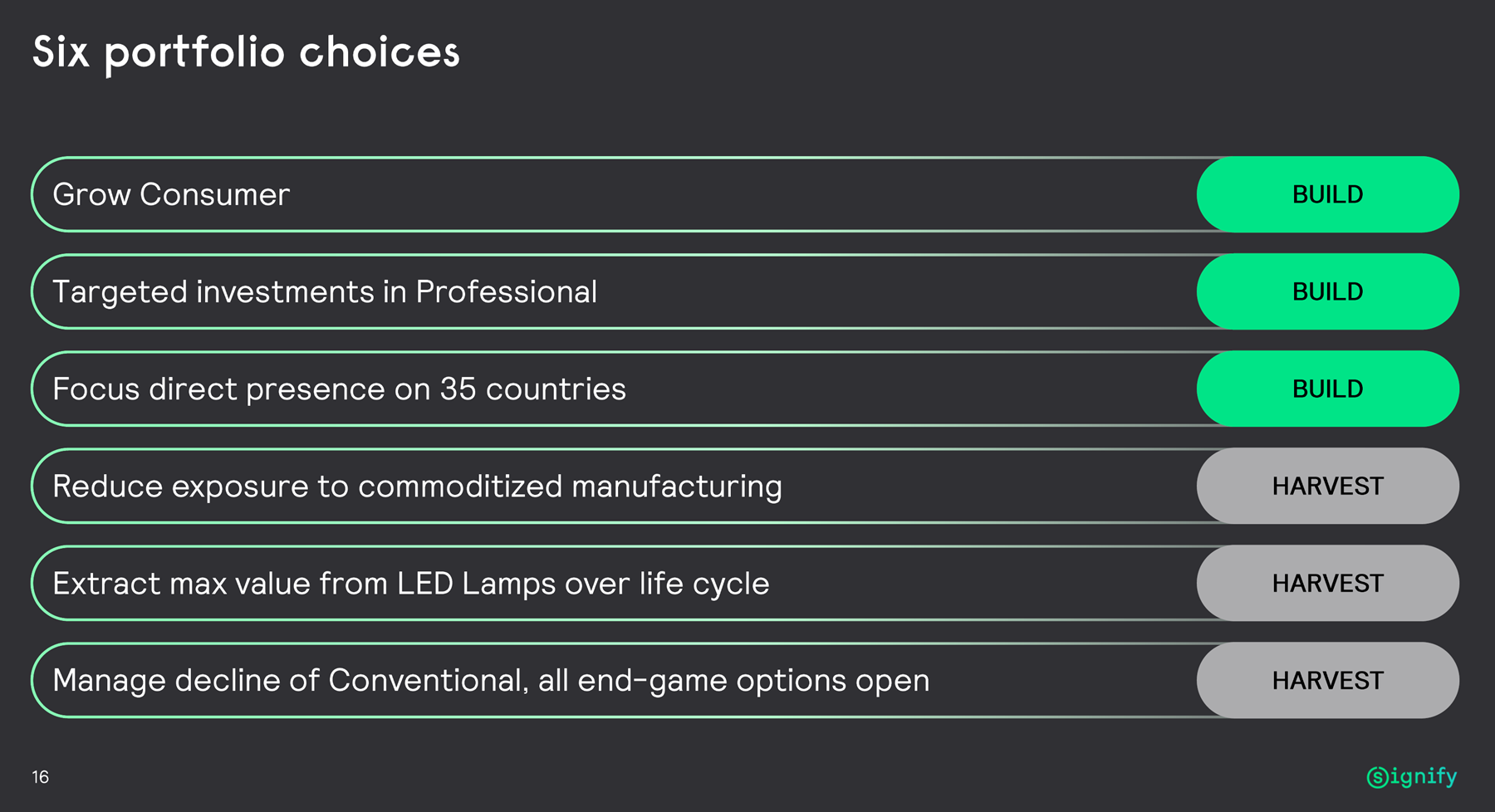
The strategy divides Signify's business into two camps. Build businesses, currently representing 72% of revenue and roughly €4.2 billion ($4.83 billion) in sales, receive investment and growth mandates. Harvest businesses, the remaining 28% at approximately €1.6 billion ($1.84 billion), get managed for cash and margin. Six explicit portfolio choices, split three to three between Build and Harvest, lay out where those lines fall.
- On the Build side: grow Consumer, make targeted investments in Professional, and focus direct geographic presence on 35 countries, down from the current 55.
- On the Harvest side: reduce exposure to commoditized manufacturing, extract maximum value from LED lamps over their product life cycle, and manage the decline of Conventional lighting with all end-game options remaining open.
"We are making deliberate portfolio choices and applying differentiated playbooks to drive a step-up in performance," Tempelman said.

The North America Signal
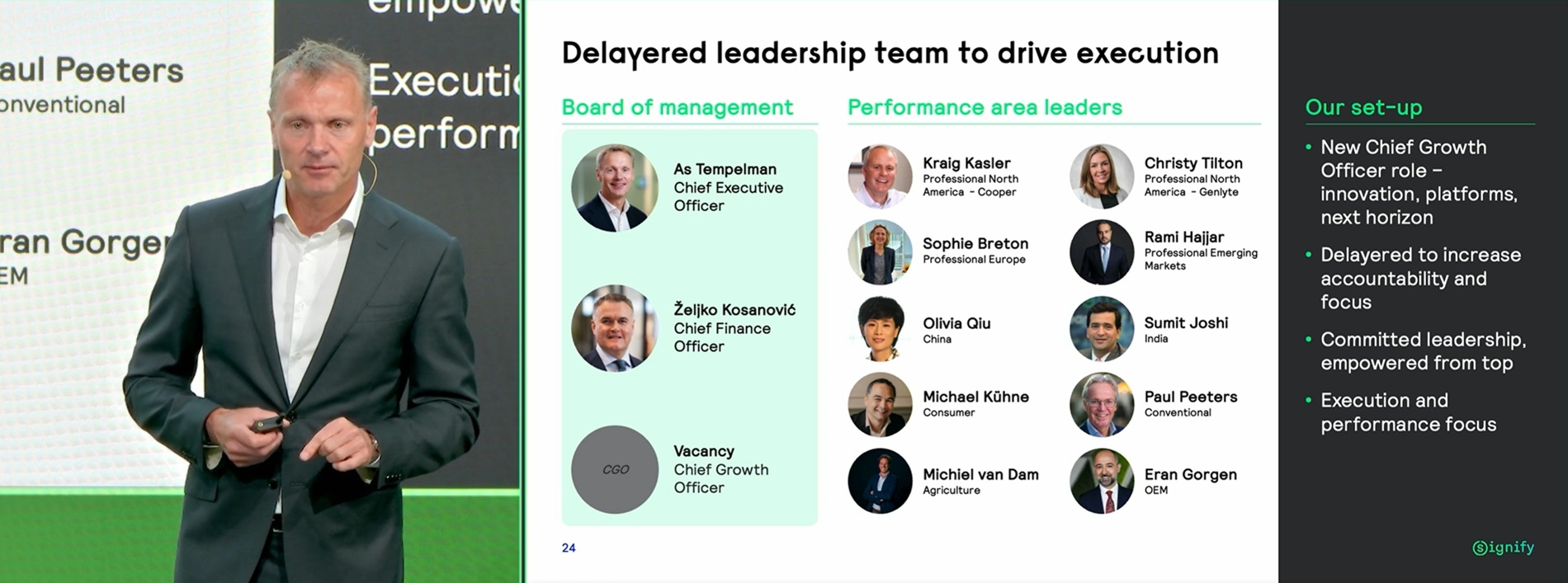
The event's structure told its own story. After Tempelman's opening presentation, three businesses received dedicated deep dives: Consumer, North America Professional and India. Cooper Lighting Solutions, not the broader Professional division, occupied its own agenda slot, with Kraig Kasler, president of Cooper Lighting Solutions, presenting to investors.
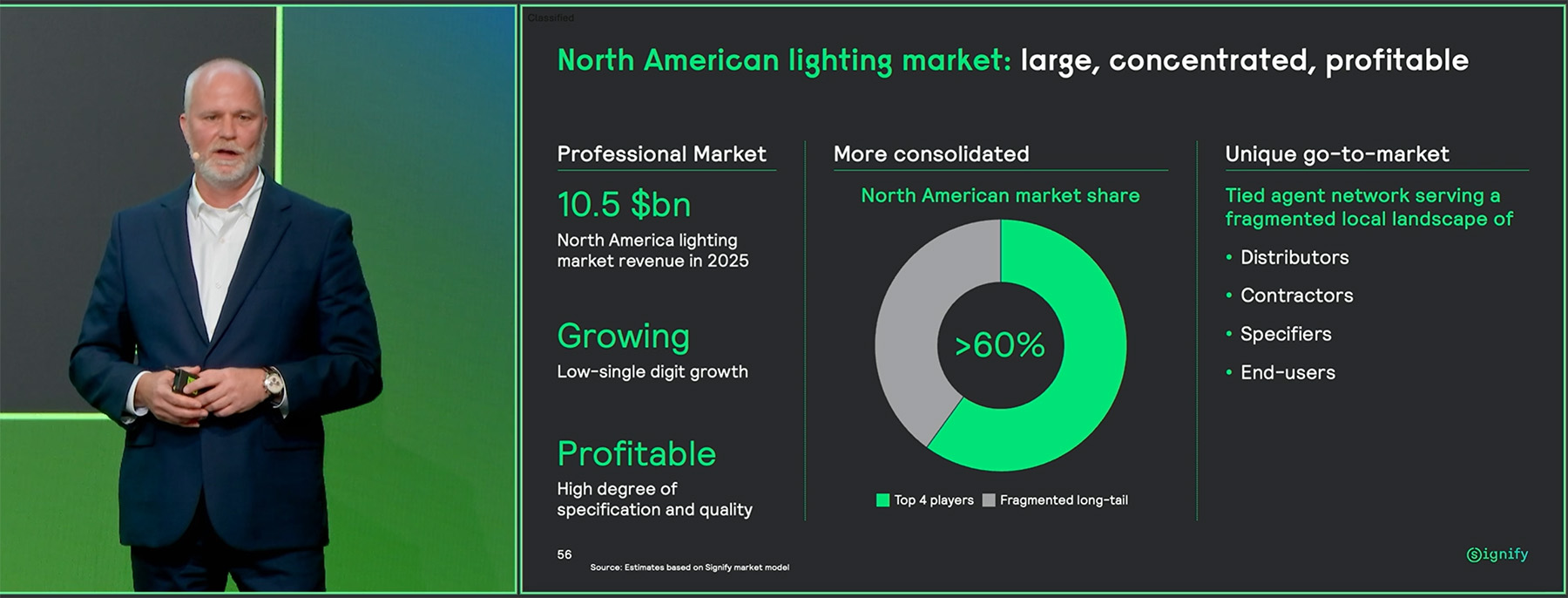
Above: Cooper Lighting Solutions President, Kraig Kasler, presents at Signify's Capital Markets Day in Eindhoven
The presentation identified Cooper as holding a clear number-two position in the North American professional lighting market, a market Signify estimated at $10.5 billion in 2025 with low single-digit growth. The North American Professional segment accounts for roughly half of Signify's total Professional revenues. Kasler's appearance on the stage, and the granularity of his strategic roadmap, made clear that Cooper's trajectory is a priority rather than a background concern.
Genlyte Solutions, the company's second North American professional brand, was assigned to what the presentation described as a "turnaround" playbook. Cooper's playbook calls for maximizing operating leverage and maintaining profitability, a meaningful distinction in how each organization will be resourced and measured going forward. The two brands retain separate front-end structures and separate agent networks, sharing back-end infrastructure.
Inside Lighting will follow up with a separate Tuesday interview with Tempelman, the only global trade media outlet granted a one-on-one with the CEO today, for a deeper analysis of what this strategy means for the North American professional channel.
Connected Lighting as the Thesis
Running through every segment presentation was a consistent argument about where the lighting market is headed. Signify's market model positions connected lighting as a €12 billion ($13.8 billion) global segment growing at roughly 4% annually through 2029, approaching what the presentations called an inflection point on the technology adoption curve.
Professional connected lighting currently represents only 10 to 15% of the installed base, by management's estimate. Consumer connected penetration is lower still. Tempelman described connected as the segment where the company holds competitive advantages that are genuinely difficult to replicate: an established patent portfolio, platforms with proven scale, and brands that carry weight in a category where data security and system longevity matter to buyers.
"This is where the excitement is," Tempelman said of connected lighting, pointing to a market that rewards operating leverage as it scales, a structure where software economics start to shape the profitability curve.
Philips Hue, presented by Consumer chief Michael Kühne, illustrated the point concretely. In the Netherlands, Hue's most penetrated market, average household device counts have grown from 11 devices in 2022 to 17 in 2026. Average net sales price per device has risen 8% over five years. The Consumer business returned to growth in 2025 after a period of deterioration, and management framed that as proof of concept for the connected thesis, not a temporary recovery.
The 2029 Targets
Signify set three medium-term financial objectives: comparable sales growth of 0% to 1%, adjusted EBITA margin of approximately 10%, and free cash flow generation of 7% to 8% of sales. The adjusted EBITA margin target represents meaningful improvement from the 8.9% the company delivered in 2025. The 2026 guidance range sits between 7.5% and 8.5%, signaling that the expansion path runs through 2027, 2028, and into the target year.
Capital allocation priorities include maintaining an investment-grade credit rating, paying dividends at a 40% to 50% payout ratio of continuing net income, investing in organic and selective inorganic growth, and returning residual cash to shareholders. The company explicitly stated it does not intend to resume the share repurchase program it announced in 2025.
Whether these targets are achievable depends substantially on how well the playbook framework holds in practice, and on whether the Build businesses can offset continued Harvest decline fast enough to stabilize the topline. The ambiguity Tempelman has now replaced with a strategy will take quarters to validate.
For the North American lighting channel, agents, distributors, and specifiers now have Signify's clearest public statement yet about which parts of its business it plans to invest in and which it intends to run for cash. The signal is legible. What follows is execution.