


May 28, 2026
Zumtobel Investors Got One Story. The U.S. Market Got Another.

Headquarters reaffirms U.S. closure plans despite contradictory comments from a U.S. executive
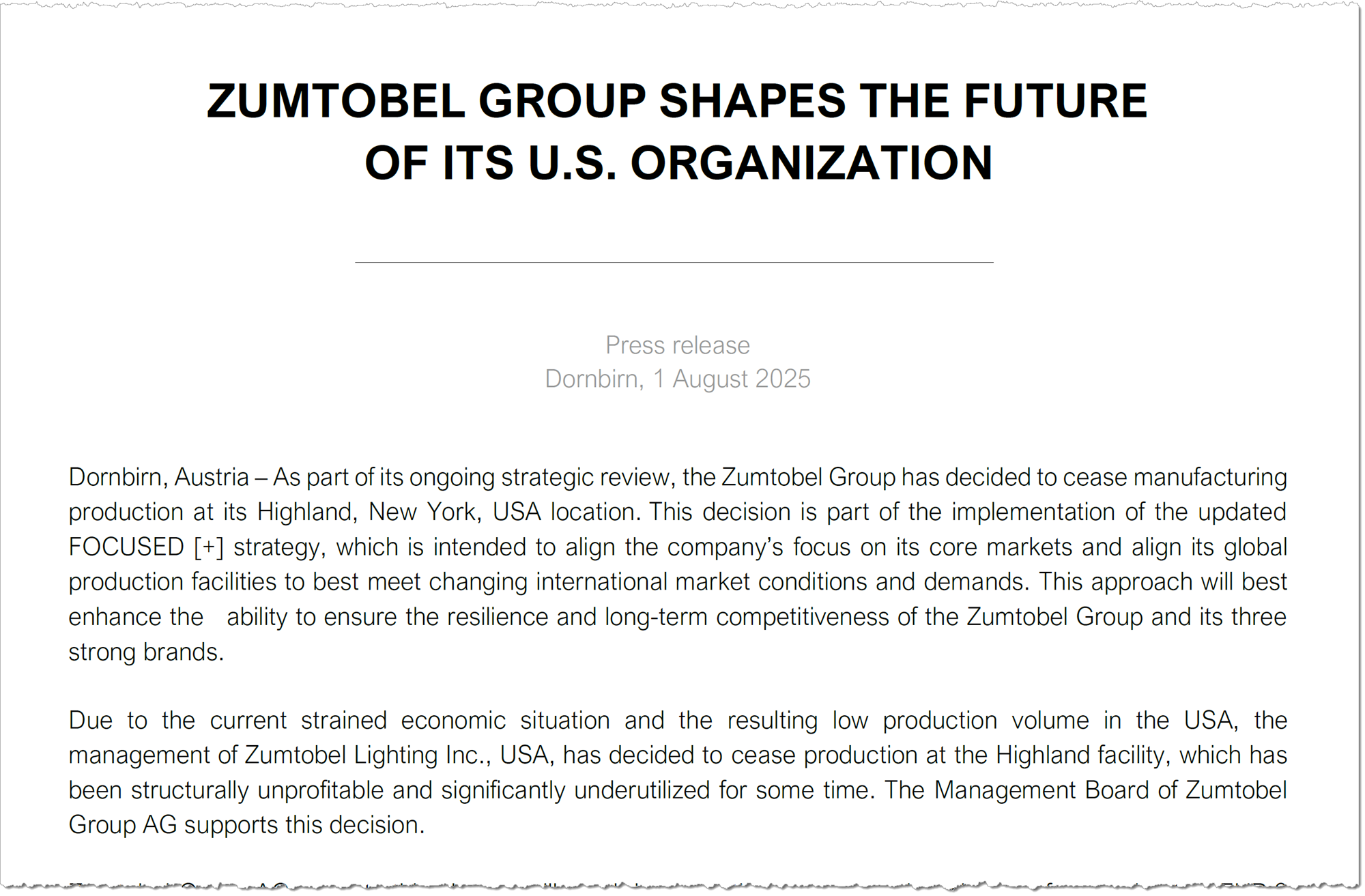
Nine months ago, Zumtobel Group announced it would end manufacturing at its Highland, New York facility. The language from its Austria headquarters was unambiguous: the plant was "structurally unprofitable and significantly underutilized for some time." While the news was covered by Inside Lighting, it went unreported by the broader U.S. lighting trade press.
Seven months later, at Light + Building in Frankfurt, we stopped by the Zumtobel booth. Graham Whittaker, President of the company’s U.S. operation, told us production at Highland was still happening. Then Justin Telesha, a Zumtobel U.S. sales director, paraphrased one of our headlines back at us. The lights are dimming at Zumtobel, he offered, with a smile. It was a playful dig at Inside Lighting's coverage, coverage built entirely on Zumtobel's own public statements. The moment was notable less for its edge than for what it revealed: the U.S. team had a different story to tell, and they were comfortable telling it.
A month later, Whittaker did it again, on camera.

A Different Story for a Different Audience
At LEDucation 2026, Whittaker sat down with Edison Report for a recorded interview and delivered the U.S. market message in full. "I'm here to tell you that we are maintaining our production facility in Highland," he proclaimed, "and the lights will remain on and we'll continue productivity for the very foreseeable future." He named specific product lines in active production: Slotlight III, LDA, custom engineering work, a new recessed LDA, and downlight components. He pushed back on press coverage of the closure. "I read myself about the lights are dimming in Highland. I'm here to say that the lights are on and brighter than ever."
The press coverage he was pushing back on was ours. And our coverage was based on his own HR director's layoff notice and his parent company's own press release and financial filings.
What Investors Were Hearing
While Whittaker was reassuring the U.S. market, Zumtobel Group, a company with annual revenues approaching $1.25 billion, has been telling a different story to the people watching its stock on the Vienna Stock Exchange.
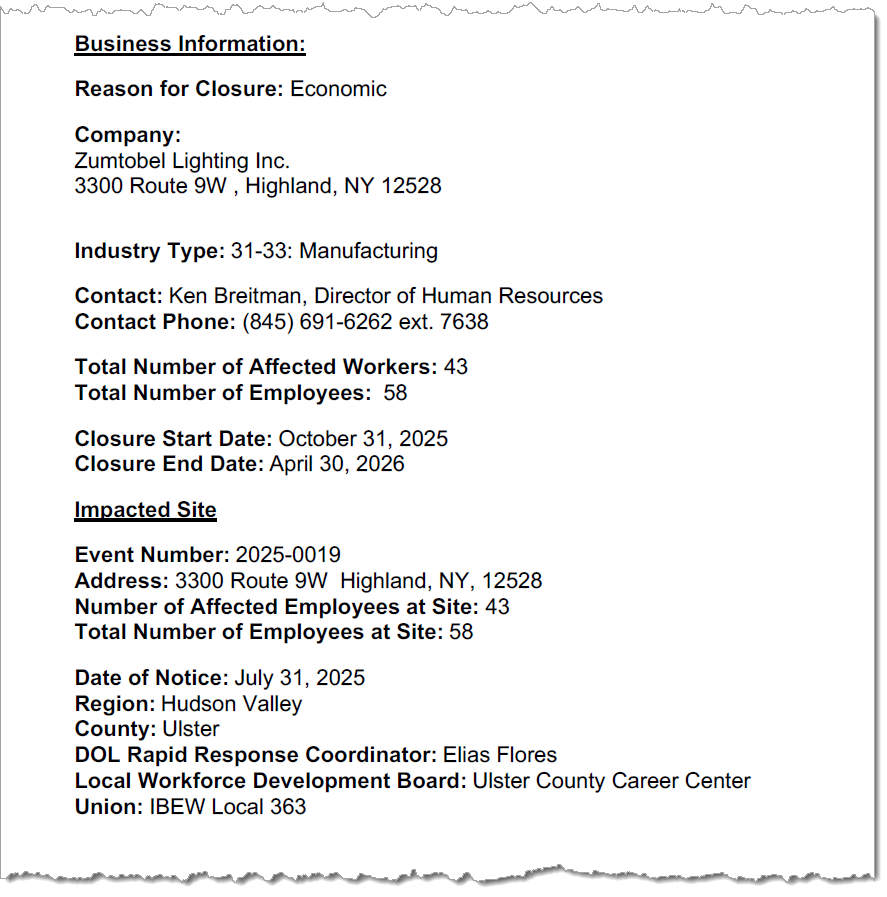
Above: New York State Department of Labor records document a July 2025 notice of Zumtobel Lighting Inc. laying off 43 of 58 workers at its Highland, NY production facility
Zumtobel’s August 2025 detailed closure announcement was only the beginning of a sustained investor communications campaign.
- The August 1 announcement cited approximately 70 affected employees, however the layoff notice filed a day earlier with New York State cited 43. That gap has not been explained publicly.
- Earnings reports tracked restructuring charges tied specifically to "the termination of production in Highland, New York" across various reporting periods. Zumtobel initially estimated the closure would result in approximately €9 million in one-time charges. Subsequent filings reported €7.4 million, €6.0 million, and €5.3 million in Highland-related restructuring costs. The company has not publicly explained the differences among those figures.
- On March 6, 2026, two days before Whittaker told Inside Lighting at Light + Building that production was continuing, Zumtobel Group CFO Thomas Erath discussed "the closure of our U.S. production sites" with analysts on an earnings call.
The investor communications drumbeat never varied. The U.S. market message, delivered at trade shows, washed the walls with different light entirely.
Headquarters Did Not Have Whittaker’s Back
Inside Lighting sought clarification from Whittaker twice, beginning on May 6. He has not responded. For someone who had shown little hesitation criticizing trade press coverage, Whittaker went remarkably quiet when the press came looking for clarifications about the contradictions his own remarks had created.
After 12 days of non-response from Whittaker, the matter was escalated to Zumtobel Group headquarters in Austria. Sandra Schuster, Head of Group Communications and Public Affairs, replied on behalf of the company. Notably, headquarters did not defend its U.S. president.
Her response confirmed that Zumtobel Group had "not deviated from its official communications" on Highland. Then came the more remarkable passage: "We were not aware of, nor involved in, the interview format and specific statements referenced," adding that the company "cannot comment on individual remarks made in an external interview setting." For the head of communications at a major lighting company, "cannot comment" is a curious word choice. "Will not comment" might have been more accurate.
Headquarters, in writing, declined to stand behind its own U.S. president's remarks. Schuster suggested that Whittaker's comments "relating to local site activities may have been interpreted more broadly than intended." Her framing placed the problem with listener interpretation rather than with the statements themselves. Whittaker had named product lines, described future production plans, and characterized closure reporting as inaccurate. Those are clear remarks that don’t lend themselves to misreading.
Two Audiences, One Problem
The result was two very different messages regarding Highland: one presented in investor communications and another delivered to the U.S. market.
For investors, the message has been orderly and documented: Zumtobel U.S. was unprofitable, the closure was strategically sound, the charges are being absorbed.
The U.S. channel received a different signal: the factory is open, production continues and the press that reported otherwise got it wrong.
Running separate messages for separate audiences has a certain cold logic to it. Specifiers drift when commitment looks uncertain. Agents hedge when they sense retreat. But that calculation may assume the two audiences never compare notes, the trade press stays manageable, and the executives delivering the market-facing message don't go on camera and contradict the CFO.
The possible motivations on each side of this divide are not difficult to reconcile:
- Investors and analysts want to see that unprofitable U.S. operations have been addressed decisively. A shutdown factory floor is a problem solved, a charge absorbed, a line item closed.
- U.S. executives seemingly want to project something different: continuity, commitment, a reason to keep specifying Zumtobel. The production facility is actively assembling fixtures.
Those are not unreasonable things to want. They are, however, difficult to deliver simultaneously with a straight face when the factory in question is the same one.