


March 9, 2026
Inside Light + Building's Expanding Global Stage
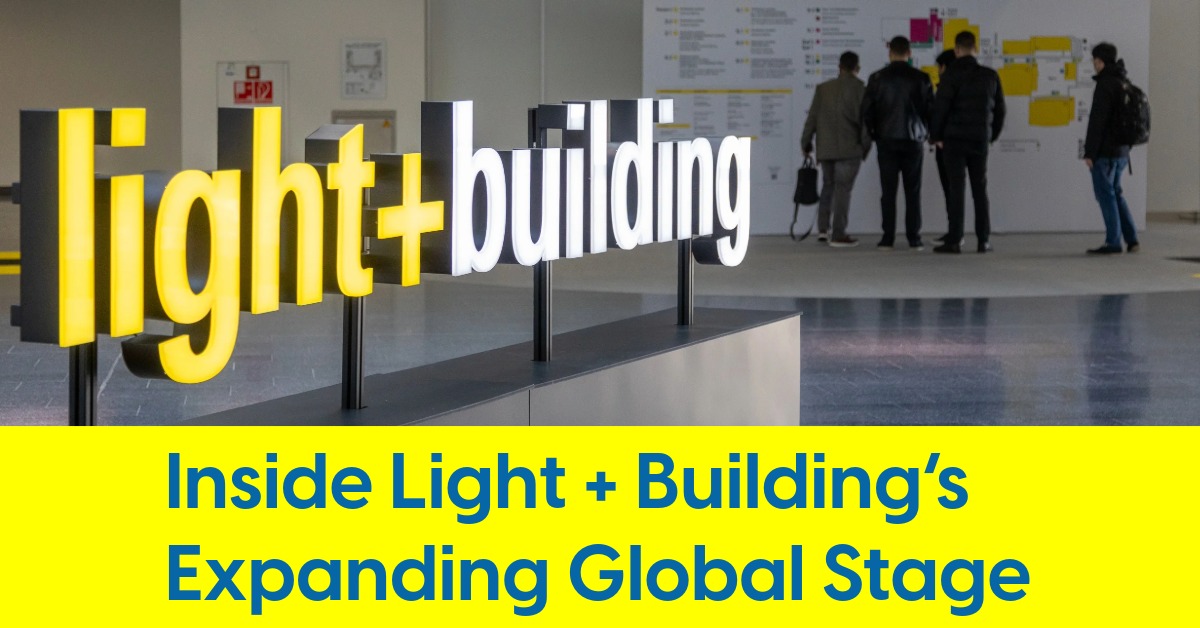
Global designers and manufacturers meet as Frankfurt fills with light for six days
The global lighting industry has once again descended on Frankfurt, where the cavernous halls of Messe Frankfurt are now humming with conversation, caffeine, and more than a few ambitious product launches.
Inside Lighting is on the ground this week as Light + Building 2026 runs from March 8 through March 13. The biennial exhibition remains the largest gathering in the lighting and building technology world. Roughly 2,000 exhibitors are expected, and about 60 percent represent the lighting sector, with the rest focused on connected building systems, electrification, and energy technologies.
For many attendees from North America, the value of the trip often extends beyond booth traffic. Europe tends to move faster on sustainability mandates, circular design ideas, and certain architectural lighting trends. Frankfurt provides a preview of concepts that may soon cross the Atlantic.
A Six-Day Trade Show Moves At Its Own Rhythm
Lighting events in North America tend to run on compressed schedules. One day. Two days. Maybe three. Everyone rushes through the aisles like commuters catching the last train home.
Frankfurt plays a different game. Light + Building stretches across six days, from Sunday through Friday. The longer format spreads activity unevenly across the week. Early days and the closing stretch move at a slower pace, while Tuesday and Wednesday traditionally bring the heaviest crowds.
Even so, the opening day already showed steady activity. Exhibitors reported meaningful booth traffic.

Post-Pandemic Attendance Still Climbing?
One of the storylines hovering over the halls this year is attendance.
The show welcomed 151,192 visitors in 2024, a strong rebound after the pandemic-disrupted Autumn 2022 edition drew about 93,000 attendees. The benchmark remains 2018, when the event attracted roughly 220,000 visitors, a number that still looms large in industry memory.
The 2024 event included 2,169 exhibitors and visitors from 146 countries. Germany accounted for 51 percent of attendees, while international visitors made up the remaining 49 percent. Nearly half of all trade visitors held top-management positions, reinforcing the show’s reputation as a decision-maker gathering rather than simply a product showcase.
The top five visitor countries in 2024 were Germany, China, Italy, the Netherlands, and France. Whether those numbers continue climbing in 2026 will be closely watched across the industry.
Sustainability Is Everywhere, Including The Actual Booths
One theme is already impossible to miss: sustainability messaging remains front and center.
It appears not only in product messaging but in the physical construction of the exhibition floor itself. Many booths feature visible wood framing, reusable structures, and other materials meant to signal environmental responsibility. Some stands look less like trade show architecture and more like minimalist Scandinavian living rooms.
The shift reflects a broader industry narrative. Sustainability is no longer limited to product efficiency claims. It increasingly touches manufacturing processes, material sourcing, lifecycle planning, and even the temporary architecture of a trade show booth.
Why North Americans Still Make The Trip
For many designers and specifiers traveling from the United States and Canada, the draw is perspective. North American lighting designers are already making appearances throughout the exhibition halls.
Robert White, principal at Illuminart, told Inside Lighting that visiting the show helps him stay ahead of emerging design thinking. In essence, he explained that Europe often pushes forward new architectural lighting ideas earlier than North America, and walking the Frankfurt halls offers a chance to see solutions and concepts that may eventually find their way into projects back home.
Another early sighting came at the Zumtobel booth, where New York lighting designer Attila Uysal of Lumen Architecture was spotted alongside Zumtobel representatives Graham Whittaker and Justin Telesha.
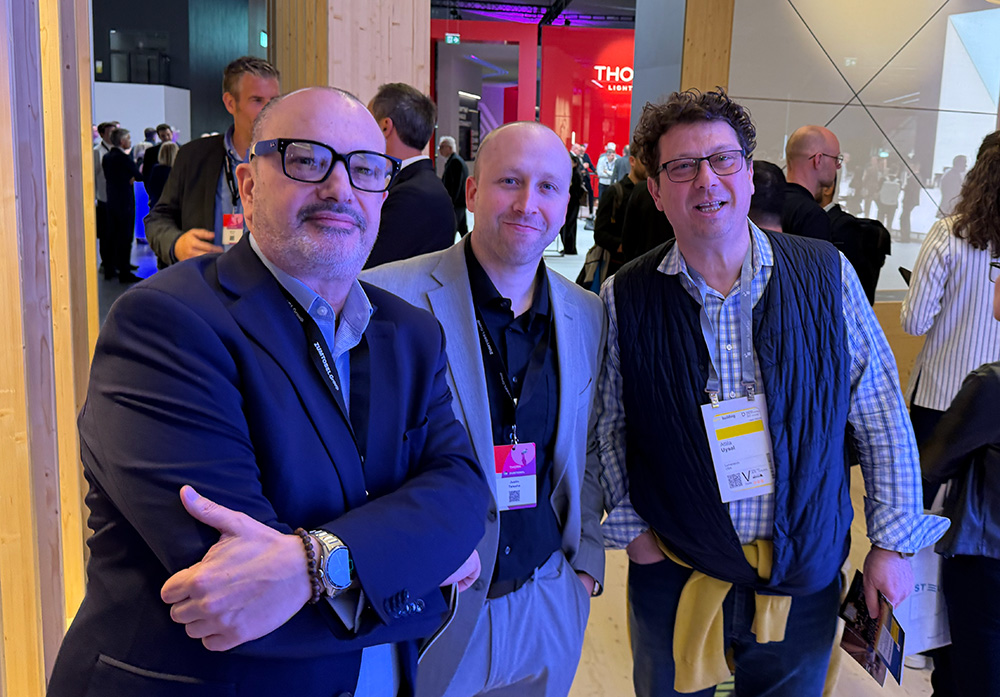
Above: New York lighting designer Attila Uysal (R) of Lumen Architecture visits the Zumtobel booth with company representatives Graham Whittaker (L) and Justin Telesha (middle) at Light + Building 2026.
Meanwhile, the Illuminating Engineering Society has once again established a visible presence at the event. Rather than sending a single delegation for the entire six-day show, the organization is rotating staff through the week, with some attending early activities and others arriving later to maintain a steady presence across the event.
The Original Light + Building
In a world increasingly filled with rebranded trade shows and newly minted conferences, Frankfurt still holds a certain historical gravity.
This event is widely viewed as the original center of the Light + Building universe, tracing its lineage to earlier Hannover Fair and evolving over decades into the flagship exhibition for the global lighting and building technology sector.
Today it anchors a wider Messe Frankfurt network of related exhibitions, including the Guangzhou International Lighting Exhibition, Light + LED Expo India, Light Middle East, Interlight Russia, and Interlight South America.
The newest addition to that ecosystem is Light + Intelligent Building North America, the event that emerged after the rebranding of LightFair.
The Long Game For North America
The North American edition of the Light + Building concept will debut in Las Vegas in March 2027, followed by a planned Philadelphia edition in 2029.
No one expects those early events to replicate Frankfurt’s scale anytime soon. A six-day exhibition drawing well over 100,000 visitors does not materialize overnight.
But the ambition is clear. Organizers are trying to build an ecosystem event where lighting, controls, electrification, and connected building technologies converge under one roof. Frankfurt provides a working model of what that vision could eventually become.