


August 12, 2026
Susan Brady vs. Acuity: A Quiet Case That Just Got Loud Again
Acuity says lighting designer committed perjury and fabricated evidence in the $31.6 million royalty dispute
Susan Brady sued Acuity three years ago, claiming the lighting giant owes her millions in unpaid royalties on a fixture family she says she designed in 2002.
In December 2024, about a month after Acuity's lawyers said her case file had no design documents predating 2008, she went looking for the original sketches to support her claim. She couldn't find them.
According to deposition testimony quoted in Acuity's recent sanctions motion, Brady recreated the missing sketches from memory. Acuity's motion goes further, characterizing those recreations as having been presented as if they were the 2002 originals. She did not admit otherwise until her fifth deposition testimony, in August 2025, after Acuity pushed for a forensic examination of the physical documents.
Brady’s apparent admission now sits at the heart of a recently filed motion asking a U.S. federal judge to throw her entire case out.

That is where Susan Brady v. Acuity Brands Lighting stands today, three and a half years after we first reported on the prominent lighting designer's claim to millions in unpaid royalties on one of the architectural lighting market's most recognizable linear fixture families. The case went quiet for long stretches while both sides tried, and failed, to settle it. On July 24, it got loud again, with a stack of dispositive motions landing on the docket in a single afternoon.
The Original Deal
Brady's claim traces back to a 2002 licensing agreement with then independently-owned Mark Lighting Fixture Company in Edison, New Jersey (Exit 130).
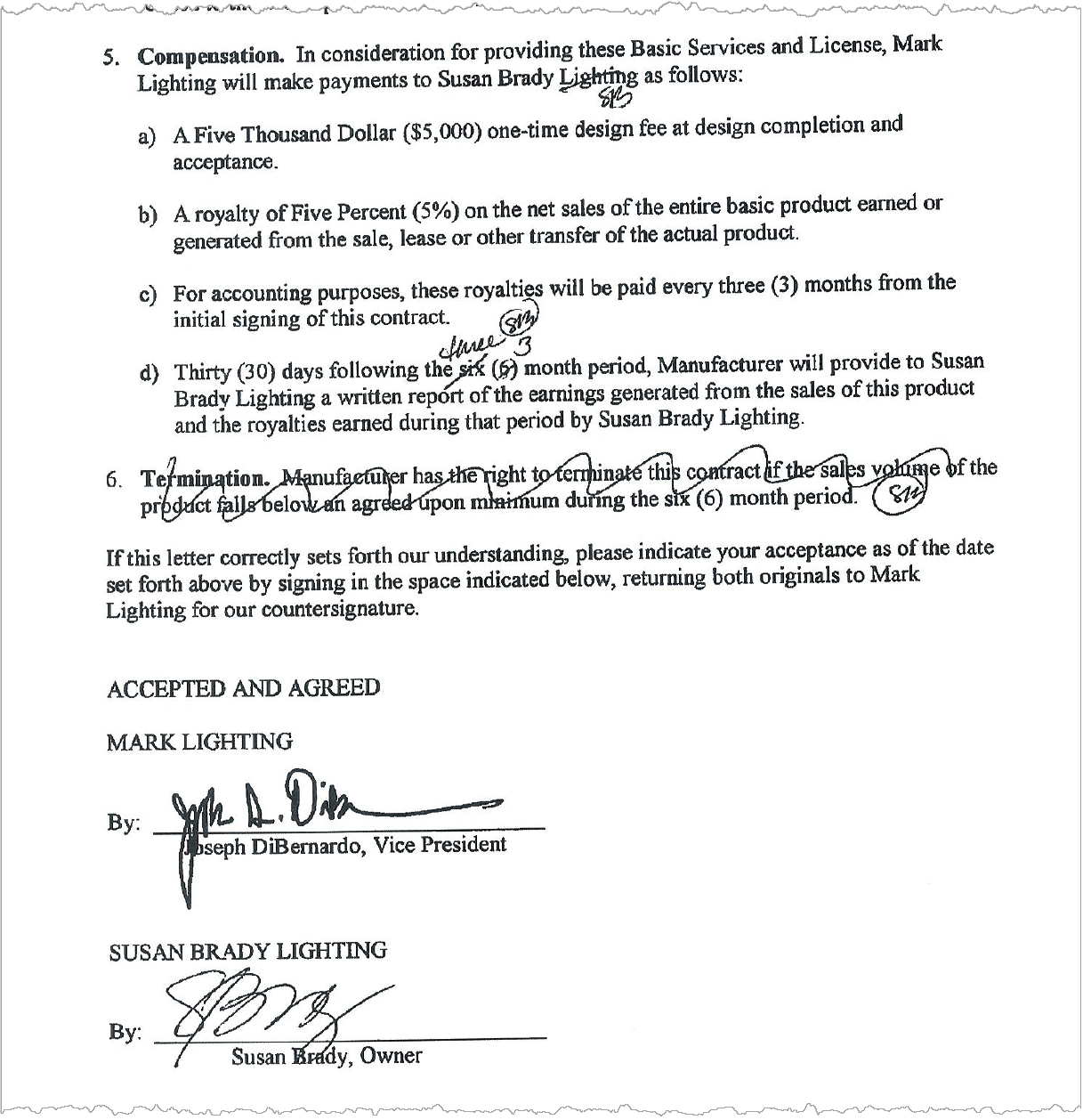
Above: Excerpt from a signed 2002 Product Design Services Agreement between Mark Lighting Fixture Company and Susan Brady
Under the original agreement, Brady says she was owed a design fee plus 5% of net sales on fixtures built from her concepts, covering the Slot fixture family, Multi-Task, and Veil families. When Acuity Brands acquired Mark Lighting for $44 million in 2007, Brady contends an unsigned letter from Acuity executive Chuck Meteer carried that royalty arrangement forward to the new owner. By Acuity's own account, it honored that arrangement for years, paying royalties on Slot fluorescent products sold after the acquisition.
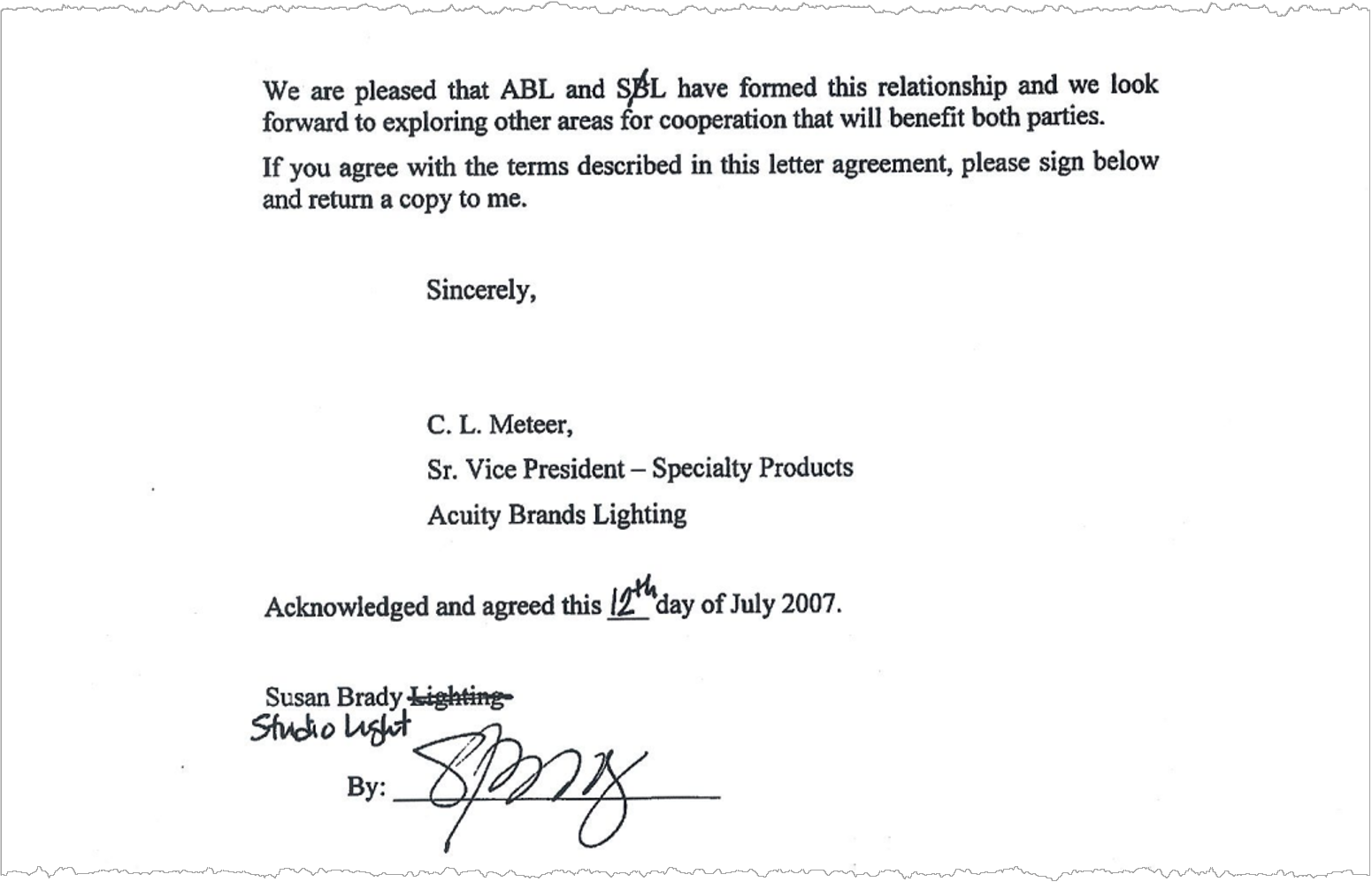
Above: Excerpt from the unsigned 2007 Chuck Meteer letter, relating to Mark Lighting's previous royalty agreement on Slot, Multi-Task, and Veil
The dispute that actually reached federal court is narrower than that history suggests. Brady says the royalty obligation should have extended to the LED fixtures Acuity later developed under the Slot name, and that she was never paid on those sales. Acuity disagrees. There is no live claim over Multi-Task, which was discontinued in 2015 and falls outside the statute of limitations, and no LED version of Veil was ever built, leaving only a smaller fluorescent-only royalty claim on that product line.
The real money is almost entirely in Slot LED. Brady claims Acuity sold more than $630 million of Slot products from March 11, 2017 through November 2024 and calculates that at least $31.6 million in royalties should have been paid.
Where Fluorescent Meets LED
For long-time lighting people, the technical details related to this case comes with familiar nuance:
- The original Slot fixtures were built around T8, T5 and T5HO fluorescent lamps, an omnidirectional source that leaves the housing and optics to do the actual work of shaping and aiming light.
- Getting a clean line of light out of that source meant designing around socket shadow, the dark gap that appears where one lamp ends and the next begins, often by staggering lamps with a few overlapping inches, a discipline that has no equivalent in LED design.
- LEDs are directional emitters by nature, and reengineering Slot for LED meant new optics, new thermal management, and new driver electronics, not a simple lamp swap inside an existing shell.
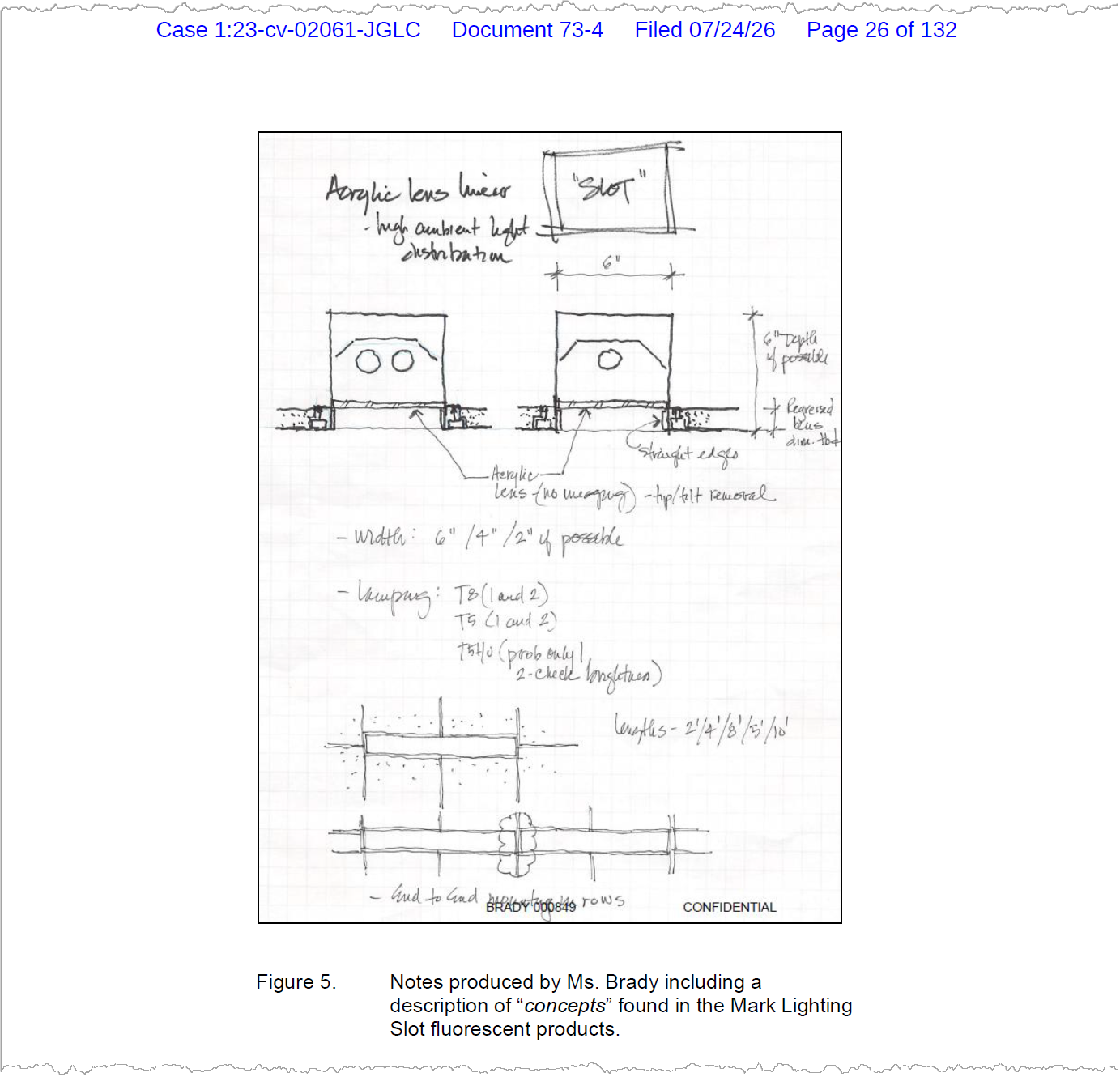
Above: An excerpt from Dr. Kaitlin Spak's expert report, incorporates evidence that is now under scrutiny
That fluorescent-LED distinction is exactly why the case is not a straightforward contract dispute. The 2002 agreement gives Mark Lighting the right to modify the design and sell the modified product under the same royalty terms — and the fight now turns on whether swapping a fixture's light source from fluorescent to LED counts as a modification of Brady's original design, or something new enough to fall outside the agreement altogether.
Acuity's position is that the LED redesign was substantial enough to break any chain connecting Brady's original aesthetic concept to the products on the market today. Brady's position is that her design language carried through regardless of what was happening inside the housing.
The July 24 Filing Blitz
Both sides moved for summary judgment on the same day, each asking Judge Jessica Clarke to rule in its favor without a trial. Both sides also moved to keep witnesses off the stand.
Acuity wants to exclude two former Mark Lighting employees Brady is relying on as non-retained experts, industry shorthand for a witness allowed to offer opinion testimony because of firsthand involvement, without the fuller disclosure process required of a hired expert.
Brady, in turn, is asking the judge essentially to rule as a matter of law that Acuity inherited the Brady royalty agreement; Slot, Veil and Multi-Task were covered products; later Slot LED versions constitute covered modifications; and Acuity therefore owes unpaid royalties on Slot LED and Veil sales within the limitations period. Brady is also trying to exclude Acuity's paid expert witness, arguing her report crosses from technical analysis into attacking Brady's credibility.
The Sanctions Motion: Alleged Perjury and Evidence Fabrication
Acuity alleges that two drawings central to Brady's case, exhibits the parties refer to as D-17 and D-131, were presented across four depositions as original 2002 sketches given to Mark Lighting at the time.
According to deposition transcripts quoted in Acuity's filing, Brady testified that she created both drawings in December 2024 — and that she didn't disclose this until her August 2025 deposition, after Acuity had pushed for a forensic examination of the physical documents.
Asked what prompted her to make them, she said she had been "getting a lot of pressure to find documents" and had "recreated what I remember had been the original sketches."
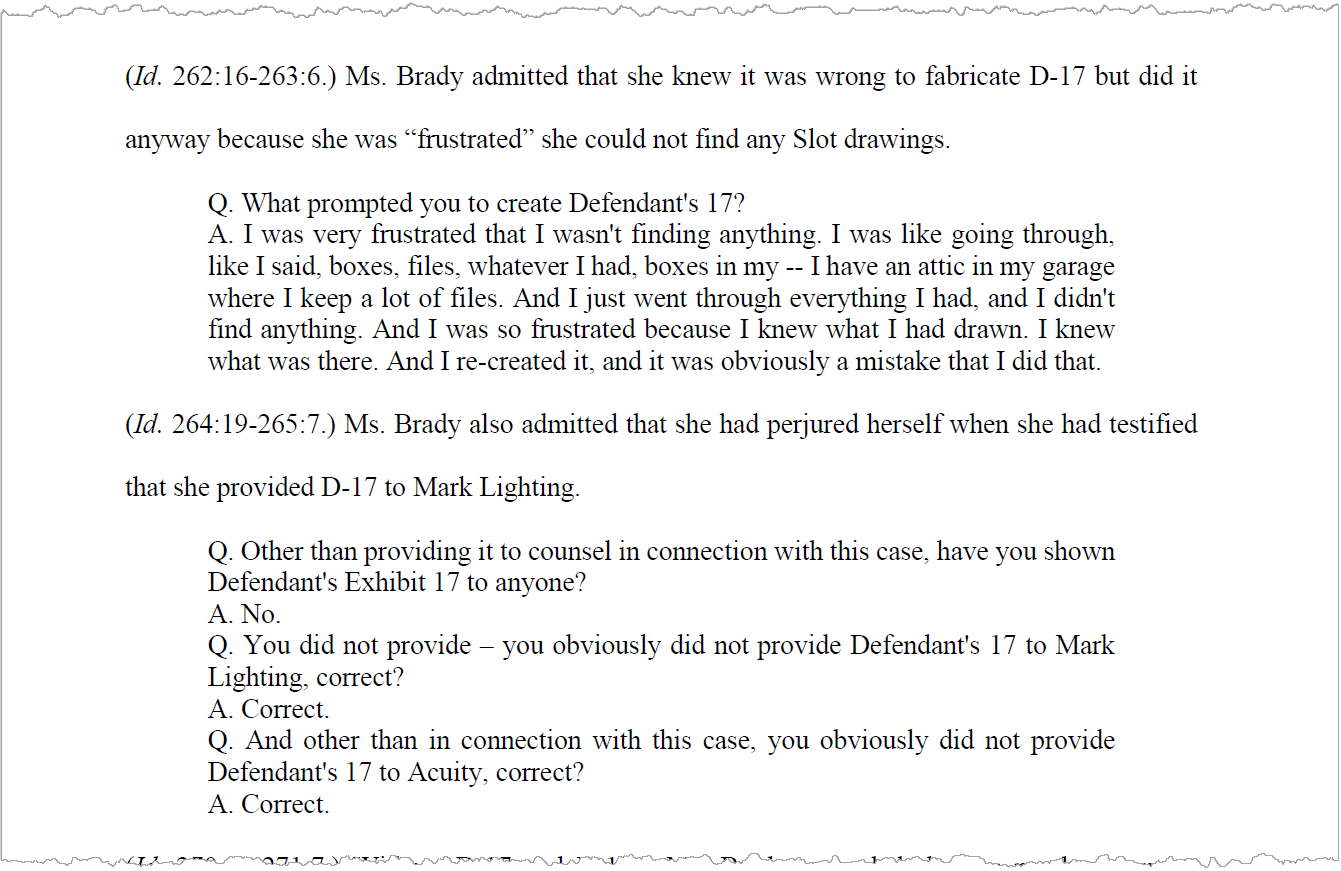
Above: Excerpt from Acuity's Motion for Sanctions, filed July 24, 2026
Acuity is asking the court to dismiss the complaint with prejudice and to make Brady pay its attorneys' fees, arguing the alleged fabricated documents tainted testimony from nearly every witness who was shown them, including Acuity's own expert.
What Brady's Side Is Saying
Reached by Inside Lighting ahead of publication, Brady's attorney Michael Ferch sent a statement on behalf of the plaintiffs: "Susan Brady and her lighting fixture design company, Studio Light, Inc., will vigorously oppose Acuity's motion for sanctions, as well as Acuity's motion for summary judgment, by filing opposition papers by the end of September pursuant to a timeline set by the Court. It is inappropriate for Susan Brady, Studio Light, or their counsel to comment on the merits of the parties' dispute until the Court's briefing schedule is complete, which will be in November, 2026. At that time, the parties' full positions will be in the public record."
We asked Attorney Ferch directly about the alleged perjury, evidence fabrication, and discovery misconduct. He did not address those specific allegations, pointing instead to the briefing schedule and saying the parties’ full positions will be in the public record when briefing is complete.
"While Acuity filed motions against Susan Brady and Studio Light, Ms. Brady and Studio Light also filed their own motion for summary judgment against Acuity as well as a motion to preclude the testimony of Acuity's expert witness. Those motions are in the public record and will also be fully briefed in November, 2026. We are confident that when the briefing is complete, and the Court has before it all of the facts and circumstances, the Court will render a fair and impartial decision. Susan Brady and Studio Light are confident in the merits of their claims and their positions in this lawsuit."
What's Actually Been Decided?
Nothing. That is worth saying plainly, because a stack of motions this size can read like a verdict to anyone skimming the docket. Judge Clarke has not ruled on the sanctions motion, the competing summary judgment motions, or either side's attempt to exclude the other's witnesses. Brady's opposition papers are due September 23, and the case will not be fully briefed until November.
If the court agrees with the fabrication allegations, Brady's case could be dismissed entirely, or narrowed to strip out the larger Slot LED claims while leaving her smaller Veil claim intact. Judges often don't default to the most extreme option, so some other middle course is also possible once briefing wraps in November.