


August 10, 2026
Signify Wins the Verdict, Not the Windfall
The verdict stands, but Signify’s $4.3 million push for attorney fees does not
In February, Lepro lost on every question a jury could decide. Infringement, all six patents. Validity, upheld. Willfulness, found. What the company did not lose is nearly everything Signify tried to collect after the verdict.
That asymmetry, not who "won," is the actual story here. On August 7, U.S. District Judge Jennifer Dorsey denied Signify's bid for $4.3 million in attorney fees, denied enhanced damages that could have tripled the award, and denied prejudgment interest and ongoing royalties, without disturbing the jury's finding that Lepro infringed.
Some background for readers who have not followed this one closely. Lepro Innovation is not a manufacturer in the traditional sense. It buys LED lamps and other residential consumer finished goods and resells the products under its own brand through Amazon, Walmart, and its own website.

Signify sued Lepro in 2022, accusing it of infringing six patents covering LED heat dissipation, modular fastening hardware, and tunable-white color-mixing technology, the building blocks behind everyday smart bulbs and fixtures. Most Signify patent disputes settle or get resolved on summary judgment long before a jury ever hears them. This one did not. It ran nearly three years and ended in a seven-day trial in February, a rarity for a company that typically prefers licensing to litigation.
The order closes one chapter and opens another, with real money still on the table and a jurisdictional wrinkle that has not gone away.
What Signify Wanted
- $4,326,020 in attorney fees, arguing the case was "exceptional"
- Treble damages for willful infringement
- Interest dating back to 2017/2018, the first infringement dates
- Royalties tripled going forward (up to 19.5%)
- A forensic audit of Lepro's sales records
- Full litigation costs: $231,689
What Lepro Argued
- Judgment as a matter of law, or a new trial entirely
- Insufficient evidence on three patents; one patent invalid
- Damages math was flawed
- Opposed every financial request Signify made
- Late claim: some sales exempt under patent exhaustion, tied to Signify's majority stake in Klite factory in China
What the Court Decided
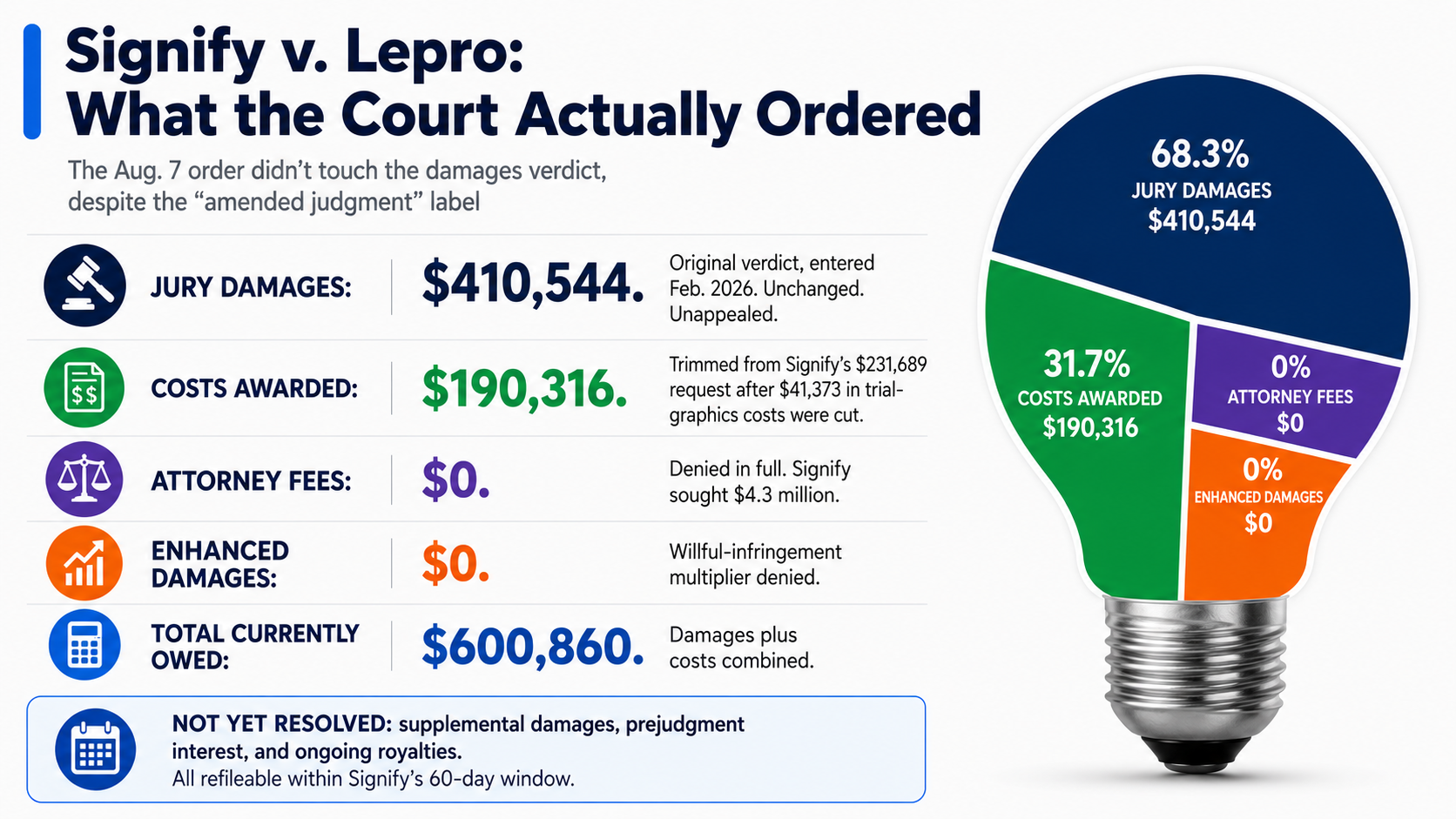
- Jury verdict stands in full: $410,544. Nothing overturned.
- Attorney fees: denied. Case called "close," not exceptional.
- Enhanced damages: denied. The court found the circumstances did not warrant increasing the jury's award.
- Interest and royalties: denied without prejudice. Signify can refile.
- Costs: $190,316 awarded after the court rejected $41,373 in trial-graphics expenses.
- Forensic audit denied, but Lepro owes back-pay on missed sales.
What Changed Since March
In March, we flagged Signify's $4.3 million fee request as the figure to watch, noting that some award seemed more likely than not given the jury's unanimous willfulness finding. That assessment did not hold. Judge Dorsey denied the fee motion in full and, for largely the same reasoning, declined to enhance damages.
Her rationale rested on a single word: exceptional. Under 35 U.S.C. § 285, fees flow only in cases that stand out from the ordinary run of patent disputes, and Dorsey found this one did not qualify despite the willfulness verdict. Lepro's defenses on the '604 and '320 patents, which accounted for 95 percent of the damages at issue, were reasonable enough that a jury could have gone either way.
Why the Judge Said No
Dorsey's opinion reads as a rebuke of the idea that losing badly at trial automatically means paying the winner's legal bill. She described Lepro's litigation conduct, including dropped defenses and a late-arriving patent exhaustion argument, as ordinary zealous advocacy rather than sanctionable behavior.
The distinction matters for lighting people watching from outside the courtroom. A jury can find willful infringement and a court can still conclude the fight itself was fair. Dorsey walked through the factors one by one: no copying, reasonable good-faith defenses, no evidence of concealment or intent to harm. Only the size disparity between the companies cut weakly in Signify's favor, and even that fell short.
What's Still Moving
Nothing here is fully closed. Supplemental damages, covering sales Lepro failed to disclose during discovery and any infringing sales since September 2025, are owed but not yet calculated. Prejudgment interest and ongoing royalties were denied without prejudice, meaning Signify can refile within 60 days of the August 7 order.
The Klite thread remains the case's most unresolved wrinkle. Lepro began sourcing some products from Klite, a Chinese subsidiary 51% owned by Signify, arguing those sales are exempt under patent exhaustion. Dorsey did not resolve that question; she ordered the parties to exchange discovery on it before any ongoing-royalty request can proceed, a decision that could shape how much Signify ultimately collects going forward.
Litigation as an EnabLED Sales Tool
Signify did not need $4.3 million from Lepro for this lawsuit to do its job. The company runs two enforcement tracks: EnabLED, a portfolio-licensing program Signify has touted as topping 1,800 licensees, and litigation against those who decline to join it.
EnabLED is the offer that lets manufacturers avoid years of this kind of exposure. Litigation, even when it recovers less than requested, sends a cost signal to every manufacturer weighing whether to negotiate or fight. Licensing revenue, roughly $130 million and about 2% of Signify's total sales, is the quieter, more reliable outcome next to any single verdict.
That framing helps explain why Signify pushed as hard as it did for fees and enhanced damages despite the odds. Enforcement spend can be justified by its deterrent value across the whole market, independent of what any one court ultimately awards.
What Comes Next
The 60-day clock is running, the Klite question is unresolved, and a verdict 3.5 years in the making still is not fully closed. For lighting people negotiating with Signify's counsel, the lesson of this order may matter more than the number attached to it: winning at trial and getting paid for winning are two different fights.