


August 8, 2026
5 Things to Know: August 8
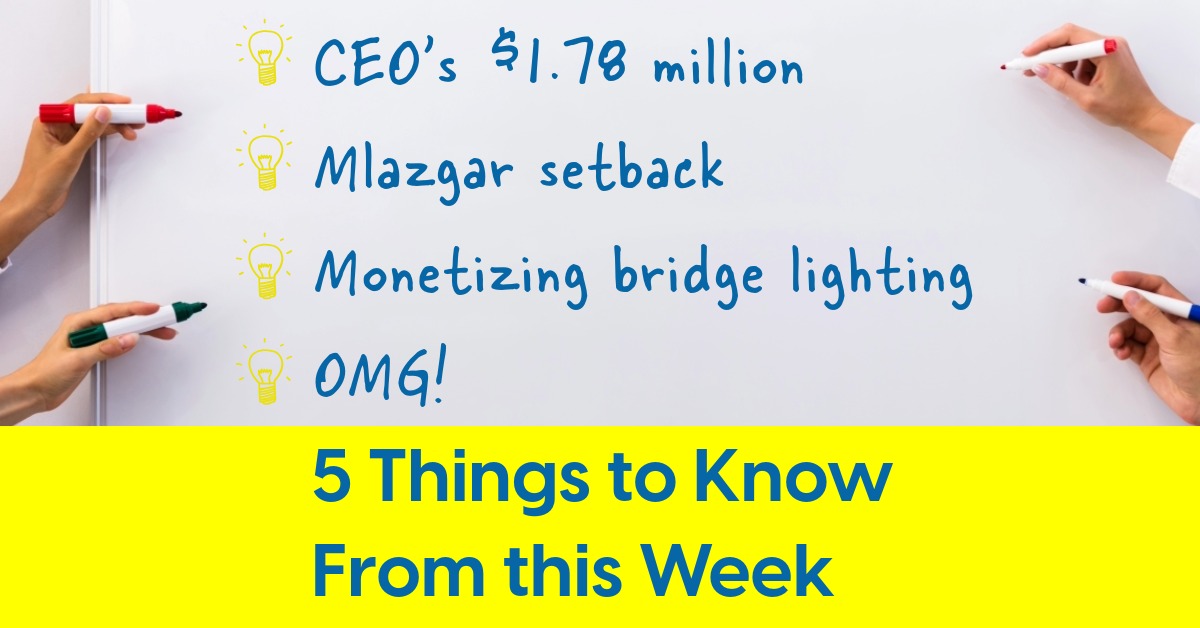
Jury selection starts for Mlazgar vs. Current. Plus, a CEO orchestrates a turnaround and maxes out her bonus.
Here's a roundup of some of the week's happenings curated to help lighting people stay informed.
1. CEO Pay Package Tracks With Orion’s Recovery
Sally Washlow took over as chief executive of Orion Energy Systems in April 2025. She inherited a business that had posted an $11.8 million net loss the year before. Sixteen months later, Orion's fiscal 2026 numbers tell a different story: revenue grew to $86.3 million, the net loss narrowed to $3.2 million, and adjusted EBITDA turned positive at $2.2 million, enough to clear the board's target for the year.
Washlow's pay reflects that shift, though not in the way a simple "raise" would suggest.
Her base salary is $425,000. That figure isn't a merit increase so much as a restoration. When she was hired, Orion's executives, including her predecessor Michael Jenkins, had all taken 10% pay cuts during a rough fiscal 2025. Washlow's contract specified that if those cuts were reversed for the rest of the leadership team, hers would move up in step, to $425,000. The board restored everyone's base salary on October 1, 2025, once the company's improved financials justified it. Washlow's new base landed at the same level Jenkins had earned before the cut took effect.
The bigger number is total compensation. Washlow's fiscal 2026 pay came to $1.78 million, combining her base salary, a $425,000 bonus, a $500,000 signing bonus, stock awards, options and other benefits including a car allowance and 401(k) benefits. Under a separate SEC-mandated calculation known as "compensation actually paid," which adjusts for the year-end value of unvested equity, that figure rises to nearly $1.98 million.
The bonus alone shows how tightly her pay is tied to results. Orion's board set dual targets for fiscal 2026, tied to adjusted EBITDA and revenue. The company hit the maximum threshold on the EBITDA side, triggering the full $425,000 payout.
2. Mlazgar vs. Current: Progress Settles, Case Narrows Ahead of Jury Selection
Minnesota lighting agent, Mlazgar Associates, and Progress Lighting have reached a settlement, removing one defendant from the sprawling sales-agency dispute just days before jury selection proceedings are scheduled to begin in Greenville, South Carolina. Current remains as the other primary defendant.
The Progress settlement came during a July 31 conference before U.S. District Judge Jacquelyn D. Austin. According to the court docket, Austin told the parties she was skeptical of Mlazgar's arguments that Progress improperly terminated its contract and that one lighting manufacturer could be held jointly liable for commissions allegedly withheld by another. A settlement was reached that day, and Austin subsequently ordered the parties to finalize the agreement and Mlazgar to dismiss its claims against Progress.
Progress and Hubbell Lighting were sister companies under Hubbell when the events underlying the lawsuit occurred. Their paths have since split: Hubbell Lighting was acquired by Current in 2022, while Progress Lighting was later sold to private equity ownership.
Mlazgar sued in 2022 after its longstanding Hubbell Lighting relationship unraveled, asserting contract and tort claims involving commissions, termination of the agency agreement and former employees.
Last month, the judge tossed out 14 of Mlazgar's claims and a much narrower case is heading toward trial. Since then the court has since narrowed Mlazgar's case further, dismissing the portion of its breach-of-contract claim alleging that HLI imposed an "illusory and fraudulent cure period."
Jury selection is scheduled for Monday, August 10, with trial beginning August 17.
The settlement resolves Progress's portion of the case. Financial terms were not disclosed.

3. How A City Monetizes Its Own Skyline
New Orleans has built out a full commercial lighting-as-a-service operation around the Crescent City Connection, the cable-stayed bridge carrying Highway 90 over the Mississippi River, and the pricing structure reads like a menu built for a lighting controls engineer.
The bridge's necklace, piers, and trusses can be programmed into four tiers of complexity, from single-color washes to fully dynamic, moving scenes, with costs tied directly to the design and programming labor involved.
A permanent calendar already assigns colors to dozens of holidays and observances, while the special-event slots get filled through a public request form the city manages out of its Office of Strategic Engagement.
For lighting people who like their pricing transparent, here's the schedule:
- Basic ($1,000): single color, necklace/piers/trusses uniform
- Enhanced ($3,000): up to 2 colors, includes one site visit
- Advanced ($6,000): up to 4 colors, includes one site visit
- Custom Dynamic ($12,000): moving scenes, 16 hours of programming, two site visits
4. The Streetlight Surveillance Debate Has No Off Switch
Streetlights that double as surveillance infrastructure keep resurfacing around the world, and the latest iteration comes from Warwickshire, England, where Conflow Power Group's AI-equipped iLamps are billed as solar-powered fixtures capable of facial and vehicle recognition, according to the Guardian.
The pattern is familiar to anyone who followed San Diego's streetlight fight, which has dragged on for years after the city quietly outfitted thousands of poles with cameras and sensors, then faced a public backlash once residents learned police were pulling footage without their knowledge. Privacy advocates in the UK are raising the same concern now: infrastructure installed for one stated purpose, like adaptive lighting or traffic data, tends to acquire new capabilities over time, often without a fresh public conversation about what changed.
Rabih Bashroush of the University of East London told the Guardian the datacenter claims behind the iLamps have "no chance" of working as advertised, which raises a separate question, whether the surveillance capability is the real product being sold.
5. A Path Toward Flexible LED Materials
Gallium nitride is the semiconductor material that makes LED lighting possible in the first place, the layer inside nearly every commercial LED chip that actually converts electricity into light.
Researchers at the University of Chicago and Argonne National Laboratory have now found a way to shrink it into nanocrystals, a scale that had been off-limits for this material because its atomic bonds are too strong to rearrange during crystal formation, according to Phys.org. Using a molten-salt method combined with precise temperature and ammonia pressure, the team got those bonds to break and reform correctly.
The commercial relevance is years out, not immediate, but it points somewhere real: gallium nitride nanocrystals could eventually be blended into polymers or printed onto flexible surfaces, opening the door to LED lighting that isn't locked into rigid chip packages. The same technique also worked on titanium nitride and niobium nitride, suggesting the applications reach past lighting into electronics and medical devices.