


August 5, 2026
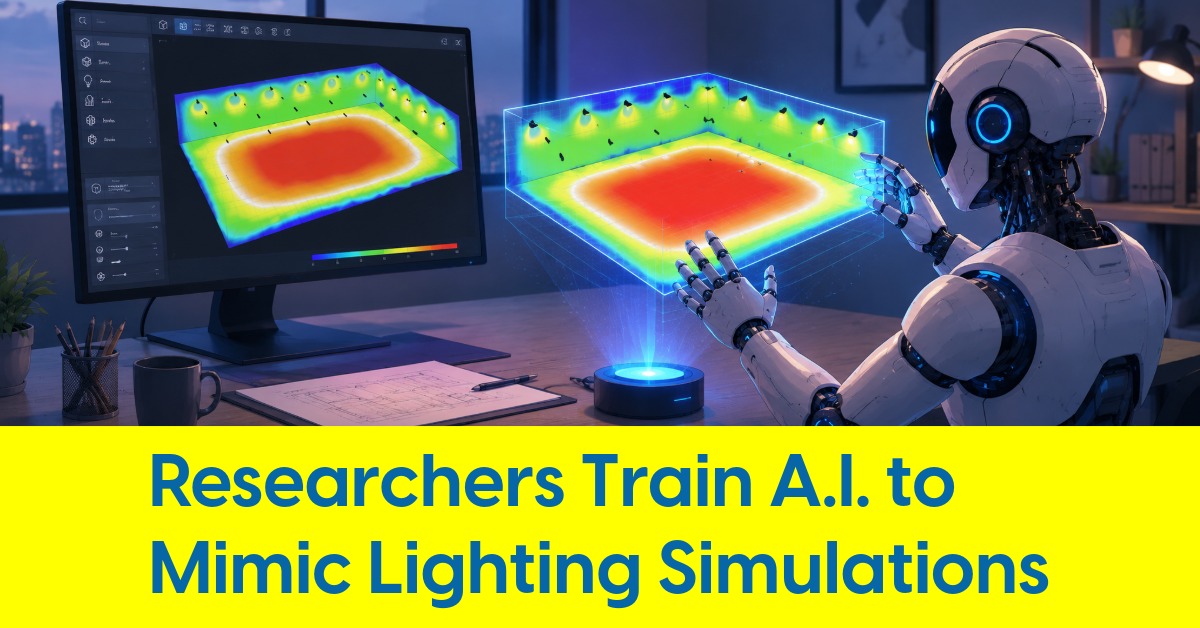
Researchers Train A.I. to Mimic Lighting Simulations
Accuracy reached 92% on average, though results varied widely across different layouts
Lighting specifiers do not get paid to wait. Yet waiting is much of the job: place a luminaire, run the simulation, adjust the layout, run it again.
A new paper in LEUKOS, the journal of the Illuminating Engineering Society, proposes shortening that cycle by training a machine learning model to predict lux levels almost instantly, without running a physics-based simulation at all.
Researchers from the University of Texas at San Antonio and Shahid Beheshti University built the model using 9,000 simulations generated in ClimateStudio, producing a dataset of 684,000 individual sensor readings across varied room layouts, luminaire types, and surface reflectances. A CatBoost regressor, tested against six algorithms including a neural network, delivered an R-squared value of 0.92 on point-by-point predictions. Layout-level accuracy, however, ranged more widely, from 0.40 to 0.99, depending on luminaire type and material combinations.

The Calculator, Not the Engineer
The distinction worth making here is one engineers would recognize. They often run rough hand calculations before opening finite element software, not because the calculations replace the engineering, but because they filter out the layouts not worth modeling in detail. This tool appears to be aiming at the same role in lighting: a fast first pass that tells a designer whether a concept is in the right neighborhood before anyone opens AGi32 or Radiance.
That framing matters because the researchers are explicit about what the model is not. It was trained entirely on ClimateStudio output, so its ceiling of accuracy is defined by how well it approximates that reference tool, not by independent physical measurement.
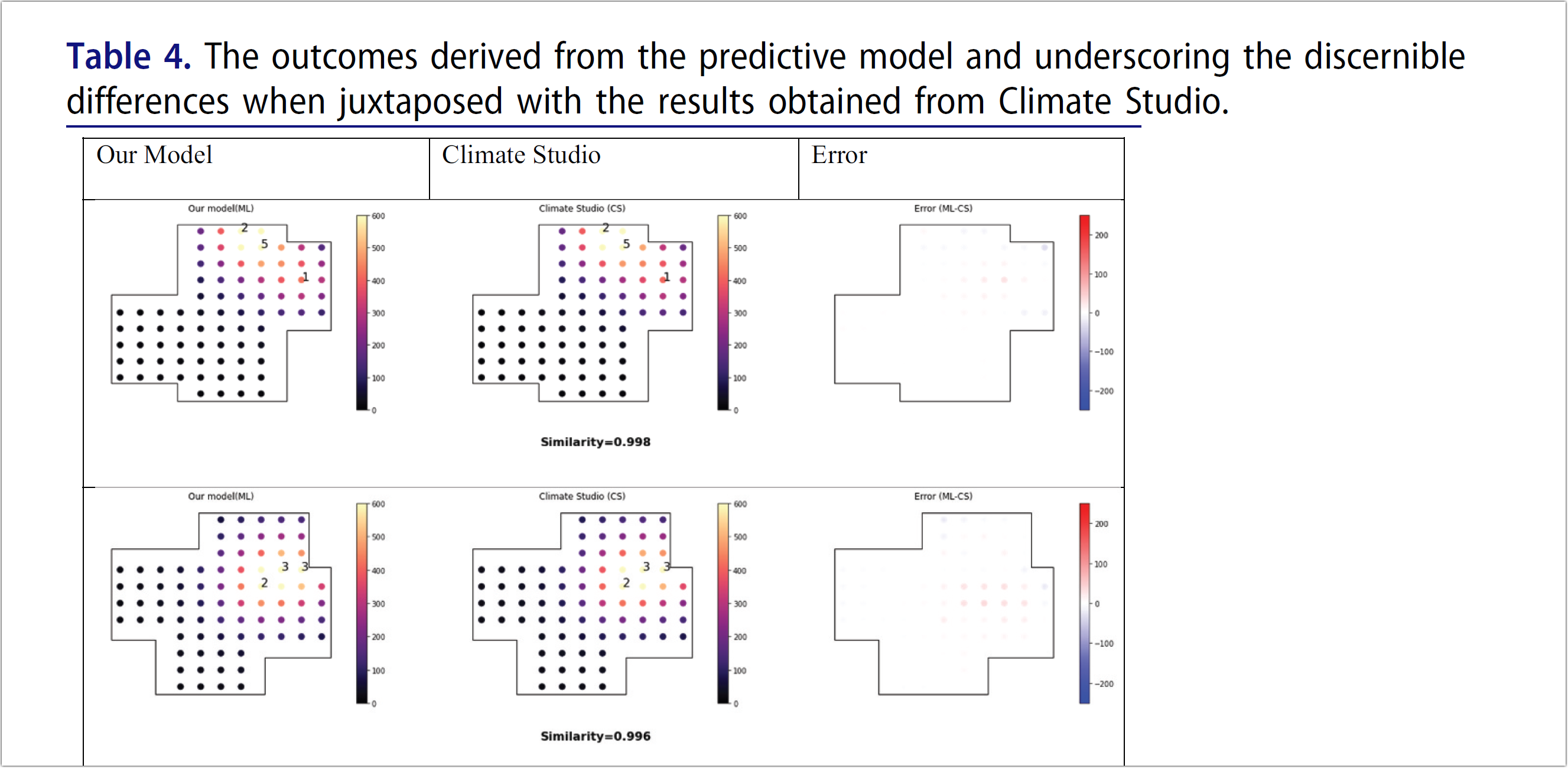
Shahverdi et al. (2026), comparing the machine learning model's predictions against ClimateStudio simulations for two layouts. Similarity scores of 0.998 and 0.996. Source: LEUKOS, DOI: 10.1080/15502724.2026.2649252.
When benchmarked separately against DIALux in two test cases, the authors' web tool differed from DIALux by as much as 21 percent on average illuminance, a gap roughly in line with the 22 percent difference between ClimateStudio and DIALux in the same test. The model, in other words, learned to mimic its teacher.
Where Trust Breaks Down
Accuracy also was not uniform. The paper reports that the model performed worst with the luminaire type carrying the highest lumen output, and struggled with certain mid-range reflectance combinations, at times falling below 80 percent accuracy. For a design tool, that pattern raises the more pointed question that will determine whether working designers ever open it: not whether the average prediction lands close to reality, but whether the tool knows when it does not.
A five-lux miss on a hallway is a rounding error. A missed hot spot over a workstation, or an undetected glare condition, is not.
Importantly, the paper does not evaluate glare, vertical illuminance, or daylight interaction at all. The current version is confined to horizontal illuminance under electric lighting only, which narrows its usefulness considerably for specifiers weighing visual comfort alongside footcandles.
What the Researchers Are Actually Building Toward
The more interesting long-term implication sits outside the paper's stated results. The authors describe their approach as sensor-point independent, meaning it generalizes to room shapes it has never seen, without relying on image processing. That is the piece that could eventually matter inside BIM platforms, where a designer dragging a luminaire in a model might see estimated illuminance update in real time, long before anyone commits to a full simulation run.
Whether that becomes standard practice, or remains an academic proof of concept, may depend less on the model's R-squared score than on whether lighting professionals come to trust software that is fast and mostly right over software that is slow and precisely right.