



August 14, 2026
Lighting’s Highest Honors Take Center Stage In Denver
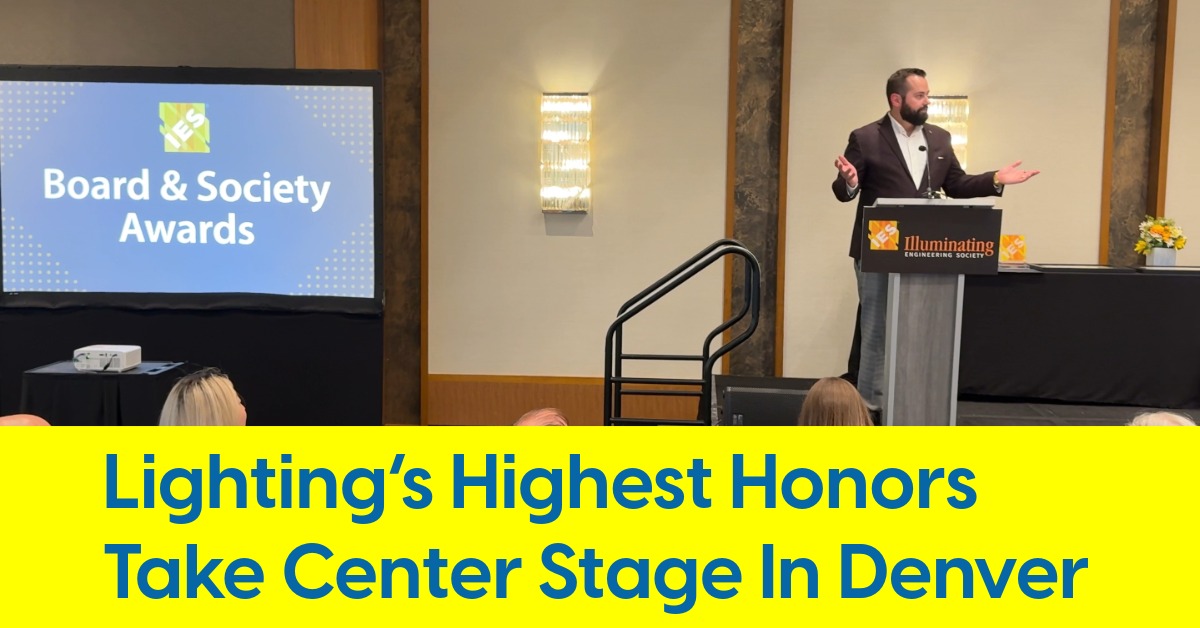
Above: IES President Jared Smith opens the Board & Society Awards program at the President's Opening Reception, August 13, 2026, Grand Hyatt Denver
IES26 recognizes medalists, fellows and leaders who shaped the profession
The Grand Hyatt Denver sits 38 stories above downtown, high enough that Thursday's sunset over the Rockies competed for attention with the evening's real business: handing out the Illuminating Engineering Society’s most consequential honors.
At the President's Opening Reception for the IES26 conference, under IES president Jared Smith, the ceremony moved through a full slate of society honors before settling into the two moments that mattered most.
The Society's most prestigious technical achievement award, recognizing meritorious work that has conspicuously furthered the profession, art, or knowledge of illuminating engineering.
Named in honor of the Society's first President, presented to a member in recognition of exceptional service of a non-technical nature.
Recognizes members for valuable contributions to the technical activities of the Society, the art or science of illumination, or related engineering fields.
Recognizes individuals who have significantly furthered the mission of the IES in non-technical areas, with at least 15 years of dedicated service.
Honors a former IES President for their leadership and lasting contributions to the Society during their term of office.
Presented by the IES President to recognize excellence among members of the Society.

Two Medalists, One Delayed Turn At The Podium
Bob Davis PhD, faculty at University of Colorado at Boulder, whose three-decade career runs through Sylvania, Rensselaer's Lighting Research Center, and the Pacific Northwest National Lab, took the podium and did what thirty years of teaching prepares a person to do: he built his acceptance speech as a genealogy. He traced his career backward through a chain of mentors who were themselves medalists, John Flynn at Penn State, Bob Levin at Sylvania, Mark Rea at the LRC, Naomi Miller, a friendship that started in 1984 and outlasted several job changes and a shared retirement party.
Davis's most durable image had nothing to do with committee work. He described driving his kids to a parking lot in Boulder at night, one still lit by low-pressure sodium fixtures, and asking them to guess the color of nearby cars under the monochrome glow. It is the kind of detail that reads as charming until Davis supplied the punchline himself: his adult children, he said, would probably have plenty to tell a therapist.
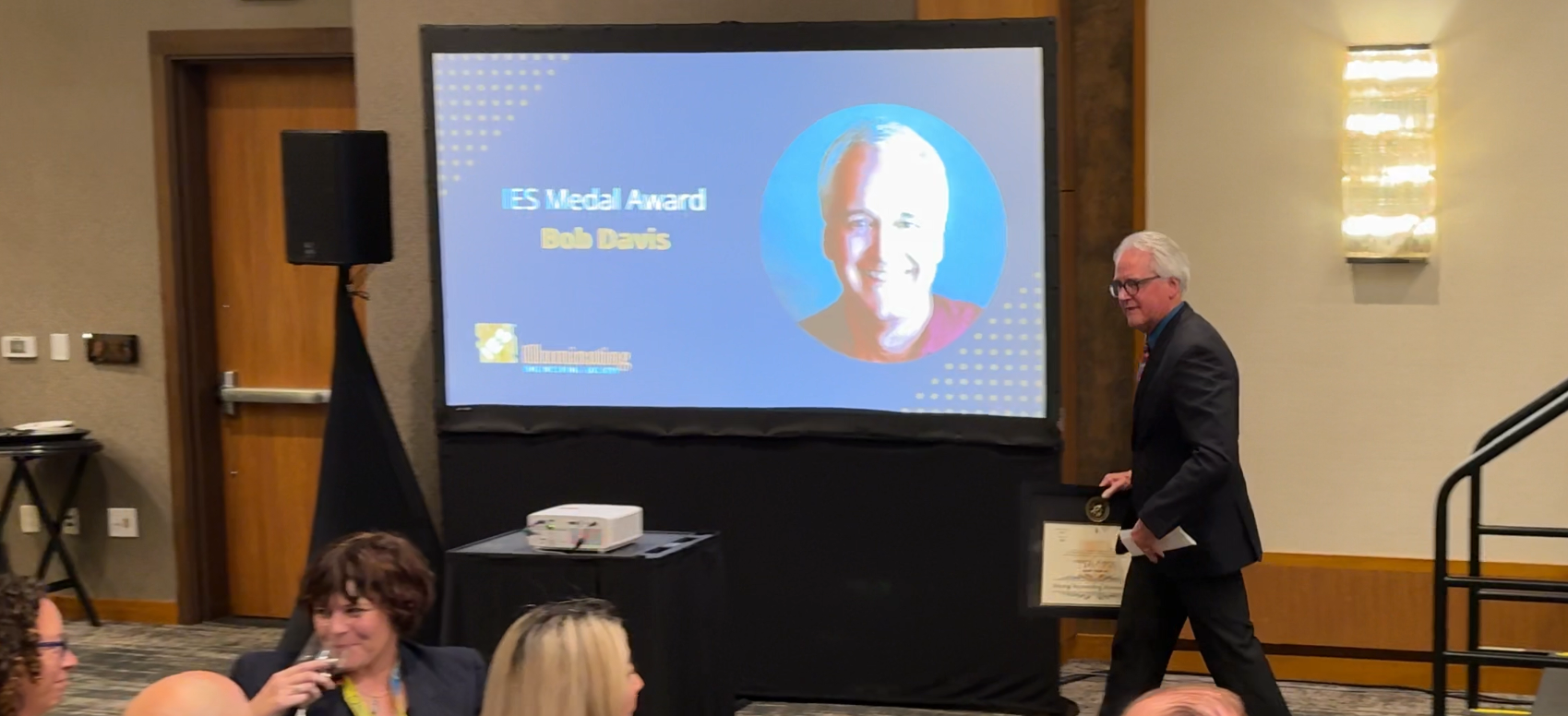
Above: Bob Davis PhD exits stage right after being awarded this year’s IES Medal Award
Kevin Houser PhD, won the IES Medal last year but could not attend that ceremony in Anaheim, travel in Asia kept him away, so the 2026 podium became his moment to finally deliver remarks in person. He thanked a list of former PhD students by name, then turned the moment outward, urging anyone still standing at the edge of the society to get involved without waiting to feel like an expert: join a committee, contribute to a standard, raise a hand for whatever interests you. He pressed further into what real engagement demands, framing disagreement inside the society as something worth doing well rather than avoiding.
Houser's remarks turned pointed when he named the specific unknowns that still trail the field:
- How much light does a person actually need to feel safe?
- What lighting conditions genuinely support circadian health?
Houser did not pretend the profession has caught up to either question, and said so plainly: acknowledging that gap is not a weakness, but part of good science, sound engineering, and responsible design.
A Room That Noticed
Not every award moment stayed measured. When Leslie North received the IES Fellow distinction, her reaction departed from the evening's controlled tone, visibly moved by tears, and the room answered with a standing ovation. For a ceremony built mostly on science, service and gratitude, it stood out as the one moment nobody had scripted, and the room let her know it noticed.
The rest of the honors filled out a packed slate: the Marks Award to Shirley Coyle, the Distinguished Service Award to Mark Lien, the Past President Award to Wilson Dau, and Presidential Awards to Steven Zhou, Addie Smith, Eric Lind, and Jana Owens.
Each award recognizes a different kind of contribution, technical, administrative, tenured, discretionary, but the evening's real weight sat with the two medalists whose combined decades of teaching produced, in Davis's framing, students who became colleagues, and colleagues who became the room itself.