


August 6, 2026
U.S. Collects $5.15 Million Over Mislabeled Chinese LED Imports
Federal prosecutors say Taiwan paperwork disguised the Chinese origin of imported LEDs
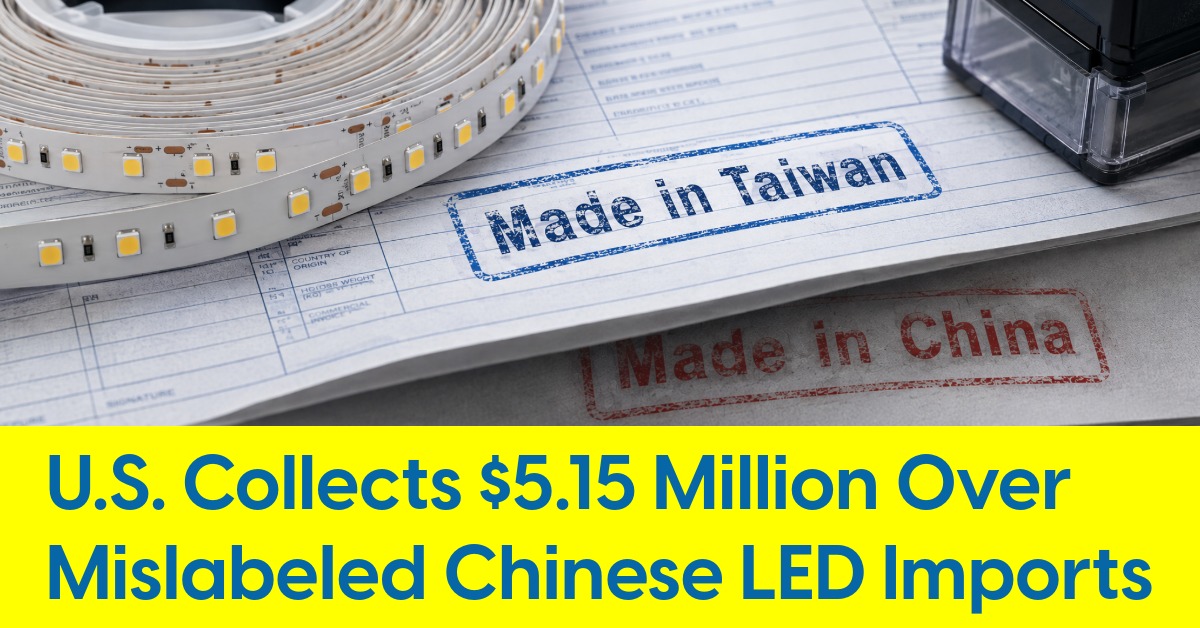
The diodes came from China. The paperwork said Taiwan. That gap, prosecutors allege, is what let a major LED supplier sidestep tariffs built specifically to make Chinese-origin components more expensive to import.
Everlight Electronics and its Texas subsidiary, Everlight Americas, have agreed to pay the U.S. government $5.15 million to resolve False Claims Act and customs allegations. The U.S. Justice Department says that from 2018 through 2022, Everlight misrepresented the origin of LEDs actually manufactured in China, routing them through Taiwan before shipment to the U.S. to avoid Section 301 tariffs aimed at Chinese trade practices. According to the U.S. Attorney's Office, CBP's Office of Trade worked the case alongside prosecutors, tracing declared origin against the tariff schedule those diodes should have faced.

An OEM Problem
Everlight is not a brand most specifiers would recognize. Founded in Taipei in 1983, the company has grown into one of the world's top five LED package manufacturers, with thousands of employees and a global footprint that includes its Carrollton, Texas subsidiary.
Its diodes get built directly into luminaires by OEMs and fixture assemblers rather than sold as finished product under the Everlight name. That distinction matters. The alleged fraud lived at the parts level, buried inside bills of materials for fixtures that carried entirely different brand names by the time they reached a jobsite.
Court records show the allegations extended past the transshipment scheme itself. From 2022 through 2025, Everlight kept importing Taiwan-labeled LEDs without adequately separating Chinese-made components from Taiwanese-made components during manufacturing. The origin problem was not simply a shipping route. It was built into the production process itself, meaning even parts assembled after the initial scheme allegedly ended may have carried the same defect.
Whistleblower, Task Force, Timing
The case began as a complaint from Tao Wang, a former Everlight employee, who under the False Claims Act's whistleblower provisions will collect $876,146 of the settlement. Average annual salary in Taiwan runs around $26,000, which puts Wang's share at roughly 34 times what a typical Taiwanese worker earns in a year.
This also lands months after DOJ formed a cross-agency Trade Fraud Task Force in August 2025, pairing the Civil and Criminal Divisions with Homeland Security to pursue exactly this kind of tariff evasion.
U.S. Attorney Kelly Hayes said the office intends to use every available tool to hold accountable companies that misstate country of origin, and U.S. Customs and Border Protection’s Susan Thomas described trade fraud as anything but victimless, framing it as a drain on legitimate revenue and a risk to compliant competitors. The claims remain allegations only, with no determination of liability, and payment is due within thirty days of the settlement's effective date.
For lighting people, the case is a reminder that Section 301 exposure does not stop at the fixture brand. It runs through every diode an OEM sources, and Everlight parts built into fixtures years ago are still active on real projects today.