



September 23, 2026
Lighting Industry Nears Another Round of Price Increases
Mounting cost pressures are pushing manufacturers toward price increases before year-end
This month we contacted a dozen lighting manufacturers and asked each of them the same question: how much cost pressure are you under? Most declined to discuss pricing on the record, and no lighting brand wants to be the first name attached to an increase. Several agreed to talk on the condition that they not be identified, and many of those answers were consistent.
Costs are rising across nearly every part of the value chain at once: metals, electronics, fuel, freight, currency and the cost of money. None of the executives we connected with described their company as insulated. They differed slightly on how much longer they thought they could keep absorbing the increases.
Taken together, the feedback points to a conclusion that runs against what much of the channel believes. The industry spent two years preparing for a policy shock, and an economic one arrived instead. Tariffs partially receded, and building and shipping a lighting product got more expensive anyway. The evidence suggests price increases are coming before year-end, and some have already been announced.

The Gap on the Spreadsheet
Federal data supports what manufacturers told us privately. According to the U.S. Bureau of Labor Statistics, the Labor Department agency that tracks what producers pay and charge, steel mill products rose 23.4% over the 12 months ending in August, aluminum mill shapes rose 27.3% and copper mill shapes rose 20.9%. Over the same period, the bureau's index for nonresidential lighting fixture manufacturing rose about 1.6%. It has barely moved since June 2025, when the last wave of tariff-driven increases worked through the channel.
A price index can't see inside a company's bill of materials, and it doesn't measure margins. Eric Gaus, chief economist at Dodge Construction Network, made the same point this week: a persistent gap between raw-material and finished goods inflation is consistent with manufacturers absorbing costs, but the data can't confirm it. Still, someone has been covering the difference, and some of the manufacturers we spoke with believe it has been them.
One manufacturer's chief executive agreed to speak on the record. "The cost structure behind lighting products has moved up materially this year, and manufacturers can't absorb that indefinitely," said Ira Greenberg, CEO of Keystone Technologies. "At some point the math stops being a margin absorption question and starts being a market pricing question." Greenberg did not say whether Keystone plans an increase of its own.
The Cost of Money, Copper, and Diesel
Last week’s Federal Reserve's 1/4 percentage point rate increase adds cost in less visible places: inventory financing, credit lines and receivables. The committee's projections leave room for another hike this year. For manufacturers or electrical distributors holding finished goods longer than they planned, money now costs more at an inconvenient time.
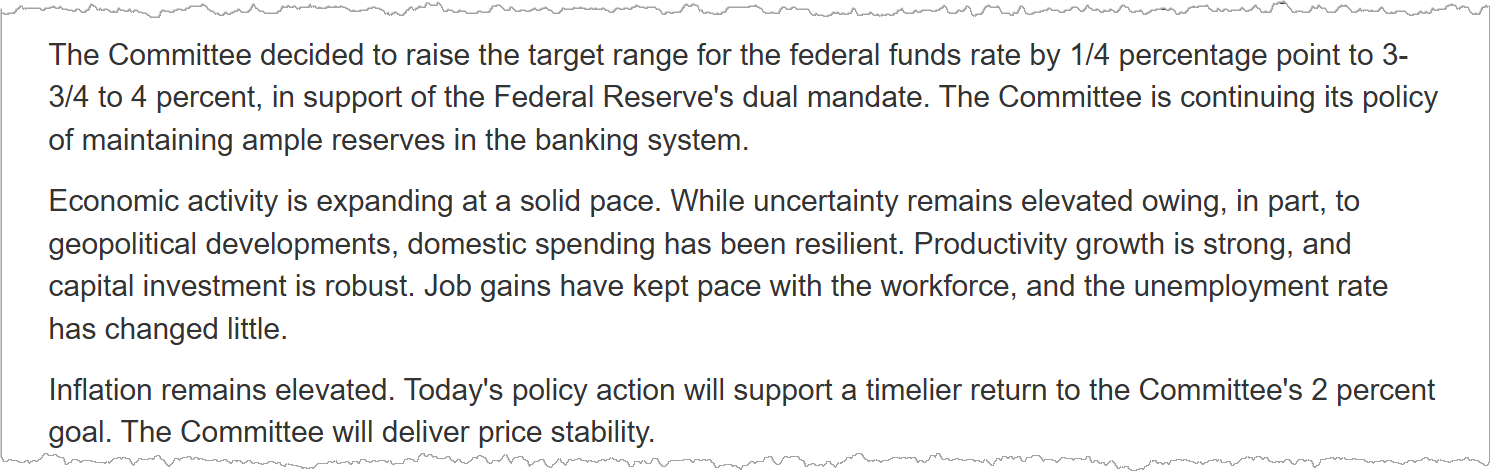
September 16: The U.S. Federal Reserve's Federal Open Market Committee approved the above statement for release by a 12 - 0 vote
Copper closed near $6.83 a pound on September 22, up from about $4.64 a year earlier, a gain of roughly 47%. Copper runs through conductors, wiring, drivers and controls, and there's another date to watch: the Commerce Department has proposed copper duties of 15% starting January 2027 and 30% in 2028, pending a presidential decision. Tariffs haven't gone away. In the feedback we gathered, though, they were no longer the main event – but due to recent tariff policy, Canadian manufacturers who derive much of their business in the U.S. continue to feel the pain.
Data source: Yahoo! Finance
Diesel matters to every company in the business, whether it imports finished luminaires or assembles them in Sheboygan. AAA put the national average at $6.23 a gallon on September 14, a record and nearly 69% above a year earlier. Every container that reaches a West Coast port still has to travel inland by rail or truck. The ocean leg costs more too. The Freightos Baltic Index for China to the North American West Coast was $3,407 per 40-foot container in mid-September, about 56% above last year, though below its July peak of $3,980.
Above: Container rates from China to West Coast USA. Data source: Freightos
Signify Raises OEM Prices
The clearest signal so far comes from electronics, not metals. In a notice dated August 24, Signify's China OEM unit told partners and end customers that supply prices for Philips-brand LED OEM products, including indoor and outdoor drivers, LED modules and related accessories, would rise by an expected 10% to 15% starting October 1. The letter cites tight global semiconductor capacity and longer lead times for power-supply materials, and says it expects the pressure to continue for the next several quarters.
Signify's China OEM unit says semiconductor capacity is tight and power-supply lead times keep lengthening. Price increases of 10% to 15% on drivers and modules take effect Oct. 1.
— Inside Lighting (@InsLighting) September 22, 2026
Aladdin Lighting Network pic.twitter.com/9wfl6x4X1J
The most telling line is a request. Signify urged customers to finalize their demand forecasts and orders for the next three to six months as soon as possible. When a component supplier asks customers to commit half a year of demand early, it's saying something about where it thinks supply is headed.
The notice addresses the Chinese market. Additionally, Inside Lighting has confirmed that Signify's OEM pricing changes also take effect October 1 in all other global markets, though it isn't clear whether the same 10% to 15% range applies. Drivers and modules go into a large share of luminaires sold in North America, including many made by companies that compete with Signify at the fixture level. Separately, we understand Signify’s US-based Genlyte Solutions is putting a price increase into effect October 1. The size has not been disclosed.
Why "Made in America" Doesn't Completely Solve It
Domestic assembly has been the industry's standard answer to tariff risk, and it helps. The feedback we received was blunt about its limits. Wherever a luminaire is assembled, it still depends on drivers, boards, semiconductors and electronic components sourced from around the world. A strong domestic footprint reduces exposure, but it doesn't remove it.
Mexico hasn't provided the protection many companies expected either. USMCA membership has not shielded Mexican production from a rising peso, which manufacturers identified as an unexpected cost driver. A stronger peso means the same factory invoice costs more in dollars, even when nothing on the factory floor has changed.
In conversations with manufacturers and reps over the past several weeks, we've also heard about projects stuck in holding patterns. A job scheduled to ship in August may now release in November or January. Meanwhile the product sits in a warehouse, financed at higher rates, carrying a cost basis that may no longer match what it would cost to replace.
How Long the Pressure Lasts
Keystone’s Greenberg expects it to last. "I don't see near-term relief in any of these lines," he said. "Freight and diesel are still climbing rather than flattening. Metals have no obvious catalyst to come down. Component supply is the tightest of the group and the least elastic since you cannot add capacity on a quarterly timeline. I'd plan on these conditions holding into next year rather than easing."
There are counterweights. Diesel dropped sharply earlier this summer before it rebounded, and Gaus noted that if it drops again, August may turn out to have been a one-month energy spike. Higher rates also cool construction, and slower projects weaken any manufacturer's pricing power. Price increases are easier to announce than to make stick.
What Comes Next
The next few weeks will test the thesis. October 1 is when the Signify and Genlyte changes take effect. The Bureau of Labor Statistics publishes September producer prices on October 15, which will show whether diesel held. The decision on copper duties sits just ahead of January, the month when many manufacturers traditionally reset list prices anyway.
The manufacturers who wouldn't talk on the record this month may not need to, because their price letters will speak for them. For lighting people who spent two years reading trade proclamations, the more useful document this fall may be a supplier letter with a red stamp at the bottom.