


July 10, 2026
Yet Another Standard for Lighting Manufacturers?
Will specifiers soon start asking about zero-waste certification, too?
A lighting manufacturer shipping crew loading a truck this week is standing on more compliance ground than any of them may realize.
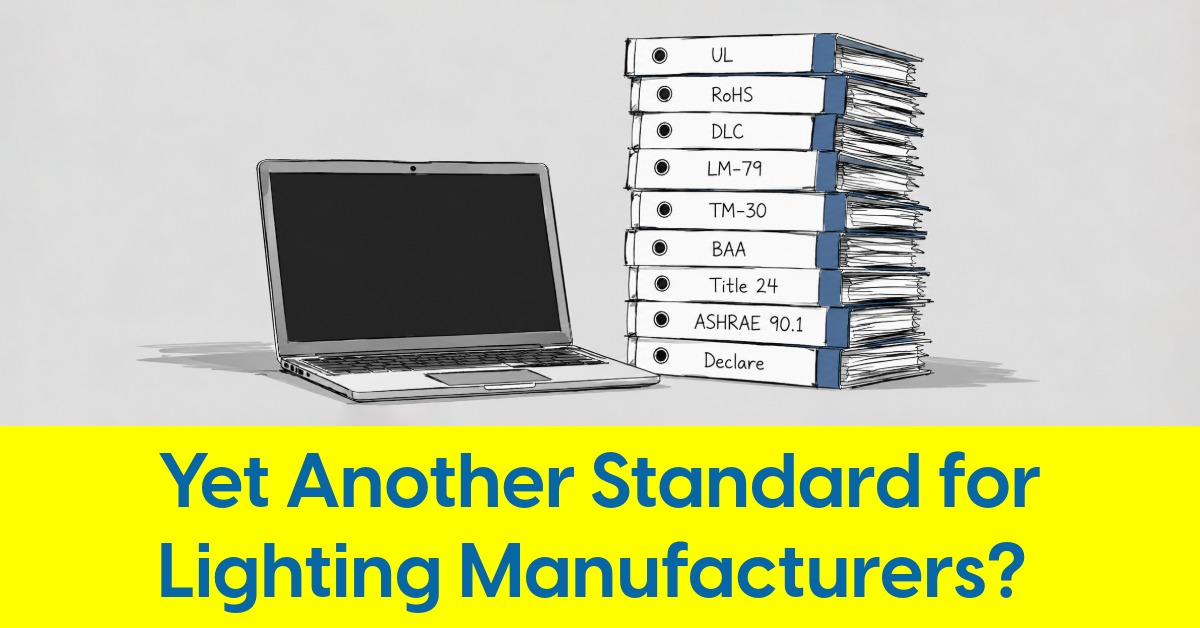
The fixtures in the boxes carry UL and RoHS marks. The paperwork trailing behind carries DLC listings, LM-79 test reports, TM-30 color data. The spec sheet references Title 24 and BAA. Somewhere in a back-office drawer sits a Declare label report that nobody has asked for in at least a year.
Now there is a new acronym circling the industry's periphery: TRUE, the zero-waste certification administered by Green Business Certification Inc., the same organization behind LEED. The question worth asking is whether TRUE joins that list, or whether it stays a niche credential that a handful of manufacturers chase for marketing copy.

What TRUE Actually Certifies
TRUE is not itself new. The rating system traces back to 2013, when the U.S. Zero Waste Business Council created it as the first third-party zero waste certification; GBCI took over administering the program in 2016 and has certified projects under it since 2017. What's changed recently isn't the credential's age but the volume of case studies and hype pointing to it — a decade-old program recently getting a marketing push rather than a genuinely new standard.
TRUE does not certify fixtures. It certifies facilities and operations, meaning a manufacturing plant, a distribution center, or a corporate headquarters can earn Platinum, Gold, Silver, or Certified status by diverting at least 90 percent of nonhazardous waste from landfill and incineration over a 12-month period, according to GBCI's published requirements.
That distinction matters for how the credential moves through the channel. DLC and LM-79 travel with the product. TRUE travels with the address. A manufacturer's Ohio plant might be TRUE Platinum while its Mexico plant has never heard of the program, and a specifier evaluating a fixture line has no straightforward way to know which factory built which order.
In that sense it has more in common with ISO 9001 or Buy America compliance than with DLC or LM-79: a designation about how a building operates, not what it ships. A lighting manufacturer cannot put a TRUE seal on a luminaire the way it puts a DLC listing on a spec sheet.
TRUE travels with the address. A manufacturer's U.S. plant might be TRUE Platinum while its Mexico plant has never heard of the program, and a specifier evaluating a fixture line may have no straightforward way to know which factory built which order.
The Open Questions
Whether the TRUE distinction matters commercially is yet to be seen. Architects and owners have not, so far, been documented asking suppliers about zero-waste operations the way they routinely ask about Buy America compliance or IP ratings on outdoor gear. Whether TRUE certification appears in RFPs, whether it factors into specification decisions, or whether it functions mainly as an ESG talking point for corporate sustainability reports remains an open question that the industry has not yet had reason to answer.
What is documented is the direction of travel. Sustainability conversations in the built environment are expanding past energy metrics and into material flows and circularity, a shift GBCI's own reporting frames explicitly around programs like TRUE and LEED v5's tightened diversion requirements.
Lighting has spent two decades organized around efficacy and controls. Whether waste diversion becomes the next line item on that list, alongside embodied carbon and material transparency, is a trend line worth watching rather than a verdict worth issuing today.