


August 19, 2026
Cree Lighting USA's Conflicts Take Two Very Different Turns

Employee class actions consolidate as a vendor moves toward judgment after months of silence
In March, when Cree Lighting USA offered its only comment on the mounting pile of lawsuits then facing the company, the message was almost soothing in its vagueness: "Just a general statement is that we expect to positively, fairly and quickly resolve any disputes."
Five months later, Cree Lighting USA's legal picture has split into two distinct stories moving in opposite directions. One is a turf fight partially resolved. The other is a company that appears to have stopped showing up.
Both cases are also playing out against a company that no longer operates the way it did when the disputes began. Cree Lighting USA sold substantially all of its assets in a May 12 auction to two newly formed Delaware LLCs. Cree Lighting USA still exists as a legal entity and remains the named defendant in both cases. What it still owns is a separate question.

Ex-Coworkers Sue Cree Lighting USA Hours Apart
The Worker Adjustment and Retraining Notification (WARN) Act requires large employers to give workers 60 days' written notice before a mass layoff or plant closing, so people can find another job or arrange finances before the paycheck stops. Most states, including Wisconsin, layer their own version on top of the federal one.
A class action lets similarly affected workers, here, employees let go from the same Racine facility, sue together instead of filing hundreds of separate cases. One or two named plaintiffs represent everyone in the same position, and damages scale with class size. That's why fights over who belongs in the class, and who leads it, are not procedural housekeeping. They determine how much money is at stake.
Two such class actions were filed against Cree Lighting USA on the same day in March, close enough that Judge Dries would later liken it to a photo finish, with barely ten hours separating the two filings. One argues the clock started when 172 workers were formally terminated on March 12. The other argues it started five months earlier, when roughly 580 employees were furloughed with no return date. That gap, five months and roughly 400 additional workers, is the entire ballgame for how large Cree Lighting USA's exposure could be.
The Class Actions Get a Structure
On August 14, Magistrate Judge Stephen Dries consolidated the two competing cases, ending the standoff between rival plaintiffs' firms that Inside Lighting covered in May. The Sorenson case becomes the lead docket. Raisner Roupinian LLP, representing the broader class tied to the October furlough, was appointed interim class counsel over the narrower Sorenson class.
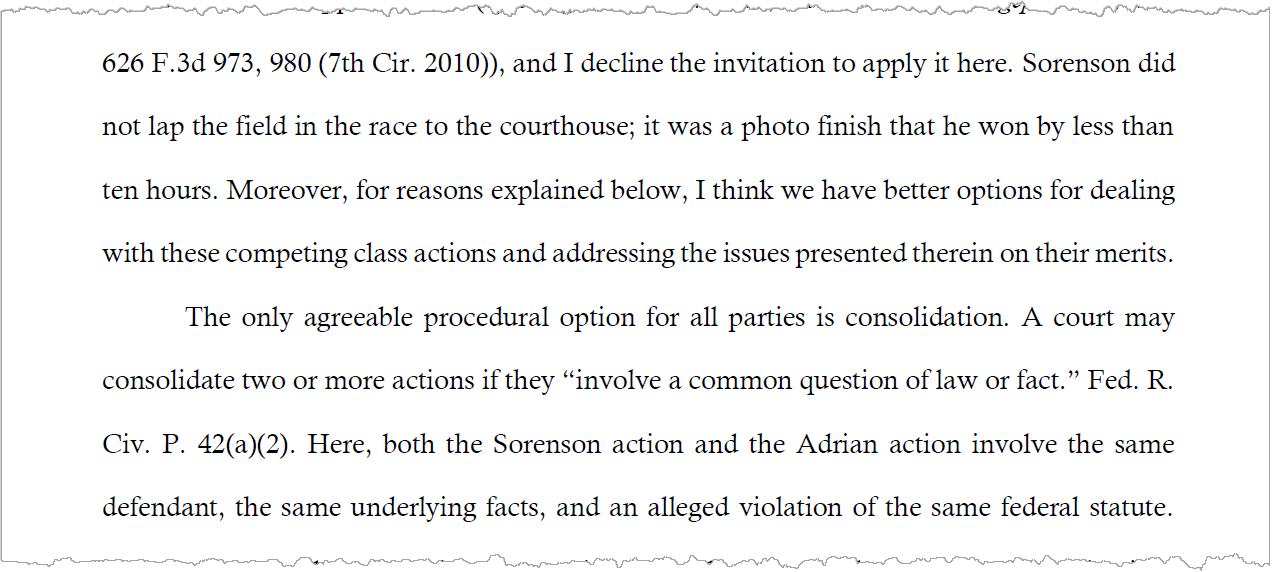
Excerpt from August 14 court order consolidating the two WARN Act class actions against Cree Lighting USA
The order did more than referee a fight between lawyers. It cleared the way for the underlying WARN claims, over whether Cree Lighting USA's furlough functioned as a mass layoff in disguise, to move toward a Rule 16 scheduling conference set for September 3. That question remains unresolved. But the question of who leads the case against Cree Lighting USA no longer is.
What the Mayville Case Is, By Contrast
Not every lawsuit against Cree Lighting USA involves workers or a federal statute. Mayville Engineering Company's case in Racine County Circuit Court is a straightforward commercial collection matter: a supplier says it shipped goods, invoiced for them, and never got paid. No class, no statute beyond ordinary contract law, just a vendor owed $194,484.
What makes it notable isn't the legal theory. It's the process. MEC served 19 requests for admission on April 29, formal written questions that, under Wisconsin law, are automatically treated as admitted if a defendant fails to respond in time. Cree Lighting USA's responses were due June 1.
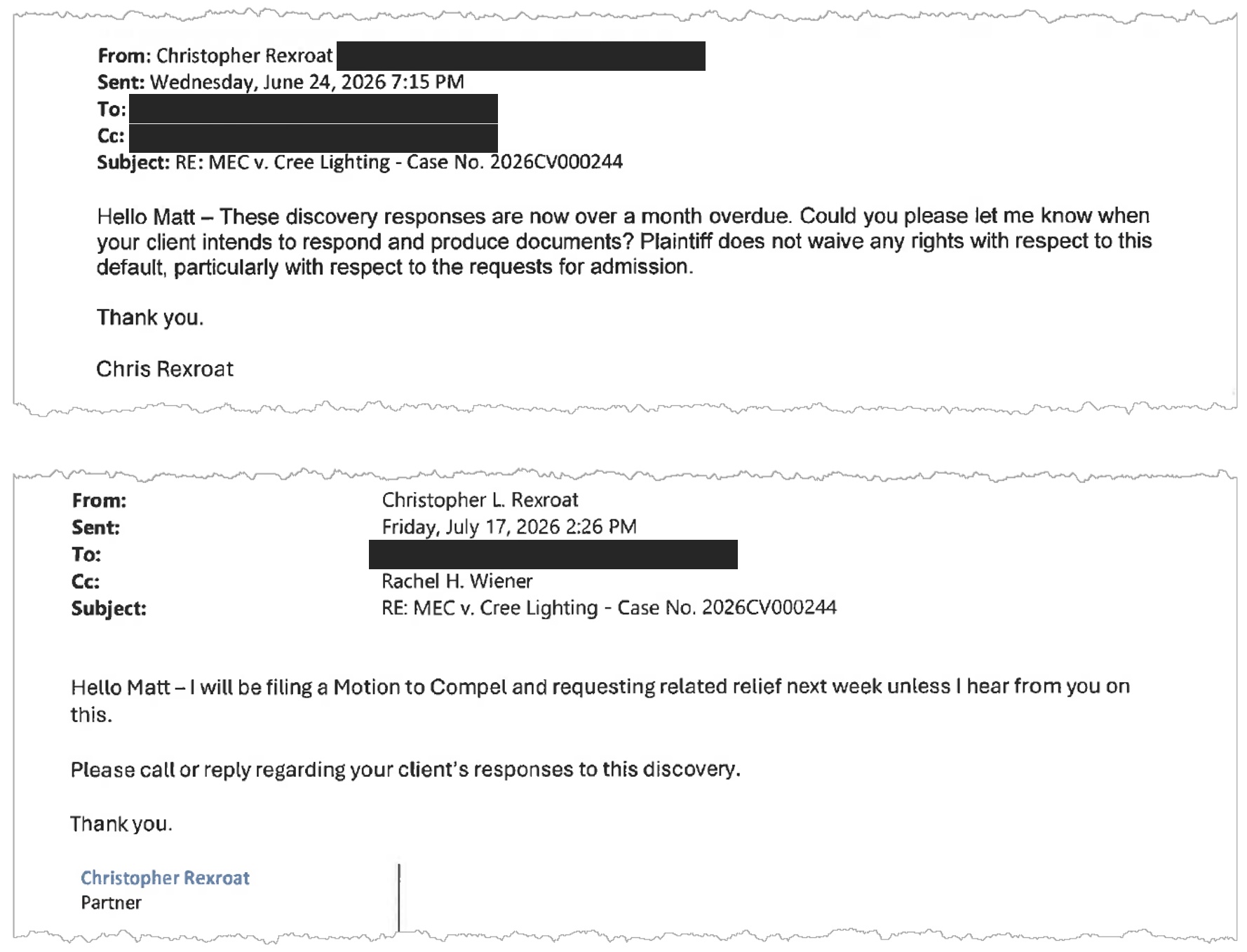
Email excerpts from MEC’s attorney documenting repeated attempts to obtain a response from Cree Lighting USA before seeking court intervention
According to an affidavit from MEC's attorney, nothing has come back from Cree Lighting USA since, not after a June 5 phone call, not after a June 24 written warning, and not after a July 17 notice that a motion would follow within the week. MEC now argues that silence has already conceded the case: receipt of the goods, no timely objection, and an unpaid balance of $194,484.
On August 3, Inside Lighting asked Cree Lighting USA whether its March position that it expected to "positively, fairly and quickly resolve any disputes" had changed in light of the Mayville case. The company did not respond to the email.
A Company Fighting on One Front, Silent on Another
Put side by side, the two threads describe a company allocating its attention unevenly. Cree Lighting USA has counsel actively defending the WARN litigation: answering both complaints, arguing for consolidation, weighing in on class counsel. On a comparatively modest vendor debt in state court, it appears to have gone quiet for nearly three months.
That contrast isn't evidence of companywide disengagement. It looks more like triage, a company choosing which fights are worth resourcing and which are not. For lighting people trying to read the state of Cree Lighting USA's finances from the outside, that kind of selective silence tends to say more than a press release would.
What's Next
MEC's summary judgment motion is scheduled for a hearing on August 28 at 10 a.m. The consolidated WARN case has its Rule 16 scheduling conference on September 3, less than a week later. Both dates test different versions of the same underlying question: not just what Cree Lighting USA owes, but what, if anything, remains to pay it with.