


August 18, 2026
IES Looks Steadier, With Details Still Pending
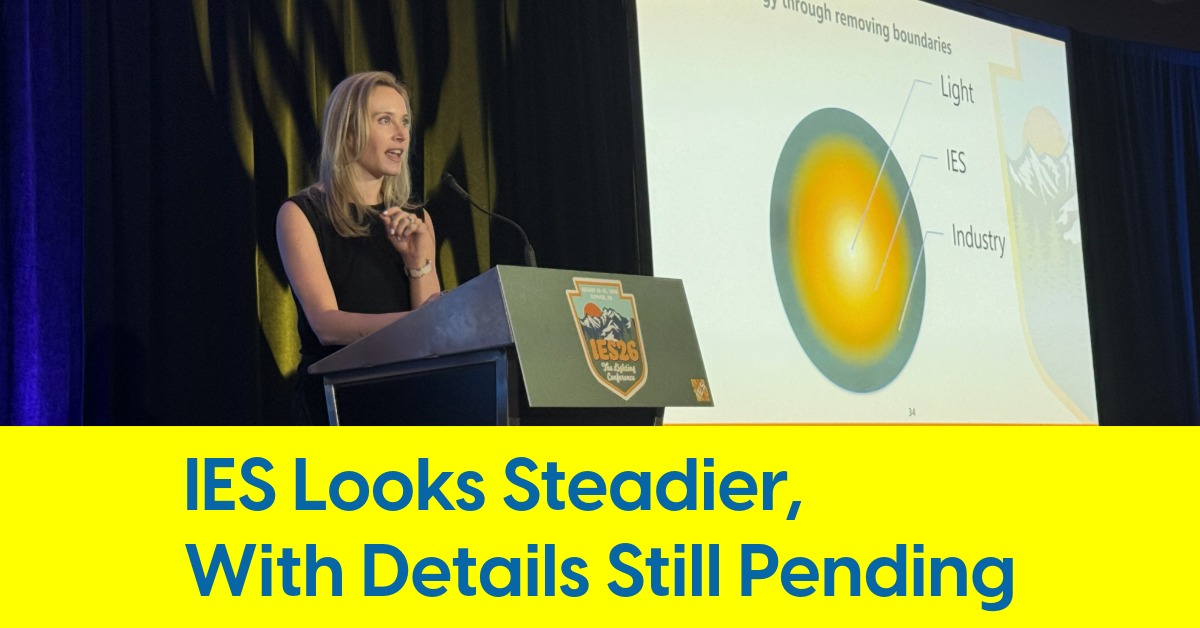
Colleen Harper, IES executive director, addresses members at IES26 in Denver
Membership growth, a new A.I. tool and a broader strategic outlook
A year ago, the Illuminating Engineering Society stood in front of its members in Anaheim and did something trade organizations rarely do: it published a five year membership model, broken down to the individual year, built on a stated 10 percent attrition assumption and a target of 7,500 members by 2029. That kind of specificity invites accountability. It also invites comparison, which is exactly what this year's meeting in Denver offered, whether or not that was the intent.
IES arrives at 2026 in better shape than the deficit years that prompted last year's blueprint in the first place. Colleen Harper, IES's executive director, told members the Society's new 2026 to 2028 strategic plan is built around what she called "lasting, scalable growth," and that the organization can now focus on the future rather than the "firefighting" that defined her earlier years in the role. That context matters. Nothing suggests an organization in trouble. What it suggests is an organization choosing, this year, to talk about its progress in broader strokes.

A Tool Built to Stay Inside Its Own Walls
One of the more interesting operational changes to come out of last week’s IES26 in Denver may not be the membership story at all. IES plans to launch an AI chat tool for its Lighting Library, the searchable home of more than 100 standards, technical memorandums, and recommended practices, sometime around late October or early November. Brienne Wilcock, IES's associate executive director, described it as a way to navigate the collection rather than replace it: answers are cited directly to specific IES documents, and the tool has no ability to pull in outside sources, including anything referenced in a standard's own bibliography.
That last restriction is the part worth sitting with. Most AI research tools are built to roam, pulling in whatever the web offers on a topic. IES built the opposite: a model that can only draw from documents the Society itself has vetted through its consensus process, and nothing else. Ask it a question, and it cannot wander off into an unreviewed blog post or a manufacturer's marketing claim to fill in the gaps. It can only answer from what IES has already put its name behind.
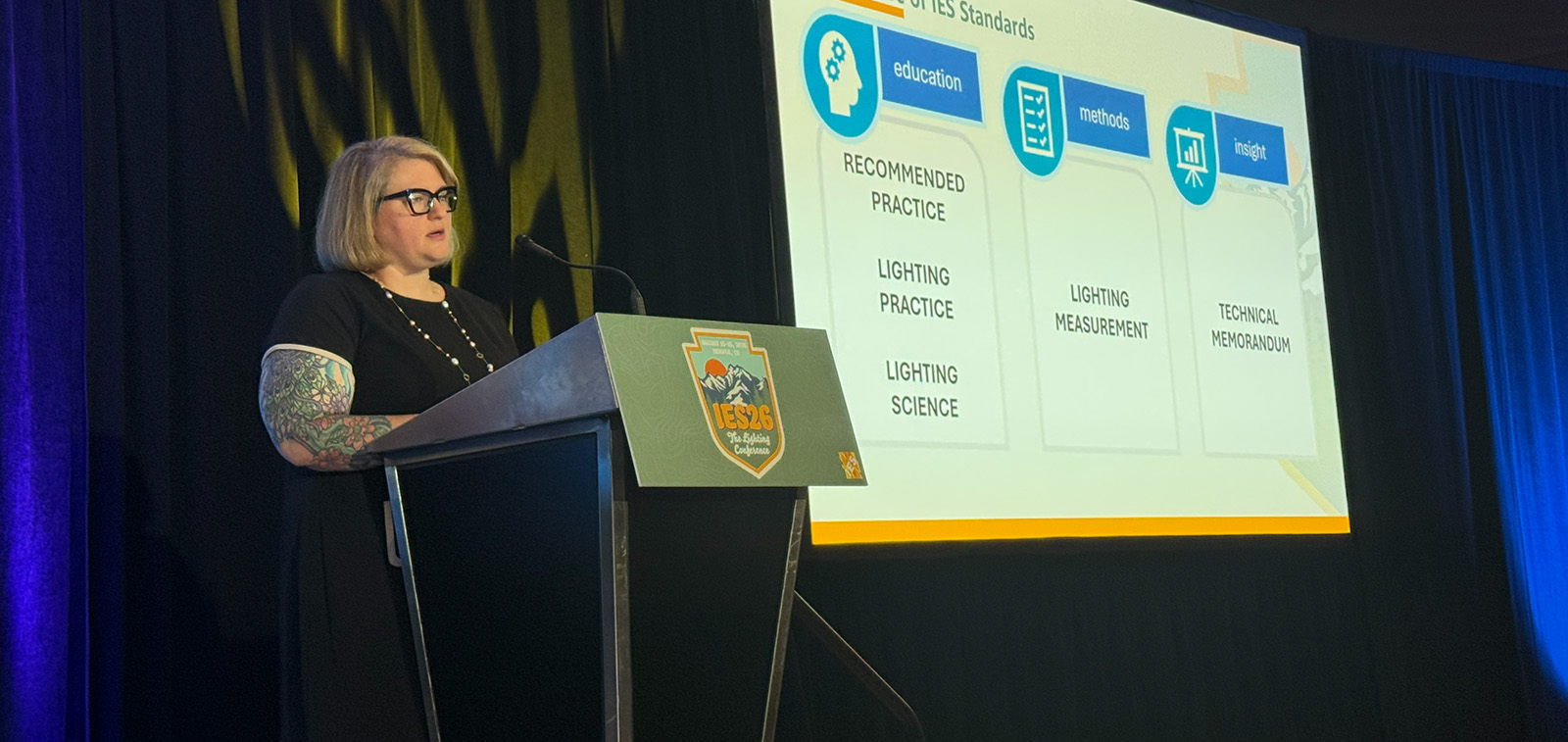
Brienne Wilcock, IES associate executive director, speaking at IES26 in Denver
That constraint solves a real problem. Anyone who has tried to find a specific provision buried inside an RP document knows the two standard methods: a keyword search or a manual flip through a PDF, both of which work fine when the answer lives in one place. The harder problem is the question that spans several documents at once, a lighting power density issue that touches one recommended practice, a testing method covered in another, and a definition that only appears in a third. A tool trained exclusively on IES's own library is positioned to stitch that kind of answer together in a way a keyword search cannot, and it is worth watching closely once it actually launches and gets used.
IES also announced a separate integration, letting users query IES standards from within outside professional workflows they already use, again with citations tied back to the source documents rather than open ended generation. Neither tool is live yet, so neither has been tested by the audience it is meant to serve. But the underlying design decision, keeping the model fenced inside vetted, consensus built content, is a meaningfully different approach than most AI layered onto reference libraries today.
The Membership Picture, Rounder Than Before
Where last year's presentation offered a chart with a starting number, an ending number, and every year in between, this year's discussion offered something closer to an assurance: membership is around 5,000, and it is growing. No slide rolled up the total. No year over year comparison accompanied it.
The sustaining membership numbers illustrate the pattern. Sustaining membership is IES's organizational tier, the category built for manufacturers, distributors, and other companies rather than individual professionals, and IES broke it out by category, Bronze, Silver, Gold, Platinum, Diamond, without ever adding them up. We did: 299 sustaining members this year, up from 281, an 18-member gain led by 17 new entries at the Bronze level. It's a real, positive number.
One piece of good news arrived without needing a spreadsheet. A year ago, in our coverage of the Anaheim meeting, we specifically flagged that IES did not support automatic credit card renewal for individual members, and argued that adding it, even as a simple opt-out option, could meaningfully cut into the unintentional churn driving the Society's 10% attrition assumption. The good news: they've already implemented it. Members can now opt into auto renewal, a fix that should, in theory, chip away at attrition in the years ahead.
The fuller individual membership breakdown will presumably arrive with IES's annual report later this year. Until then, "approximately 5,000 and growing" is what members have to work with, a full year into a model that called for 5,475 by the end of 2026.
Widening the Tent
IES is also opening its doors wider to professionals who touch lighting without working in it full time. A new allied organization membership, launched this year, offers a reduced rate to members of adjacent design and construction associations, groups whose day to day work brushes against lighting decisions without lighting being the core discipline.
Wilcock was candid about a related challenge: newer professionals sometimes hesitate to join technical committee work, unsure if they're ready. IES's answer is a program letting emerging professionals observe a committee for a year before formally joining, though uptake so far has been modest, fewer than 10 participants, by Wilcock's estimate. With EPs and students now the Society's fastest growing membership segments, that pathway is one worth watching as it matures.
National Lighting Bureau:
A Postcard-Sized Operation Joins the Fold
IES also announced a management agreement with the National Lighting Bureau, joining the National Council on Qualifications for the Lighting Professions (NCQLP) and the Audio Engineering Society (AES) as organizations IES now manages for an annual fee. Harper described the arrangement as part of a stable, staff supporting revenue stream and an opening toward more consumer facing education.
The scale is worth stating plainly. NLB's IRS filings show gross revenues of $50,000 or less in every year on record dating back to 2010, a threshold low enough that it doesn't even require a full tax return, and one that puts "revenue stream" in useful proportion. By contrast, the Audio Engineering Society has posted annual revenues of $3.2 million and $2.7 million in recent years.
NLB, despite its long history, remains an organization whose mission and impact aren't widely understood in the industry. One former NLB board member, asked directly by Inside Lighting in 2025 what NLB does and what impact it has, said they genuinely could not explain it.
Interestingly, the trade outlet EdisonReport covered the agreement as one of the board meeting's “most significant announcements.” What that coverage didn't mention is its own publisher's tie to NLB: EdisonReport's headquarters and NLB's listed contact address are the same building in Tennessee, and editor Randy Reid was cited as an NLB board member as recently as March 2026, even though his name hasn't appeared on the organization's board webpage since 2024.
None of that proves anything about IES's intentions in signing the deal. It does mean the announcement deserves a more measured read than the glowing coverage it received, and it raises a fair follow up question for IES directly: what, specifically, does the Society expect to gain from managing an organization small enough that the IRS has never required more than an e-Postcard at tax time?
What to Watch Next
The clearest picture of IES's footing will come with the 2025 Annual Report, whenever it lands. That document should put real numbers behind the "approximately 5,000 and growing" framing, with the kind of detail last year's presentation set as the standard. Until then, lighting people have a Society that looks steadier than it has in years and a genuinely interesting tool arriving this fall for anyone who has ever lost twenty minutes hunting through a PDF.
The full numbers, when they come, will round out the picture.