


June 17, 2026
Liberty, Acuity End Bitter Legal Battle Over 2021 Split
Failed acquisition talks with Illuminations sparked a three-year legal battle
Acuity and Liberty Lighting Group were once the power couple of Northern New Jersey's lighting industry. That ended in 2021.
What followed was a three-year, high-stakes legal battle that turned a calculated agency transition into a comprehensive, and occasionally messy, audit of how the industry does business.
Court records filed in Morristown, New Jersey (Exit 142B), show that Liberty Lighting Group, Acuity Brands Lighting, Illuminations, Inc., and a group of current and former executives from both companies reached a settlement in May, ending nearly three years of litigation that had grown well beyond the contract dispute that started it. The parties agreed to dismiss the case with no public disclosure of terms.
The dispute began with a familiar grievance. In November 2023, Liberty Lighting Group, long the dominant commercial lighting agency in Northern New Jersey, filed suit after Acuity terminated its sales agency agreement in March 2021 and handed the territory to Illuminations, Inc., a Philadelphia-based agency that had been representing Acuity in that market. Liberty's principal Robert Czarny alleged the termination was unlawful, and the complaint named Acuity, Illuminations, and five individual executives from the two companies.
What followed was not a simple wrongful-termination case.
The Setup: Project Unity and Shared Secrets
To understand what the lawsuit became, you have to understand what happened before the termination.
In mid-2020, Acuity executives initiated discussions among Liberty, Illuminations, and Acuity's New York City agency, New York Digital, about combining the three businesses into a larger regional platform. Internally, the effort was known as Project Unity. The hypothetical combined entity was nicknamed I2L2 — shorthand for Illuminations Inc. and Liberty Lighting — which, to be fair, sounds more like a droid dispatched to service every Turtle & Hughes and Cooper Electric Supply counter in North Jersey.
To facilitate the conversations, all parties signed a non-disclosure agreement (NDA) in July 2020 and began exchanging sensitive business information.

According to court filings, Czarny disclosed customer lists, compensation records, and a succession plan he had developed for the agency, one that contemplated selling Liberty to his son and two senior agency staffers at a discounted price. He was, by his own account, mapping out the future of a business he had built over nearly three decades.
Project Unity eventually collapsed. And in March 2021 Acuity informed Liberty that the agency agreement would end the following month. Illuminations moved into the territory. Several executives from New York Digital joined Illuminations as part of that transition.
Liberty alleged that what looked like an orderly channel reorganization was actually something else: that the defendants had used the NDA process to access Liberty's most sensitive information, pursued a discounted acquisition using terms derived from Czarny's own succession plan, and when Liberty declined to sell, terminated the relationship anyway without disclosing that termination was the backup plan.
The Case Grew More Contentious
The original complaint brought franchise and contract claims. The New Jersey Franchise Practices Act became a central issue because Liberty argued its relationship with Acuity, which had grown to roughly $38 million in annual sales with approximately 65 percent of Liberty's revenues flowing from the Acuity line, met the statutory definition of a franchise. Acuity disputed the characterization and argued the case belonged in Georgia under the choice-of-law provision in the agency agreement. The court declined to dismiss the case, and discovery began.
By the summer of 2025, the parties were arguing that documents produced in discovery, buried within tens of thousands of pages that defendants produced between February and June 2025, revealed for the first time that certain Acuity and Illuminations executives had been actively involved in the decisions to pursue and then abandon Project Unity, to develop the discounted buyout offer, and to withhold from Czarny the fact that termination would follow a refusal to sell. Judge Noah Franzblau allowed the amendment in August 2025.
Acuity Went on Offense
Meanwhile, Acuity attorneys had filed counterclaims of their own. The counterclaims alleged that Liberty and Czarny, while collecting commissions from Acuity, had been simultaneously representing competing manufacturers, including Finelite, Coronet, and Mercury Lighting, on projects where those products substituted directly for Acuity's offerings. Those actions, Acuity said, violated the sales agreement.
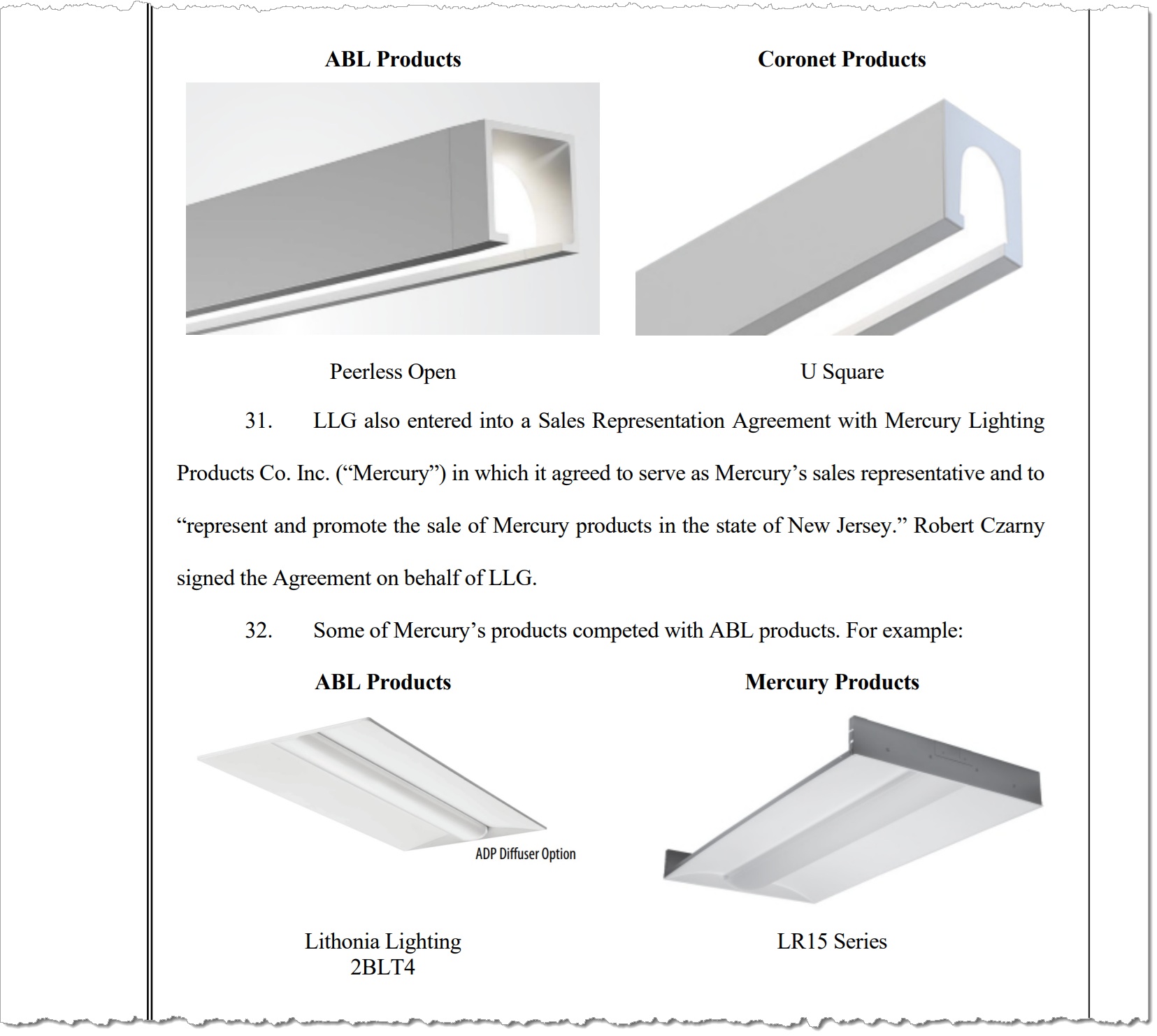
Above: Exhibits supporting Acuity's claim that Liberty Lighting profited from competing product substitutions.
The defendants further alleged that Liberty had routinely requested price discounts from Acuity, falsely representing those discounts were necessary to win bids, and then redirected the savings to inflate prices on competing products, increasing Liberty's commissions at Acuity's expense.
The counterclaims also alleged that when Liberty merged with Diversified, a competing agency operating across New Jersey and Pennsylvania, it transferred confidential information belonging to Acuity and Illuminations to a direct competitor. Czarny's reported repurchase of Liberty for $1 in January 2025, by which point the agency had been characterized in filings as a shell company, featured prominently in Acuity’s counterclaims.
Neither side has offered any public account of how those counterclaims were resolved. The stipulation of dismissal addresses all claims with equal brevity.
What It Leaves Behind
The case's final shape says something worth noting.
Liberty's original complaint portrayed a dominant local agent, built over thirty years, stripped of its major line in favor of a Philadelphia rival making geographic moves into New York City. That story had a clear protagonist and a clear antagonist. It raised genuine questions about what manufacturers and long-term agency partners owe one another, what protections exist under state franchise law, and whether the NDA process creates obligations that survive a failed deal.
By the time the case settled, those questions were still embedded in the litigation, but they were surrounded by disputes over competing commission arrangements, executive conduct, ownership transactions, and what each side actually knew and when. The lawsuit had become a comprehensive audit of the agency-manufacturer relationship, and not all of the findings were favorable to either side.
For lighting agents watching from elsewhere, the concentration risk lesson holds regardless of how the case resolved. Sixty-five percent of gross revenues from a single manufacturer, under a contract terminable with thirty days' notice, is an exposure that no favorable commission structure fully offsets.
The agency that built Northern New Jersey into a $38 million territory for Acuity ended up in a three-year legal fight to explain what that relationship was actually worth. Whether the settlement reflects the answer to that question remains, as with many things in this case, undisclosed.