


June 13, 2026
5 Things to Know: June 13

A social post triggers a lawsuit. Plus, sport officials change the rules instead of the lighting.
Here's a roundup of some of the week's happenings curated to help lighting people stay informed.
1. A Closer Look At The Louis Poulsen Deal
When we reported Thursday on the €470 million ($541 million) sale of Louis Poulsen to Danish foundation Chr. Augustinus Fabrikker, we noted it would be the fifth owner for the brand in the last twenty years. What we didn't have was the financial context behind why Flos B&B Italia was in a selling mood.
That context arrived from an unlikely source: Women's Wear Daily, which covers the fashion and luxury goods world but tracked down the balance sheet details worth knowing.
According to WWD, Fitch Ratings downgraded Flos B&B Italia to a negative outlook in 2025, citing weaker consumer demand across U.S. and European markets. The group carries €383 million in senior secured notes due in November 2028, and while 2025 sales improved to €847 million from €748 million in 2024, they remain below the 2023 peak of €898.6 million.
The sale of Louis Poulsen addresses that pressure directly. Proceeds go toward debt reduction, the company confirmed. Executive chairman Piero Gandini has been explicit about the broader strategy: sell brands asset by asset, and concentrate resources on the group's core Italian heritage properties, including Flos, B&B Italia, Maxalto, and Arclinea.
What happens to Audo Copenhagen, another brand in the portfolio, remains an open question. Gandini hinted last year that it might move alongside Louis Poulsen. It did not.
2. Holy Toledo. A Social Post Became A Lawsuit.
Lighting Dynamics, Inc. has earned attention in recent years for expanding its territory and deepening partnerships with Current and Lutron. The Akron-based lighting agent is back in the headlines, though for a different reason — and the circumstances will feel uncomfortably familiar to anyone who manages a company's social media presence.
Professional photographer Paul Velgos filed suit June 9 in the U.S. District Court for the Northern District of Ohio, alleging that LDI used his copyrighted photograph of the Toledo skyline on both its LinkedIn and Instagram accounts without permission. According to the complaint, the image appeared in posts promoting the company's Toledo-area business. LDI removed both posts within 24 hours of the filing. The company had not yet seen the complaint when Inside Lighting reached out, and declined to comment.
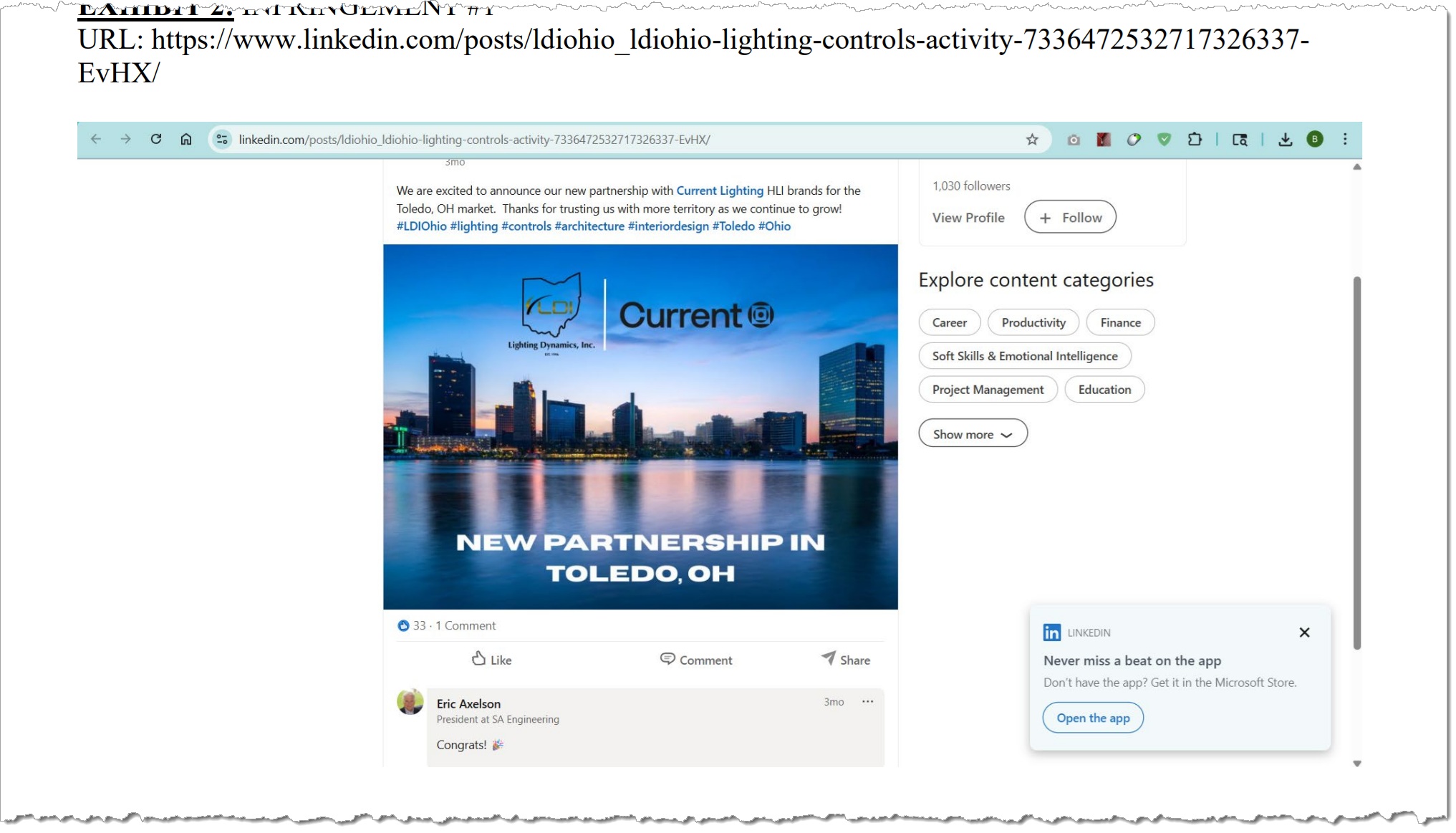
Above: Excerpt from complaint shows a LinkedIn post announcing LDI - Current partnership in Toledo
Velgos has filed five copyright infringement suits this year, suggesting a deliberate enforcement strategy rather than an isolated dispute. LDI is not the story here so much as the pattern: a professionally shot skyline image, a social post, no license.
Earlier this year, a Cincinnati-area Coldwell Banker agent faced a nearly identical claim over a skyline photograph posted to a Realtor.com page. That suit was filed, settled, and dismissed within a couple of weeks.
The lighting agent channel has seen this before. In 2020, the now-defunct Chicago rep firm Force Partners was sued by a British photographer over an image used on its website. At the time, agency principal Brian Dauskurdas told Inside Lighting "I don’t really see this as negative, maybe unfortunate but definitely part of owning a growing successful business that has created many positive success stories that we have shared amongst our peers."
For LDI, writing a check might be the quickest way to get this one off the fixture schedule. For everyone else, the lesson arrives for free.

3. GE's Iconic Schenectady Sign Now LED-Lit
News10 ABC's Payton Cavanaugh reported this week from Schenectady, New York, a city that earned the nickname "Electric City" for reasons the lighting industry knows well.
You cannot tell the history of electric light without arriving at Thomas Edison and General Electric, and you cannot tell the story of General Electric without arriving in Schenectady. The 167-foot rooftop sign that has defined the Electric City skyline since 1926 is back, freshly refurbished for its centennial and upgraded from 1,399 incandescent bulbs to LEDs. The site itself traces to 1886, when Edison's company established what was then called Edison Machine Works there.
A few details worth noting: the company occupying that campus today is GE Vernova, a fully independent, publicly traded energy company created when General Electric completed its three-way breakup in 2024. GE Vernova licenses the familiar GE meatball logo, though the restored sign does not currently include it, and whether it will remains an open question.
4. Sometimes The Fix Isn't More Light
Cricket has a visibility problem, and the International Cricket Council (ICC), the sport's global governing body, has decided the ball is easier to fix than the light.
As reported by WION, the World is One News, based in India, the ICC has approved a trial allowing officials to substitute the traditional red ball with a pink ball in matches when fading natural light threatens play. The logic is straightforward: the pink ball's brighter color and reflective coating make it considerably easier to track under the mixed natural and artificial light that defines late-session play, a condition where even well-designed floodlighting struggles with red-on-white contrast.
It is a solution that lighting people will recognize. Sometimes the answer is not more light. It is rethinking what you are trying to illuminate.
The report states that critics, including South African batter Rassie van der Dussen, argue the pink ball behaves differently from the red, generating more aerial movement and altering the contest between bat and bowl that has defined cricket for nearly 150 years.
5. Science Pushes Museums Toward Object-Specific Lighting
The dim, hushed gallery has long been the default setting for museums displaying works on paper, but a new study published in npj Heritage Science argues that the 50-lux standard governing most of those spaces was never really about protecting the art. It was about helping visitors see it.
Researcher David Saunders of the British Museum traces the 50-lux and 200-lux recommendations that appear in lighting guidelines worldwide back to visibility studies and general museum practice from the mid-twentieth century, not to any calculated threshold for acceptable damage. The implication is pointed: institutions have been managing light exposure against a benchmark that was never designed for that purpose.
The study advocates a more rigorous approach, one that weighs each object's material sensitivity alongside its cultural significance, then sets a light budget accordingly. A graphite drawing and a watercolor by Turner are both works on paper. They are not the same problem.
For lighting specifiers working in museum and gallery environments, the research reinforces the case for controls flexible enough to manage exposure at the object level, not just the room level.