


August 1, 2026
5 Things to Know: August 1
Signify positions China as both innovation lab and launchpad. Plus, Current faces unusually detailed patent allegations.
Here's a roundup of some of the week's happenings curated to help lighting people stay informed.
1. "Light trespass" or "spill light"?
The UK-based Institution of Lighting Professionals (ILP) has just published GN01/26, an updated version of The Avoidance of Obtrusive Light, replacing GN01/21 and aligning with the UK's 2024 planning framework and international lighting standards.
-
The new edition retires "light trespass" as a term, recommending "spill light," "light intrusion" or "nuisance" instead, since light cannot physically trespass on land.
-
The most significant addition is a new Appendix 3 with sample planning conditions, pushing local authorities toward requiring fuller documentation from applicants: photometric calculations, spill light analysis, ecological impact assessments, and post-installation verification of "as-built compliance."
-
The guidance also expands treatment of luminous intensity and glare beyond simple illuminance limits, and sets a baseline recommendation capping increases in vertical illuminance at 50 percent above existing levels or the relevant environmental zone limit, whichever is lower.
Throughout, the document reinforces the value of engaging a "competent lighting professional" for design and planning submissions, an emphasis some lighting people may read as institutional as much as technical.
2. Patent Suit Targets Current's LED Packages
SemiLED Innovations is suing Current Lighting Solutions over four LED patents, and the complaint reads more like a forensic lab report than a legal filing.
Filed July 23 in the Northern District of Ohio, the suit accuses Current of infringing patents covering LED chip electrode design and slim-package construction, naming the Evolve Floodlight, Evolve Roadway Light, Kim Lighting Floodlight, Prescolite LB4A and several GE Current lamps among the accused products.
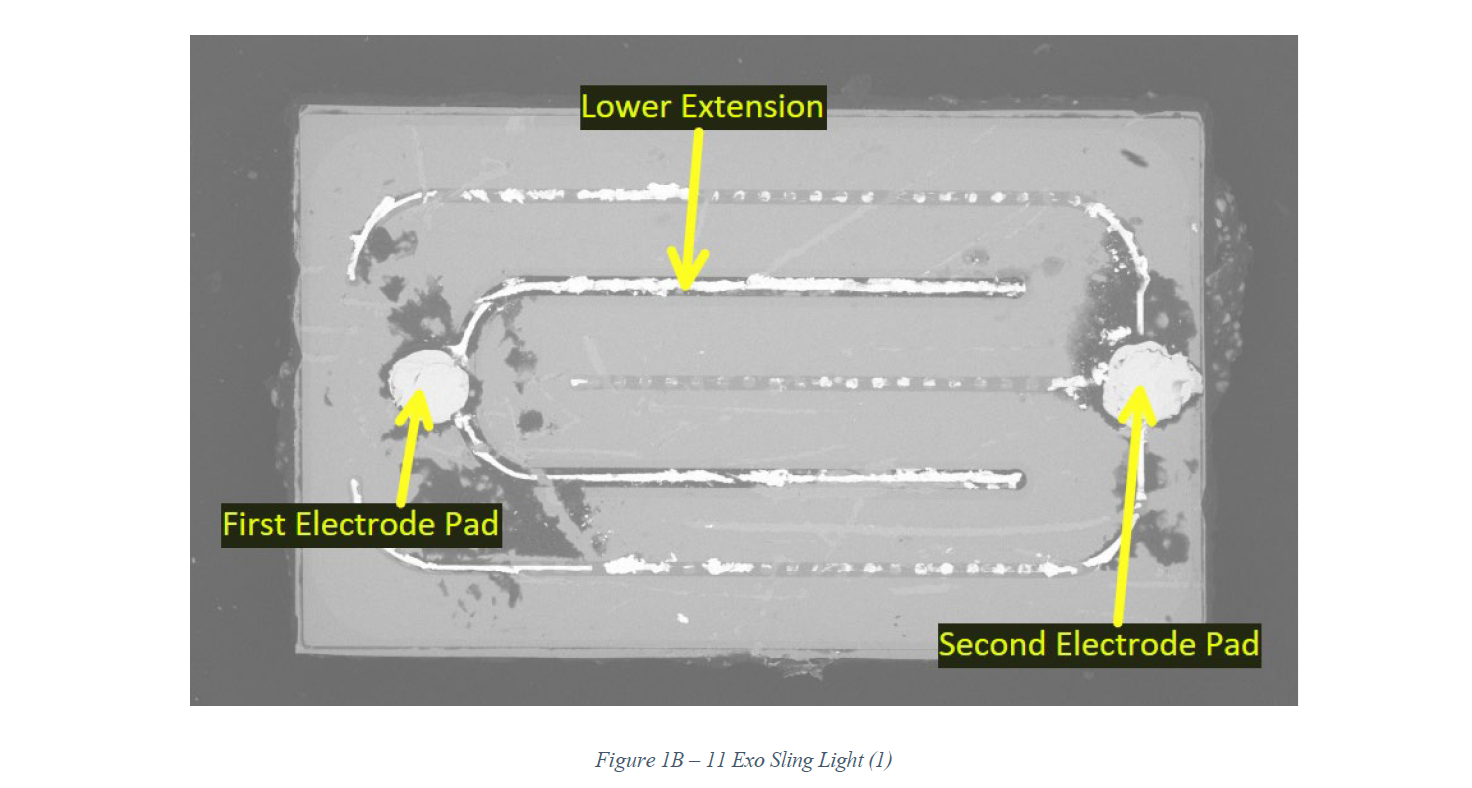
What sets this complaint apart: SemiLED didn't just cite patent numbers. It appears to have bought the products, cut the LED packages open, and photographed them under scanning electron microscopes, mapping cross-sections and elemental analysis directly onto individual patent claims. SemiLED says it approached Current about licensing before filing, positioning the case for a willfulness argument and a shot at attorneys' fees. Whether SemiLED counts as an operating company or a licensing entity trading on legacy patents is a fair question.
For now, this is one to file under "component-level patent disputes worth tracking," not one that changes anything on the fixture schedule or jobsite.

3. Signify China Chief Details Inflection Point
As reported by China Light Media, an interview with Yin Kang, CEO of Signify Greater China, offers the fullest public breakdown yet of how the company's recently announced Build-and-Harvest strategy will run in China.
Kang describes connected lighting as nearing an inflection point, noting professional installed-base penetration still sits at just 10 to 15 percent even as connected products now generate over 40 percent of Signify's professional sales. China ranks among 35 core countries in the global plan, with priorities including consumer smart lighting tailored to local tastes, AI-driven maintenance for professional installations, and smart city projects that lean on system integration and service capabilities.
"Made in China, for China, then radiating worldwide." China-based Signify management describes its innovation model there.https://t.co/qlBR5P88cL
— Inside Lighting (@InsLighting) August 1, 2026
Kang frames China as more than a sales market: R&D there reportedly develops innovations for local conditions first, then exports them globally, a model he calls "Made in China, for China, then radiating worldwide." One concrete example cited is an Interact City Flex deployment using Signify's GenAI lighting agent in Dalian's High-Tech Zone street lighting project.
For a company managing slower legacy categories alongside growth bets, the interview reads as a case study in where Signify's Asian leadership team thinks the next decade of demand actually lives.
4. Weapons of Mass Illumination
As reported by TVC News, security operations in Nigeria's North-East and North-West have reportedly uncovered evidence that insurgents and armed bandit groups are dismantling solar street light components, including batteries and wiring, for use in improvised explosive devices.
Batteries, wiring, electronics from solar streetlights ... durable, portable, and apparently attractive to insurgent groups building explosive devices.https://t.co/zbokhHZjv2
— Inside Lighting (@InsLighting) August 1, 2026
The Kareto-Ngetra corridor in Borno State has emerged as a particular concern, alongside routes in Zamfara and Katsina states that have already seen repeated IED incidents. Security analysts frame the shift as a matter of resourcefulness: durable, portable solar components offer insurgents a readily available substitute for conventional materials.
For an industry that has pushed solar street lighting as a way to extend infrastructure and safety into remote or underserved regions, the report is a reminder that public lighting assets carry exposure well beyond the usual vandalism and theft concerns already familiar to installers in conflict-adjacent areas.
5. Amber LEDs Cut Insect Attraction At Rail Stations
As published in Biological Conservation, a two-year field study at six German railway stations found that amber 1800 K LEDs attracted significantly fewer flying insects than either high-pressure sodium or cool white 4000 K LED lighting.
Researchers used AI image analysis and DNA metabarcoding to track insect abundance, biomass and species richness under real operating conditions, including threatened and legally protected species. The amber LEDs cut insect abundance by roughly 40 to 50 percent and biomass by over 50 percent compared to the other two light sources, likely due to their narrow spectral output and lack of blue wavelengths.
Notably, HPS and 4000 K LED performed about the same, suggesting CCT alone doesn't determine insect attraction. All six stations have since switched to the 1800 K amber lighting based on the findings. For specifiers working near protected habitats or dark-sky zones, this is a concrete data point on spectral tuning as a mitigation tool, not just a theoretical one.