


February 4, 2026
Signify Mulls Divestiture. What’s Actually on the Table?
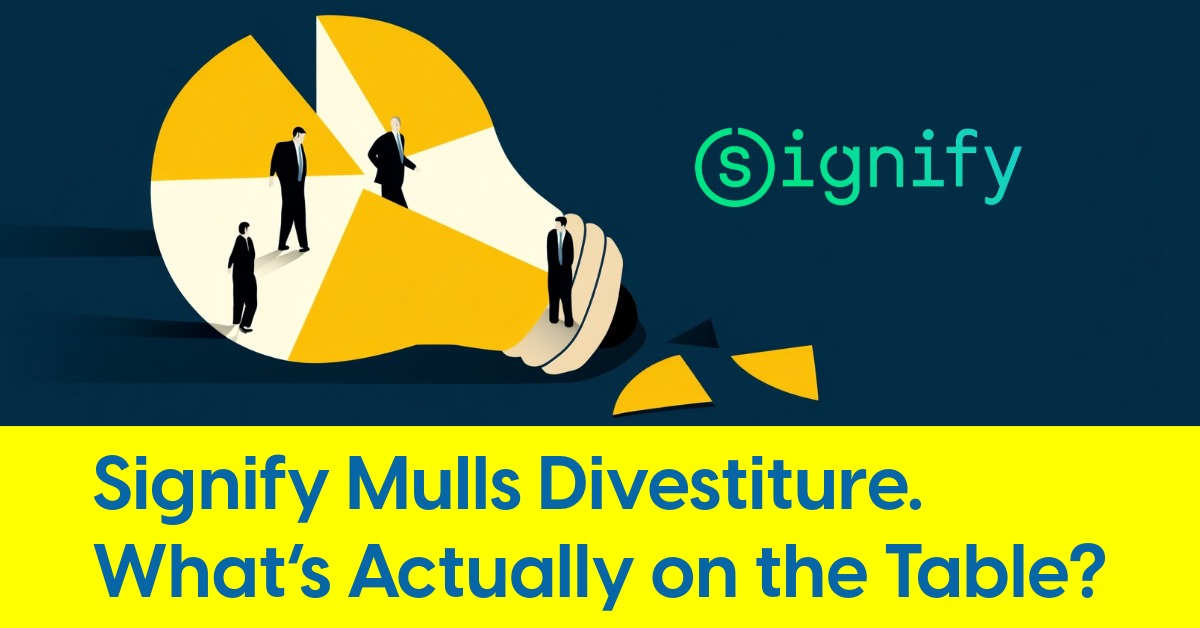
CEO confirms that parts of world’s largest lighting company are under review
When Signify reported its 2025 earnings on Friday, most eyes focused on the declining financial results, the €180 million ($214 million) cost-cutting program, and the 900 jobs it would eliminate. But tucked into the earnings call was a more structural signal: CEO As Tempelman confirmed the company is actively reviewing its portfolio and weighing parts of the business “for harvesting or divestment.”
That review is already in motion. The public reveal comes June 23, 2026, at Signify’s Capital Markets Day. Between now and then, behind glass conference room walls in Eindhoven, the world’s largest lighting company is steadily reshaping its future.
“We are making good progress on the strategy and the portfolio review. And I would like to emphasize that I'm confident about the choices we will be making to focus the company and to grow value in the future.”
“We will provide clarity at the Capital Markets Day in June about where we want to invest and grow and what are the parts of the business that we see more for harvesting or divestment. This will be completed in the coming month.”
— As Tempelman, CEO, Signify
Signify Isn’t One Company. It’s 158.
Signify’s business isn’t arranged in four neat boxes that simply mimic its business units: Professional, Consumer, OEM and Conventional. It’s a network of 158 legal entities spanning 72 countries, including 29 subsidiaries in North America alone.
| United States | Canada | Mexico |
|---|---|---|
| Cooper Lighting, LLC Peachtree City, Georgia |
Cooper Lighting Canada Limited Markham, Ontario |
Componentes de Iluminacion, S. de R.L. de C.V. Juarez, Chihuahua |
| Fluence Bioengineering, Inc Austin, Texas |
Signify Canada Holding Ltd. Markham, Ontario |
Cooper Lighting de Mexico, S. de R.L. de C.V. Cienega de Flores, Nuevo Leon |
| Genlyte Thomas Group LLC Bridgewater, New Jersey |
Signify Canada Ltd. Markham, Ontario |
Cooper Mexico Distribucion, S. de R.L. de C.V. Pedro Garza García, Nuevo Leon |
| GTG Holding, LLC Bridgewater, New Jersey |
Iluminacion Cooper de las Californias, S. de R.L. de C.V. Mexicali, Baja California |
|
| ILC Intelligent Lighting Controls Minneapolis, Minnesota |
Lightolier de Mexico, S.A. de C.V. Camargo, Chihuahua |
|
| Illumination Management Solutions, Inc. Cleveland, Ohio |
Lumisistemas de México, S.A. de C.V. Huixquilucan, Estado de México |
|
| Klite Lighting US, Inc. Wilmington, Delaware |
Signify Electronics México, S.A. de C.V. Tijuana, Baja California |
|
| MLI NA Corporation Delaware, Delaware |
Signify Holding México, S.A. de C.V. Huixquilucan, Estado de México |
|
| Once Innovations, Inc. Plymouth, Minnesota |
Signify Luminarias México, S.A. de C.V. Apodaca, Nuevo León |
|
| Signify North America Corporation Bridgewater, New Jersey |
Signify Mexico S.A. de C.V. Huixquilucan, Estado de México |
|
| Strand Lighting, LLC Dallas, Texas |
Signify Real Estate Services Mexico, S.A. de C.V. Huixquilucan, estado de México |
|
| The Genlyte Group Incorporated Bridgewater, New Jersey |
||
| Translite Sonoma, LLC Bridgewater, New Jersey |
||
| Vari-Lite, LLC Dallas, Texas |
||
| Yort Inc. Bridgewater, New Jersey |
List of all Signify subsidiaries globally »
Some of these are standalone operations with dedicated R&D, manufacturing or sales teams. Others are holding companies, dormant entities, or single-purpose vehicles created for tax compliance or regional access. Many are legacy structures from past acquisitions, including Genlyte Thomas and Cooper Lighting. What this sprawling footprint provides is flexibility — Signify could exit underperforming regions without gutting global operations. But it also creates friction: any divestiture must navigate a maze that sometimes involves cross-border contracts, global product teams and joint ventures.

What Strategic Moves Make Sense?
CEO Tempelman has framed the portfolio review as a strategy for value creation, not crisis response. The goal isn’t just to trim fat; it’s to decide which parts of the company belong in its future and which parts don’t.
Unlikely to be divested: The U.S. market. It delivered "strong topline performance" in 2025, represents about a third of global sales, and aligns with Signify's connected lighting thesis. Modest growth is forecasted for 2026. North American lighting people may notice some changes, but this isn't the market Tempelman came to dismantle.
Conventional lamps business remains a paradox — highly profitable, yet designed to shrink. In 2025, the business delivered €327 million ($389 million) in sales with a 16.1% EBITA margin, despite a 23% year-over-year decline. At some point, the margins on legacy fluorescent, HID and specialty lamps may no longer justify the operational drag. The question is: when do you stop harvesting and turn out the lights?
Consumer is the most brand-visible, but also the most exposed. The unit generated over €1.2 billion in sales last year, powered by Philips Hue, Wiz and retail LED lines — but it faces constant pressure from low-cost competitors. As Inside Lighting noted in 2025, narrowing Signify’s focus to commercial markets could sharpen execution. Spinning off Consumer would be significant — and would likely require either a sizable lead buyer or a string of smaller deals.
Regional carve-outs could be a contender. Signify’s tax filings identify dormant or low-activity markets — like Brunei, Latvia and Kazakhstan — where winding down or shifting to distributor-only models could reduce complexity with minimal disruption.
Product or brand exits could also on the table. While the company now operates independently, it was forged in the fires of divestiture when Royal Philips systematically carved out its empire — spinning off automotive, selling Lumileds, and decoupling Signify itself. So as the company assesses its current portfolio, any areas that don’t align with connected systems, energy efficiency mandates, or digital services could possibly be divested, sunsetted or licensed out.
Manufacturing consolidation is also a consideration. The company operates 41 plants worldwide, yet its filings and earnings reports acknowledge a shift toward contract manufacturing. Some sites — especially smaller, aging, or regionally redundant ones — may be closed or sold off as part of a more asset-light future. One recent example close to home: Signify’s longtime outdoor lighting plant in San Marcos, Texas was shut down as part of its 2024 restructuring plan.
However, Signify’s joint venture manufacturing footprint adds a layer of complexity. Beyond wholly owned facilities, Signify holds multiple JV stakes in key markets — including:
- Klite (China): A 51% stake in a manufacturer that supplies Philips-branded products and produces for outside brands like IKEA.
- Feihui and Ningbo Signify: Additional China-based entities with partial ownership structures.
- Signify-Dixon (India): A new JV formed with Dixon Technologies in 2025 that absorbed Signify’s LED manufacturing in India and intends to serve third-party OEMs.
These aren’t arms-length arrangements — they’re structurally embedded. Exiting or restructuring them would involve regulatory hurdles, joint governance, and in some cases, shared customer bases. The Klite model, in particular, reflects how these JVs are designed not only to manufacture for Signify but also to pursue broader market share — making divestiture stickier than a simple asset sale.
Fragmentation Is the Precedent
Signify’s scale and reach means that if a major divestiture occurs, it’s unlikely to happen as a single, clean transaction. Just look at Osram’s exit from general lighting — seven different buyers ended up with pieces of the business.
Signify, with 158 legal entities and a portfolio spanning Professional, Consumer, OEM, and Conventional lighting, could easily follow a similar path. A divestiture might include a cluster of underperforming regional subsidiaries, an OEM manufacturing footprint, and a line of legacy SKUs — all sold separately, to different types of buyers.
The Buyer Pool Is Uncertain
A few years ago, private equity firms were aggressively acquiring lighting assets. But PE acquisition activity has cooled over the past year in the lighting sector. Interest rates, tighter credit, and more cautious investors have slowed momentum.
Likely strategic buyers might not be global peers like Signify, but regional lighting groups that have historically grown through bolt-on acquisitions — particularly in Europe and Asia. Companies that operate in this mode include Fagerhult Group in Europe and MLS in Asia — firms that have expanded by absorbing brands, factories, and distribution networks rather than pursuing mega-mergers. Any such interest, however, would likely focus on selective assets such as regional subsidiaries, brand rights, or manufacturing footprints rather than full operating divisions.
It’s also unclear how much dry powder strategic acquirers — other lighting manufacturers — actually have, or whether they’re willing to spend it on fragmented legacy assets. Some regional players may see opportunity in acquiring brand rights or local manufacturing capacity. Others may not want the operational drag.
In short, the assets may be available. But that doesn’t guarantee a long line of bidders.
A Year of Transition, A Moment of Decision
This is not the first time Signify has reorganized. But it may be the first time its leadership is explicitly signaling that focus — not footprint — is the priority. The company has long competed across nearly every lighting category, in nearly every global region. Now, it appears poised to define where it can lead, and where it no longer needs to follow.
Divestiture here doesn’t signal weakness. It signals strategic intent. But how far that intent extends — whether it means slicing off underperforming markets, reshaping the manufacturing footprint, or letting go of legacy business lines — remains to be seen.
Tempelman has committed to clarity on June 23. That date won't mark the start of action — it will mark the end of ambiguity. What emerges may not just be a slimmer Signify, but also a sharper one.