


March 14, 2026
5 Things to Know: March 14
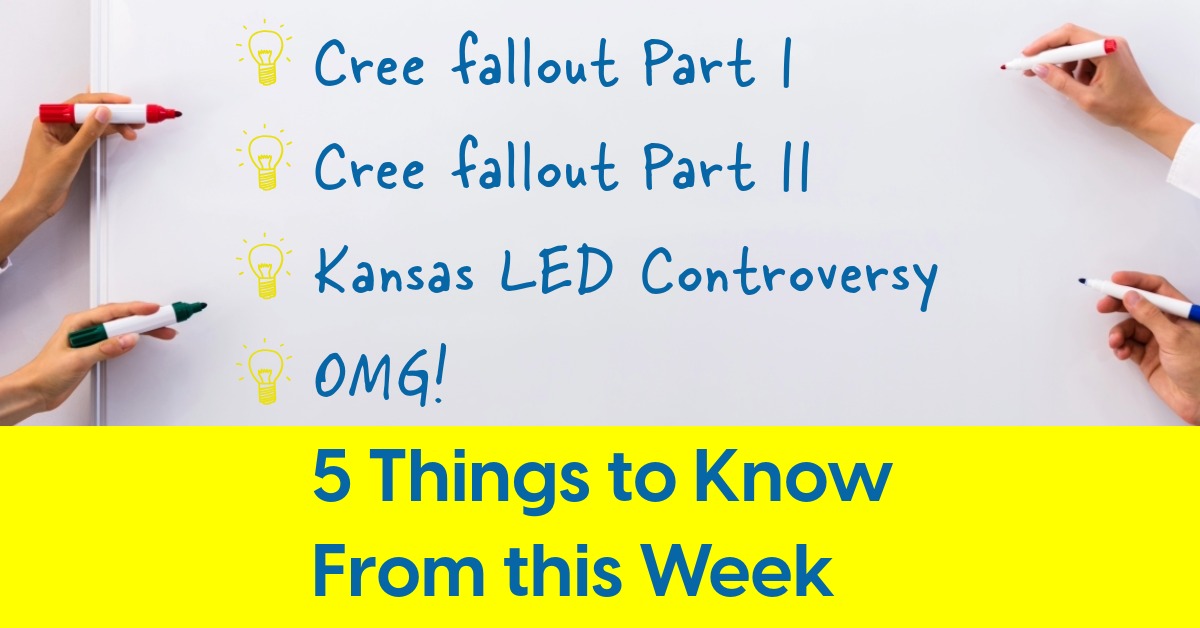
Cree Lighting’s layoff notice sparks next-order effects. Plus, LED controversy develops as March’s biggest sporting event approaches.
Here's a roundup of some of the week's happenings curated to help lighting people stay informed.
1. Cree Lighting fallout Part I
When news breaks involving a large group of potential victims, plaintiff-side law firms often move with remarkable speed. Press releases and blog posts announcing “investigations” into possible claims have become a familiar first step in areas such as product liability, investor fraud, labor violations, data breaches, and misleading advertising. The formula is simple: identify a triggering event, signal potential legal exposure, and invite affected parties to get in touch.
This week, the pattern played out in the lighting industry as one law firm wasted little time entering the Cree Lighting fray.
On Thursday, March 12, Cree Lighting filed a notice with Wisconsin officials confirming the shutdown of its Racine manufacturing operation and the elimination of 172 jobs. The filing acknowledged the company did not provide the typical 60 days advance notice required under the federal Worker Adjustment and Retraining Notification (WARN) Act, instead citing the law’s “faltering company” exception.
As Inside Lighting previously noted, that exception allows companies to bypass the standard notice requirement if they were actively seeking capital that might have prevented the shutdown. It is also the detail that appears to have caught the attention of plaintiff-side attorneys.
By Friday, a Chicago-based class action firm, Strauss Borrelli PLLC, had already launched a public investigation.
In a release posted less than a day after the filing, the firm said it is examining whether Cree Lighting violated the WARN Act and whether laid-off workers could be entitled to 60 days of back pay and benefits.
2. Cree Lighting fallout Part II
In the world of business websites, things occasionally break. Security certificates expire. Browsers throw up ominous warnings. Usually someone at the company notices quickly and fixes the issue before too many customers see it.
But the timing here is… interesting.
On Thursday, Cree Lighting announced the immediate elimination of 172 jobs.
By Saturday, as of press time, the company’s website had been blocked for several hours, displaying the familiar browser warning: “Your connection is not private.”
Two days after Cree Lighting announced layoffs, five company web domains have been blocked for several hours due to security issues.
— Inside Lighting (@InsLighting) March 14, 2026
• creelighting.com
• creelighting-canada.com
• creeltg.co
• creesolutions.com
• creebulb.com pic.twitter.com/Iv9Rfa09mU
This occurred on Chrome, Edge and Firefox using multiple IP addresses. Modern browsers block access to sites with this kind of security problem, even when the underlying issue is routine. The question isn’t necessarily sabotage. These things happen. But this also happened to five Cree-owned web domains:
- creelighting.com
- creelighting-canada.com
- creeltg.co
- creesolutions.com
- creebulb.com
The layoff notice does raise an interesting detail. Among the positions eliminated was one “Systems Programmer,” a role that might plausibly include responsibility for maintaining something like the company website.
If that’s the case, it may mean someone less technical among the smaller group of employees still remaining in Racine now has to jump in and fix the issue.

3. Kansas LED lighting controversy
Innovation met friction this week at the Big 12 Tournament in Kansas City.
The conference debuted a high-tech LED glass basketball court designed to display graphics, statistics, and other visuals in real time. For lighting and display technology fans, it was a glimpse of what dynamic surfaces might look like in the future.
Players, however, had a different reaction.
After multiple complaints about slipping and inconsistent grip, the Big 12 announced it would abandon the LED court and return to a traditional hardwood surface for the tournament’s semifinal and championship games. Commissioner Brett Yormark said the change was made after consulting with coaches to ensure players felt comfortable on the national stage.
The experiment showed what programmable lighting and display technology can do.
It also revealed something equally important: athletes still care a lot about traction as teams compete for a change to participate in the upcoming 2026 NCAA Division I Men’s Basketball Tournament.
4. Lighting adds to “Philly Phactor”
Frequent flyers on American Airlines, and before that U.S. Airways, know a particular truth about connecting through Philadelphia on a Friday afternoon. Delays are almost a certainty. Some flight attendants even have a nickname for the phenomenon: the “Philly Phactor.”
This week, the airport delivered a fresh case study.
On Friday afternoon, arriving flights at Philadelphia International Airport were halted after a lighting issue on one of the runways triggered a ground stop. According to reports from the Philadelphia Inquirer and NBC10 Philadelphia, the disruption stemmed from a lighting problem that affected portions of the runway for arriving flights.
Flights arriving in Philly are caught in a ground delay of over 100 minutes as crews work to fix a lighting issue on one of the runways. https://t.co/GlW7BA39Ue
— NBC10 Philadelphia (@NBCPhiladelphia) March 13, 2026
The ground stop was eventually lifted, but the damage was done. Arrival delays stretched past 100 minutes while departures continued largely unaffected.
And for anyone keeping score in the long-running tradition of the Philly Phactor, this time one of the key ingredients was lighting, tragically leaving some connecting travelers without enough time to grab an Auntie Anne's pretzel.
5. IES Promotes New Standards
While several staffers from the Illuminating Engineering Society were manning the booth at Light + Building 2026 in Frankfurt, the organization was simultaneously promoting a flurry of newly updated lighting standards back home.
The message: even while the global lighting industry gathers to look at the future, the technical rulebook keeps evolving.
Here is the latest batch the IES is promoting:
- ANSI/IES LP-30-26 — A comprehensive guide to specifying color rendition, explaining how designers apply TM-30 metrics through each project phase, from schematic design through construction administration.
- ANSI/IES RP-28-25 — A recommended practice focused on lighting for older adults and the visually impaired, emphasizing how design choices affect safety, independence, and visual comfort.
- ANSI/IES LS-8-25 — A lighting science overview covering perception and performance topics such as brightness, glare, flicker, visibility, and illuminance.
- ANSI/IES LP-9-25 — Updated guidance for upgrading nonresidential lighting systems, addressing LEDs, controls, maintenance, and economic performance.