


January 13, 2026
U.S. Unplugs From Climate Bodies, LEED Holds Firm
Global climate accords fray at the federal level, but green benchmarks stay aligned
With a stroke of a pen on January 7, the White House set in motion the U.S. exit from 66 international policy organizations. Climate and energy bodies were heavily targeted, but the withdrawals also swept across human rights, economic development, environmental conservation, security, and natural resources — a wholesale retreat from multilateral cooperation.
Among the 35 non-UN and 31 UN entities targeted in the sweeping withdrawal were three with direct and long-standing relevance to the built environment: the Intergovernmental Panel on Climate Change (IPCC), the UN Framework Convention on Climate Change (UNFCCC), and the International Renewable Energy Agency (IRENA). The exits signal a shift in federal posture — but not necessarily in industry momentum.

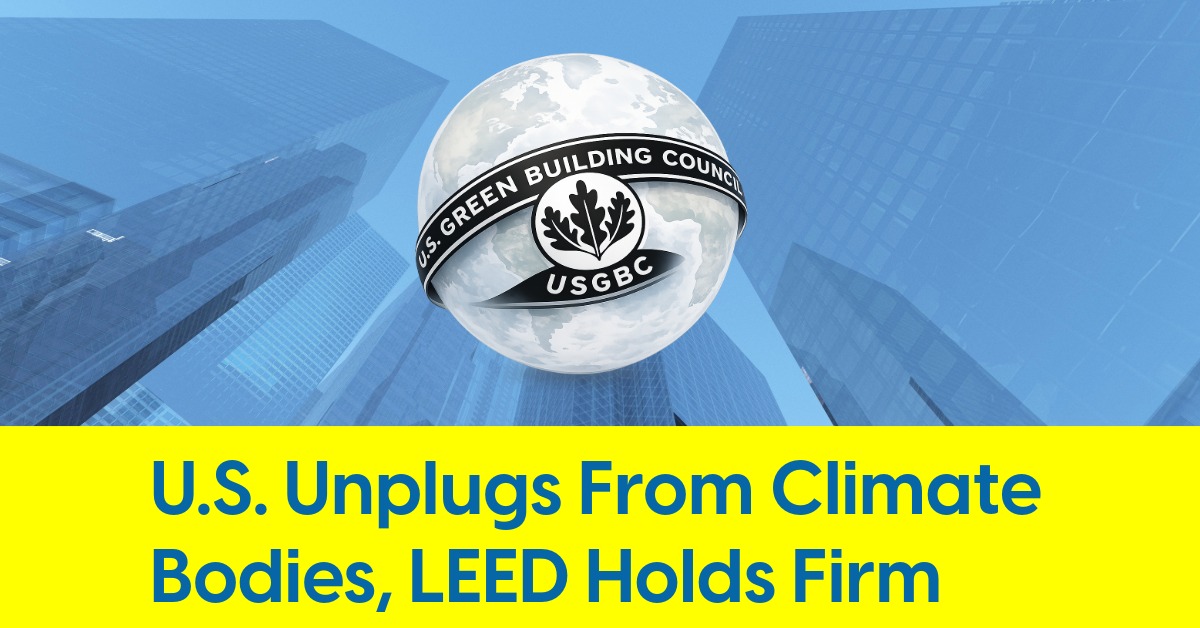
The U.S. Green Building Council (USGBC) was not among the organizations listed in the administration’s memorandum — for good reason. As a nonprofit, non-governmental entity, USGBC was never a party to the treaties or intergovernmental bodies named in the withdrawal. Still, its role in shaping global green building policy remains influential, and its response to the White House’s move was swift and deliberate.
“We remain committed to our mission and to the power of international collaboration to address climate change,” the organization stated. “The need for leadership from all sectors — especially the building sector — has never been more urgent.”
Decoupling Doesn’t Mean Disengagement
While the U.S. government’s withdrawal severs ties with climate science and policy networks, most of which have shaped global standards for building emissions and performance, private and nonprofit actors in the building space are already moving to fill the gap. USGBC, for example, has signaled that it will continue to participate in COP summits and other international working groups focused on sustainable development. Its flagship LEED certification remains anchored in data from the very institutions the U.S. has now left.
For lighting people, energy consultants, and project developers, the implications are clear: LEED's benchmarks for energy efficiency, lighting quality, and carbon emissions aren't changing. If anything, the voluntary standards may draw more weight as federal guidance retreats. The loss of U.S. involvement in global research forums may limit data-sharing at the policy level, but on the ground, designers and specifiers still rely on LEED and similar frameworks to meet client expectations and local mandates.
Green Pastures Ahead?
Lighting remains central to LEED’s point system, from daylighting credits to controls and power density thresholds. These expectations are already aligned with many international decarbonization strategies — and that alignment is likely to deepen as USGBC sustains its presence in global policy conversations. For firms marketing lighting systems or working to achieve LEED certification, the message is steady: high efficacy, smart integration, and sustainability-forward design are still the rule.
Despite diplomatic turns in Washington, the industry’s center of gravity remains local, technical, and increasingly global in scope.