



February 17, 2026
Global Guidelines Confront Premature Fixture Waste
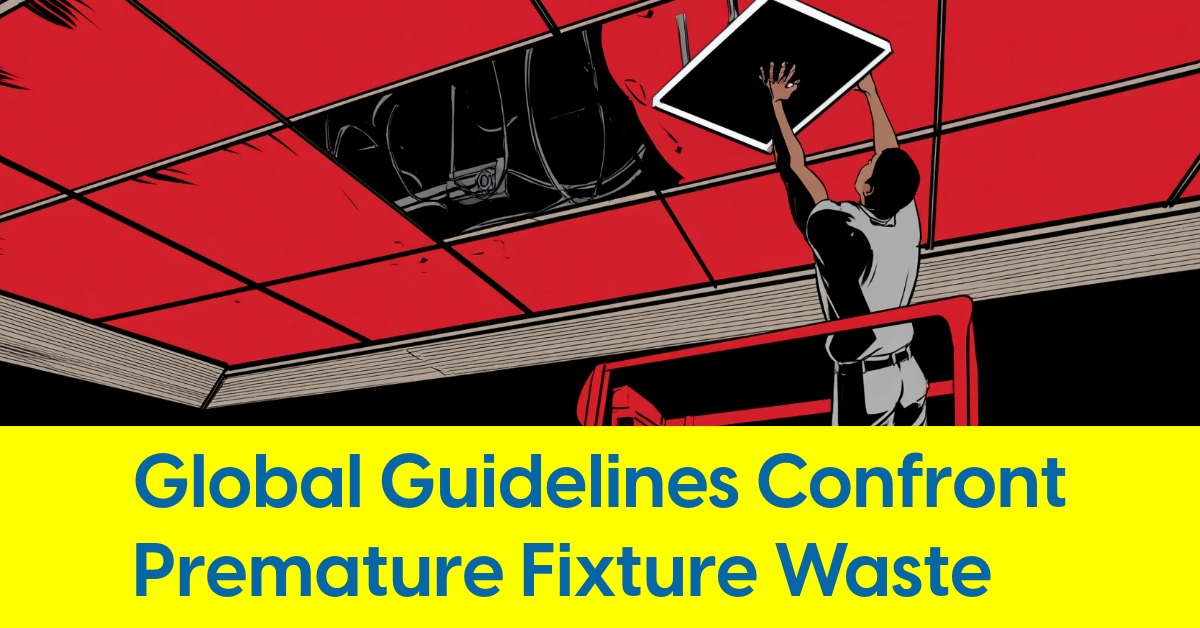
Framework promotes modular luminaires with accessible, replaceable components
The lighting industry solved one problem and created another.
We traded fluorescent lamps and standardized sockets for integrated LED modules, digital drivers, and beautifully engineered luminaires that promised 50,000 hours of life. And in many cases, we delivered. Energy use dropped. Controls improved. Maintenance intervals stretched.
But when those drivers fail at year 5 or 7 or 9, when an LED board faults or a lens assembly loosens, we are not swapping a T8 lamp or a prismatic lens. We are rolling a lift and replacing an entire fixture. Perfectly good housings, optics, and sheet metal head to landfill because one non-serviceable component expired.
The Australia-based Global Lighting Association’s recently published “Guidelines for Repairability of Luminaires” confronts this reality head-on . Rather than mandate a one-size-fits-all solution, the document lays out a best-practice framework for extending luminaire life while navigating safety codes, certification regimes, and real-world economic constraints.

At Lightfair 2025, during our 5 Big Questions interview, Anne Kustner, Principal of AKLD described what many designers are now experiencing. “Manufacturers haven’t always thought that things needed to be maintained. They lived as if LEDs would last forever,” she told us. “We’ve had projects we designed a number of years ago that are now failing. We don’t want to throw them away after seven years.”
Seven years. In a 30-, 40-, or 60-year facility, that is barely the first act.
A Best-Practice Framework
The GLA document outlines a set of practical recommendations intended to guide manufacturers and specifiers toward more serviceable luminaire design and support practices.
- Modular Design
Luminaires should be engineered so LED modules, drivers, and optical elements can be accessed and replaced independently without damaging the housing or requiring destructive disassembly. The GLA emphasizes true modular construction, avoiding permanently sealed or glued assemblies that make component-level service impractical. - Standardized Connectors
Common electrical and mechanical interfaces simplify driver and light engine replacement, reduce field errors, and lower downtime. When connectors and mounting schemes are predictable and documented, replacement becomes a controlled process rather than a custom workaround. - Spare Parts Availability
Repairability depends on sustained access to LED modules, control gear, connectors, and other critical components. The GLA stresses that spare parts must remain available for a reasonable period, because even a well-designed luminaire becomes disposable if replacement components vanish from distribution channels. - Clear Documentation
Detailed specifications, part numbers, compatibility guidance, and step-by-step instructions are essential to prevent unsafe substitutions and warranty-voiding repairs. Documentation should align with the technician’s skill level and include programming guidance for networked or tunable systems, ensuring that replaced components are properly configured. - Repair Testing Concepts
The guidelines recommend simulating common failure scenarios to evaluate disassembly steps, tool requirements, and reassembly integrity. Structured repair assessments help identify design friction points before products reach the field, improving serviceability and safety. - Safety And Certification Awareness
In some regions, luminaire repair beyond simple component replacement is restricted or requires recertification. The GLA cautions that repair strategies must align with electrical codes, thermal safety standards, and certification frameworks to preserve compliance and liability protection. - Waste Minimization Strategies
Durable materials, reduced hazardous substances, and clear end-of-life instructions for replaced components support environmental goals. In markets with take-back programs, repairability can be integrated with structured recycling pathways to reduce landfill impact.
What the GLA outlines is not an aesthetic trend. It is an operational recalibration.
Kustner framed it plainly at Lightfair: “We have to educate the industry and solve this together.” She pointed to the need for accessible drivers, replaceable LED boards, and clearer specification language so that maintainability becomes intentional, not accidental.
For specifiers, this means asking direct questions during submittal review: Are drivers field-accessible? Are LED boards mechanically fastened? Are replacement part numbers embedded in fixture QR code labels? For manufacturers, it means backing lifecycle claims with documented service pathways and sustained parts support.
Efficiency was the headline of the LED revolution. Will maintainability be its second chapter?
If we continue treating luminaires as semi-consumables in buildings designed to last generations, the landfill math becomes harder to justify. The GLA’s framework does not resolve every tension between cost, code, and design freedom. But it signals that the industry is beginning to confront the seven-year fixture problem with something more substantial than good intentions.