


February 20, 2026
Legal Blow To Tariffs, Trade Uncertainty Remains
Lighting supply chains brace for more uncertainty and another reset
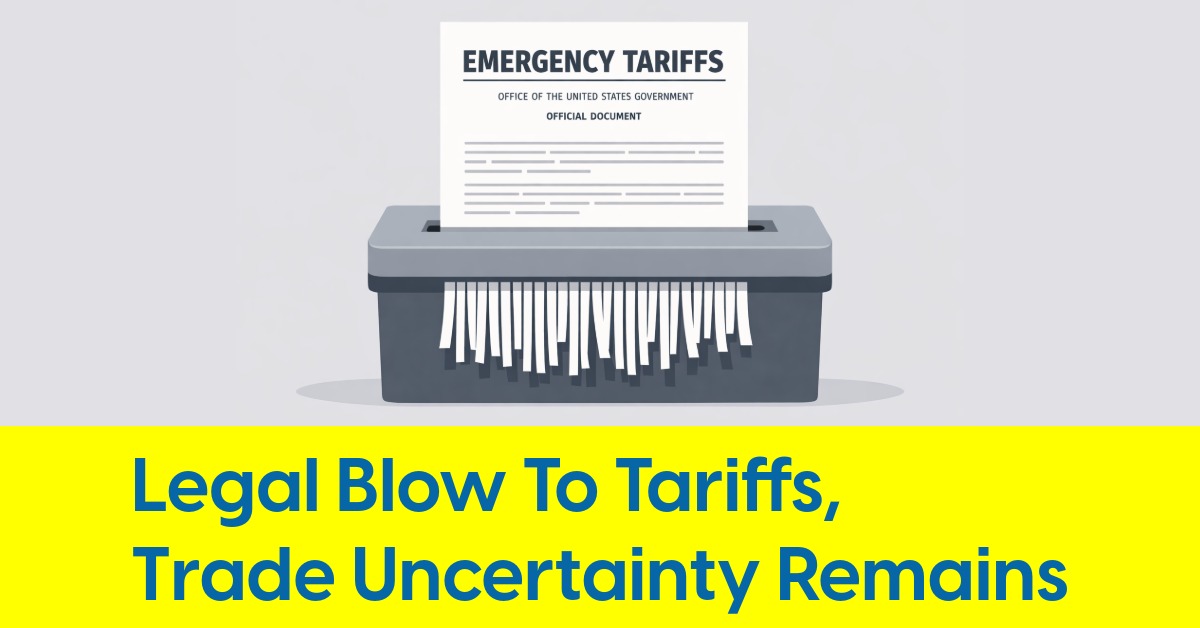
In a decision that landed like an inrush current across a lighting circuit, the U.S. Supreme Court on Friday struck down the President’s use of emergency powers to impose sweeping tariffs under the 1977 International Emergency Economic Powers Act.
The 6–3 ruling in Learning Resources, Inc. v. Trump removes one powerful tool from the White House trade toolbox. It does not remove tariffs from the table.
President Trump is widely expected to pursue alternative statutory levers — including Sections 301, 232, or 122 — to replicate or rebuild portions of the tariff regime through more procedurally grounded pathways. For lighting importers, that distinction matters legally. It may matter far less operationally.
Writing for the Court, Chief Justice John Roberts made clear that Article I places the power to impose “Taxes, Duties, Imposts and Excises” squarely in Congress’s hands. The President, he wrote, cannot unilaterally transform IEEPA’s authority to “regulate … importation” into an open-ended tariff machine.
The Court’s message was surgical but sweeping: emergency authority is not a blank check. Invoking the “major questions doctrine,” the majority concluded that if Congress intended to delegate tariff power of unlimited scope, amount, and duration, it would have said so clearly.
It did not.

What Was Struck Down
At their peak, effective tariff rates on many Chinese goods reached 145%
Lighting companies felt that volatility acutely. Fixture assemblies moved from China to Vietnam and Cambodia. Drivers rerouted through Mexico. Price lists were rewritten — sometimes monthly. Sourcing strategies hardened into what executives hoped were durable pivots.
The Court has now invalidated the legal foundation of those IEEPA tariffs. But it has not invalidated tariffs as a policy tool.
Immediate Questions for Importers
The operational implications are not theoretical.
If IEEPA tariffs are vacated, importers may face a tangle of compliance issues:
- Are duties already paid subject to refund?
- If so, are customers who were charged a "Tariff" line item entitled to a refund?
- What happens to Harmonized Tariff Schedule modifications already implemented?
- Do pricing sheets revert, or remain frozen pending clarity?
For lighting distributors and manufacturers who absorbed triple-digit effective rates on Chinese imports, even the administrative unwind could be disruptive.
The Pivot: From Emergency Power to Procedural Power
The Court did not declare tariffs unconstitutional. It declared this mechanism unconstitutional.
That distinction is everything.
The administration retains alternative statutory levers, previewed during last year’s litigation:
- Section 122 of the Trade Act of 1974: up to 15% tariffs for 150 days without congressional approval.
- Section 301 investigations: slower, but expansive authority tied to unfair trade practices.
- Section 232 national security tariffs: previously used for steel and aluminum.
- Section 338 of the 1930 Trade Act: an obscure, potentially aggressive tool.
Each carries procedural prerequisites — investigations, findings, public input. None offers the instantaneous flexibility IEEPA provided.
For the lighting sector, the most plausible next arenas are Section 301 (particularly for China-linked IP or supply chain issues) and Section 232, where arguments about critical infrastructure and national resilience could surface.
Acuity's Recent Tariff Stance
One of the more candid moments of Acuity's January 8 earnings call came in response to a question about possible tariff price reductions if the Supreme Court revisits Section 301 tariffs.
CEO Neil Ashe offered an anecdote:
“If we were to somehow realize a benefit from the tariff, like a refund, who would we give it to? So as you push that down the slide... we would have to assume that, if we did, the distributor would give it to the contractor, and that the contractor would give it to the building owner. I just don’t think that seems reasonable.”
— Neil Ashe, CEO, Acuity, Inc.
Translation: Don’t expect price rollbacks.
With additional context, Ashe stressed that he was not making a legal prediction, but said Acuity’s working assumption is that the outcome would leave market conditions largely unchanged, even in the event of an adverse ruling.
Congress Re-Enters the Frame
One underappreciated element of the decision is structural. The Court reaffirmed that tariff power resides with Congress
That shifts the center of gravity.
Will Congress codify broader emergency trade authority? Tighten it? Fragment along party lines? For an industry fatigued by executive-driven volatility, the possibility of slower, legislatively anchored trade policy may be stabilizing — or gridlocking.
Not the End, But a Reset
Three months ago, Inside Lighting asked whether the lighting industry was heading back into choppy waters.
The answer now is yes. Just different waters.
The Supreme Court has clipped one branch of presidential tariff authority. But the pressure — geopolitical, economic, electoral — remains. Supply chains that moved to Vietnam may not move back. Price sheets that rose may not fall in lockstep.
The tool changed. The uncertainty did not.
For lighting executives, the playbook shifts from emergency response to statutory watchfulness. Section numbers — 301, 232, 122 — may soon matter as much as HTS codes.
The trade war did not end this morning.
It evolved.