


February 24, 2026
Fifty Shades of 5000K: And Daylight Still Wins
Building occupants felt better under real sky light, even unknowingly
At 10:00 in the morning, in a room with no windows and no view of the sky, the light feels… fine.
Bright enough. Neutral. Professional. The kind of evenly diffused illumination we design every day for classrooms, offices, and healthcare spaces. No glare. No drama. No distractions.
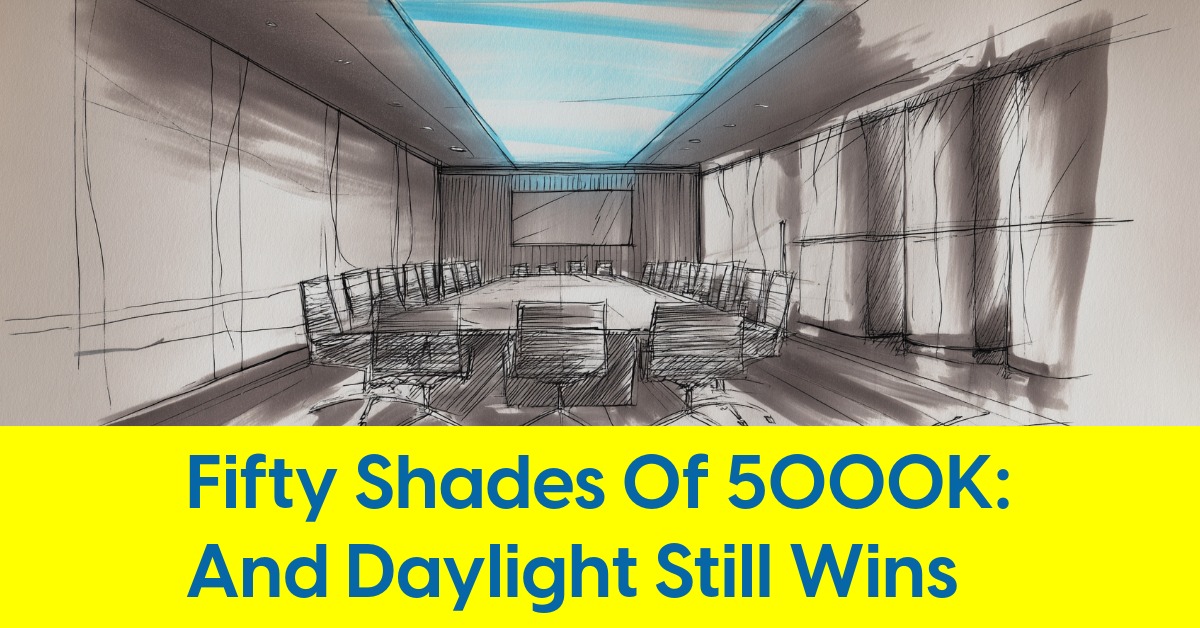
Now imagine that same room, same ceiling, same tasks. The only difference is this: sometimes the light filtering through the luminous plane is real daylight gathered from above. Other times, it is static 5000K LED light engineered to look convincingly similar.
The occupants cannot see outside. Most of them cannot tell which source they are under.
And yet, their mood improves when the light is real.

What the Study Actually Found
That is the central finding of Light and Perception: Study of the Effects of Daylight and Artificial Light on Affect, Mood, and Sleepiness Under a Sky-Lighting Machine recently published in Leukos. In a controlled experiment in Stockholm, researchers compared naturally variable daylight to static electric light in a space designed specifically to eliminate view as a factor. Both lighting conditions delivered strong daytime stimulus and met prevailing circadian-oriented guidance.
Only one consistently lifted mood.
Participants reported significantly higher mood and greater pleasure under daylight than under static LED light. Crucially, most did not realize when they were experiencing daylight. Many assumed it was artificial. The uplift, then, was not a conscious bias toward “natural light.” It appears to have been physiological or perceptual, operating beneath awareness.
The electric lighting was not poorly executed. It provided 500 to 700 lux and exceeded commonly referenced melanopic thresholds for daytime. By specification standards, it performed. But matching a metric did not replicate the emotional effect of the sky.
The Difference: A Living Light
What daylight brought into the room was variability. Intensity rose and fell. Spectrum shifted subtly as clouds moved and the sun’s position changed. The luminous environment was not frozen. It evolved over the two-hour sessions.
Within the daylight condition, higher personal light exposure correlated with better mood. The space, in a sense, had a pulse. The static LED system did not.
For designers and manufacturers, this is not a verdict against electric lighting. It is a challenge to the assumption of equivalence. If we reduce daylight to a color temperature and a target illuminance, we may be stripping away the very qualities that make it psychologically potent.
A Necessary Reality Check
There is also restraint in the findings. Task mattered. When participants shifted from quiet reading to a collaborative construction game, sleepiness dropped regardless of lighting condition. Engagement and social interaction had a stronger impact on alertness than whether the light was natural or electric.
Lighting influenced mood. It did not override the power of meaningful activity.
For those of us serving the commercial lighting market across the United States and Canada, the implication is nuanced but significant. If daylight improves mood even when occupants cannot see it, what exactly are we replicating with static overhead systems? Are we designing to satisfy a specification, or to support the human nervous system?
This study does not claim that tunable LEDs can fully reproduce the sky. It does suggest that daylight’s dynamic character may be part of its psychological edge. And if that is true, then designing for well-being may require more than hitting a number on a cut sheet. It may require designing for change.