


February 23, 2026
The Tariff Windfall: Who Owes Whom?
Tariffs moved fast. Refunds move slow. Price sheets almost never move backward.
The Supreme Court struck down the tariffs. But it did not strike down the invoices. Across the country, AP departments are now reopening old invoices and asking: do we get this back?
On Friday, the Court invalidated the President’s use of emergency powers under IEEPA to impose sweeping duties. What it did not address was the $150–$175 billion already collected.
In its ruling, the Supreme Court did not offer any guidance on the "equitable restitution" or refunding of the billions of dollars already collected. That silence is now the industry’s problem.
Estimates from the Penn Wharton Budget Model suggest refunds could reach $175 billion. The Budget Lab at Yale University pegs IEEPA collections around $142 billion in 2025 alone.
Justice Brett Kavanaugh, dissenting, warned the refund process could become a “mess.”
And the lighting supply chain is left with one uncomfortable question: If importers get their money back, is anyone else owed?
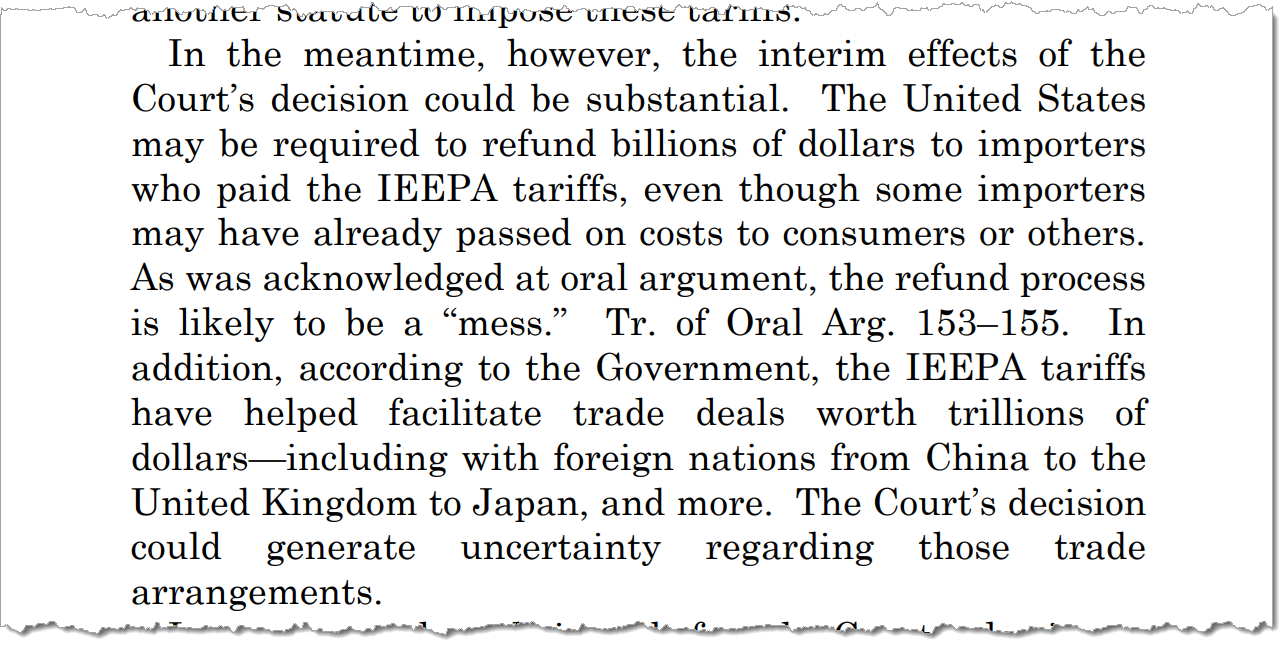
Above: Excerpt from Supreme Court's 170-page ruling
Costco, Toyota, Prada, Revlon, Ray-Ban and hundreds of other brands, from multinational companies to small business importers, have already moved to secure their claims, filing lawsuits in anticipation of precisely this outcome. Many were filed even before Friday’s ruling, a hedge against judicial uncertainty. Clearly, major importers are not waiting to see how Treasury interprets the opinion. They are positioning to be first in line if checks are written.

Scott Bessent’s Promise
Treasury Secretary Scott Bessent previously stated that if the tariffs were ruled unlawful, importers would receive refunds — even without prolonged litigation. He acknowledged the process could take months, possibly over a year, but the administration’s position was clear: the money would be returned.
That position has also been reinforced in court filings.
In a December 2025 ruling by the U.S. Court of International Trade, the government took what the judges called an “unequivocal position” that it would not oppose reliquidation and would refund duties found unlawful, with interest .
Put differently: Treasury has indicated it plans to cut the checks. The more consequential question is whether those refunds will ever be issued; and if they are, by what mechanism, on what timeline, and under whose scrutiny.
"They take months and months to write an opinion, and they don't even discuss that point. What happens to all the money we took in? It wasn't discussed…I guess it has to get litigated for the next two years.”
— U.S. President, Donald Trump
Two Scenarios for Lighting Companies:
1. The Explicit Tariff Surcharge
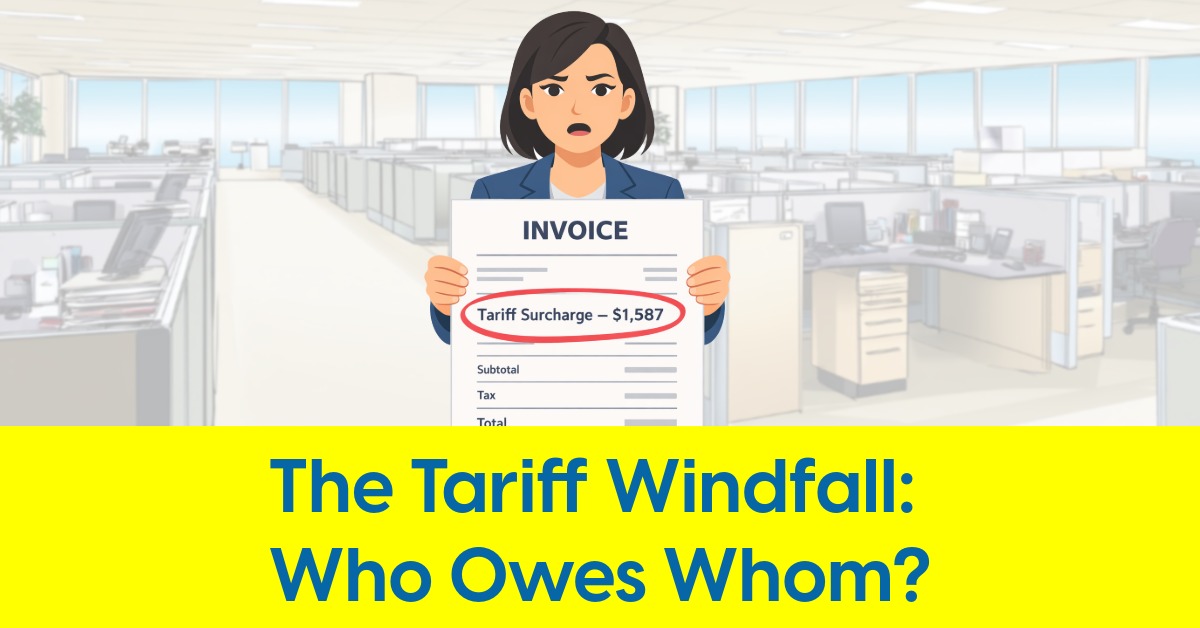
Over the last year, some manufacturers, distributors and contractors itemized it. “Tariff surcharge: $13,680.”
If that money is refunded to the importer, does the surcharge unwind? Is it contractually tethered to actual duty paid? Or was it simply a pricing mechanism during volatility?
Unless contracts explicitly promise retroactive reconciliation — and most lighting contracts do not — the obligation is murky.
Was it a pass-through? Or a price? The distinction matters now.
2. The Blended Price Increase
More common. Base pricing rose. No line item. No tariff label. Just a revised price sheet reflecting higher landed costs.
Once tariffs were folded into base pricing, they became indistinguishable from broader inflation, freight spikes, and supply-chain repositioning.
If refunds arrive, is anyone required to reduce those base prices retroactively?
Legally, probably not — absent specific contract language. Economically, only if competition forces it.
Tariffs move fast. Refunds move slow. Price sheets almost never move backward.
The Structural Reality
Lighting operates through layers: manufacturer to distributor to contractor to owner. Each layer applied margin to elevated costs.
If refunds reach importers months — or even years — after projects closed, the downstream unwind becomes nearly impossible. Contracts were written for price escalation. Not de-escalation.
The Court reset presidential authority. It did not reset the pricing architecture of the lighting industry.
And even as companies reopen last year’s invoices, a new clock is already ticking. Following the Court’s rebuke of the administration’s use of IEEPA, the White House has pivoted to Section 122 of the Trade Act of 1974, invoking a 15% surcharge set to take effect at 12:01 AM on February 24 and capped at 150 days unless Congress extends it.
In other words, the industry may soon be reconciling refunds from yesterday’s tariffs while calculating exposure to tomorrow’s. The law reset one mechanism. It did not end the cycle.