


January 21, 2026
Should Darkness Be a Legally Protected Natural Resource?
Citizen challenge targets lighting at 29 Connecticut courthouse buildings
In Connecticut, a solo lawsuit is probing an unconventional question: Can excessive outdoor lighting violate environmental law?
Leo Smith, a Suffield resident and longtime chair of the Connecticut Chapter of DarkSky International, filed suit in 2025 against the state's top judicial officials. He’s alleging that the Connecticut Judicial Branch is harming the environment — not with chemicals or noise, but with too much light.
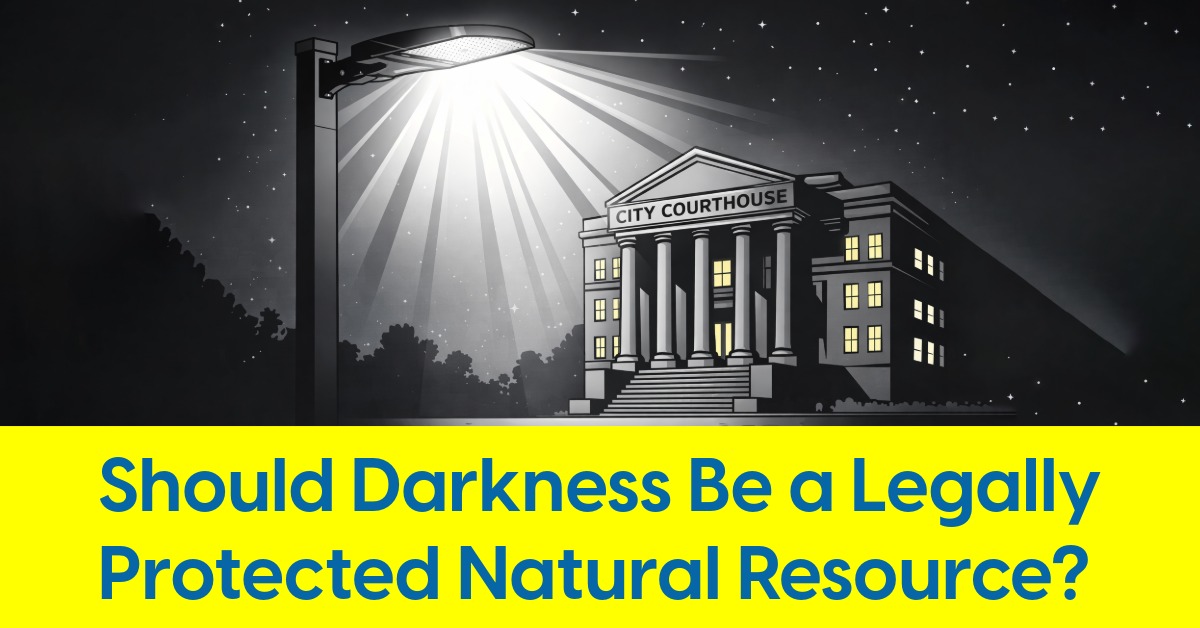
His target: the outdoor lighting at 29 courthouses across the state. His argument: that excessive illumination violates Connecticut’s light pollution statutes and, more broadly, the Connecticut Environmental Protection Act (CEPA), which allows citizens to sue for the unreasonable impairment of natural resources.
Technical Claims Familiar to Lighting People
Smith’s filings are unusually technical for a pro se case, drawing directly from language familiar to lighting designers and facility managers. He alleges that the judicial branch’s outdoor lighting violates several best practices and legal requirements:
- Luminaires not designed to minimize glare, light trespass, or pollution.
- Fixtures exceeding 1,800 lumens that are not “restricted uplight” types.
- Color temperatures: Smith advocates for fixtures no higher than 2700K.
- Lights left on past 11:00 p.m., despite being “nonessential.”

Connecticut statutes do impose constraints on state-funded outdoor lighting, including overnight shutoff requirements and performance standards for minimizing glare and conserving energy.
But enforcement is where the legal terrain gets murky.
The State’s Waiver, and Its Motion to Dismiss
In March 2025, Chief Court Administrator Elizabeth Bozzuto issued a waiver exempting all judicial facilities from the overnight shutoff law. The reasoning, now backed by an affidavit, cites courthouse security and the “confrontational” nature of legal proceedings as justification for keeping lights on overnight.
That waiver is now central to the state’s argument for dismissal. In a supplemental brief filed last week, state attorneys argue that the waiver is lawful, the lawsuit lacks standing, and CEPA doesn’t recognize darkness as a protected resource.
“Plaintiff has offered nothing but his say-so,” the brief states, insisting that Smith’s complaint fails to establish legal harm, let alone one that falls within CEPA’s scope.
The Broader Argument: Darkness as a Natural Resource
Smith contends that “natural darkness,” like quiet or clean air, is an environmental condition worth protecting. He points to statutory references to light pollution in both environmental and building codes, and argues that just as CEPA applies to intangible pollutants like noise and thermal emissions, it should also apply to excessive nighttime light.
His filings cite court precedents encouraging a broad reading of environmental laws and lean on legislative language that frames light pollution in environmental terms.
Still, courts are historically reluctant to extend CEPA’s reach through litigation alone — especially when the plaintiff appears without legal counsel and the state has claimed immunity.
Whether Smith’s case survives dismissal remains to be seen. But for lighting professionals, the dispute touches on familiar terrain: balancing energy codes, dark-sky practices, and safety-driven exceptions.
Smith may not win this round. But the question he’s asking — how much light is too much, and who decides — won’t go away any time soon.