


January 5, 2026
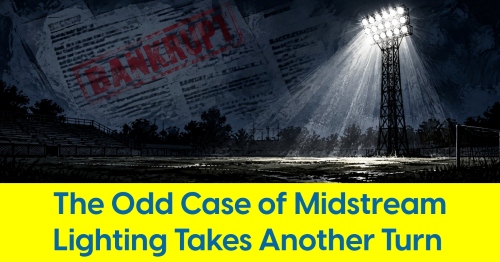
Current Lighting Sued Over LED Royalties Dispute
CHM claims Current sold Evolve high-mast LED roadway products without paying agreed royalties
This is not a standard-issue patent lawsuit. According to federal court filings, Texas-based CHM Lighting alleges that Current Lighting continued selling licensed high-mast luminaires even after halting royalty payments — a dispute centered not on the origins of the product, but on whether Current upheld the terms of an agreement it once accepted.
The complaint, filed December 19 in the U.S. District Court for the District of Delaware, accuses Current of violating a 2018 license deal related to its Evolve LED Roadway Light High Mast Luminaire (ERHM) and later versions of that product. CHM contends that, despite the agreement, Current withheld royalty payments for certain product configurations and continued selling the luminaires, a move CHM alleges constitutes patent infringement.
Inside Lighting contacted Current Lighting on December 23. The company declined to comment on ongoing litigation.

A License Once Signed, Now Contested
According to the complaint, CHM (then known as Carolina High Mast) and Current (then known as GE Lighting Solutions) entered into a Settlement and License Agreement effective November 1, 2018, following CHM’s earlier notice that the ERHM product allegedly infringed its patent portfolio. The agreement, CHM states, required royalty payments tied to the sale of licensed products.
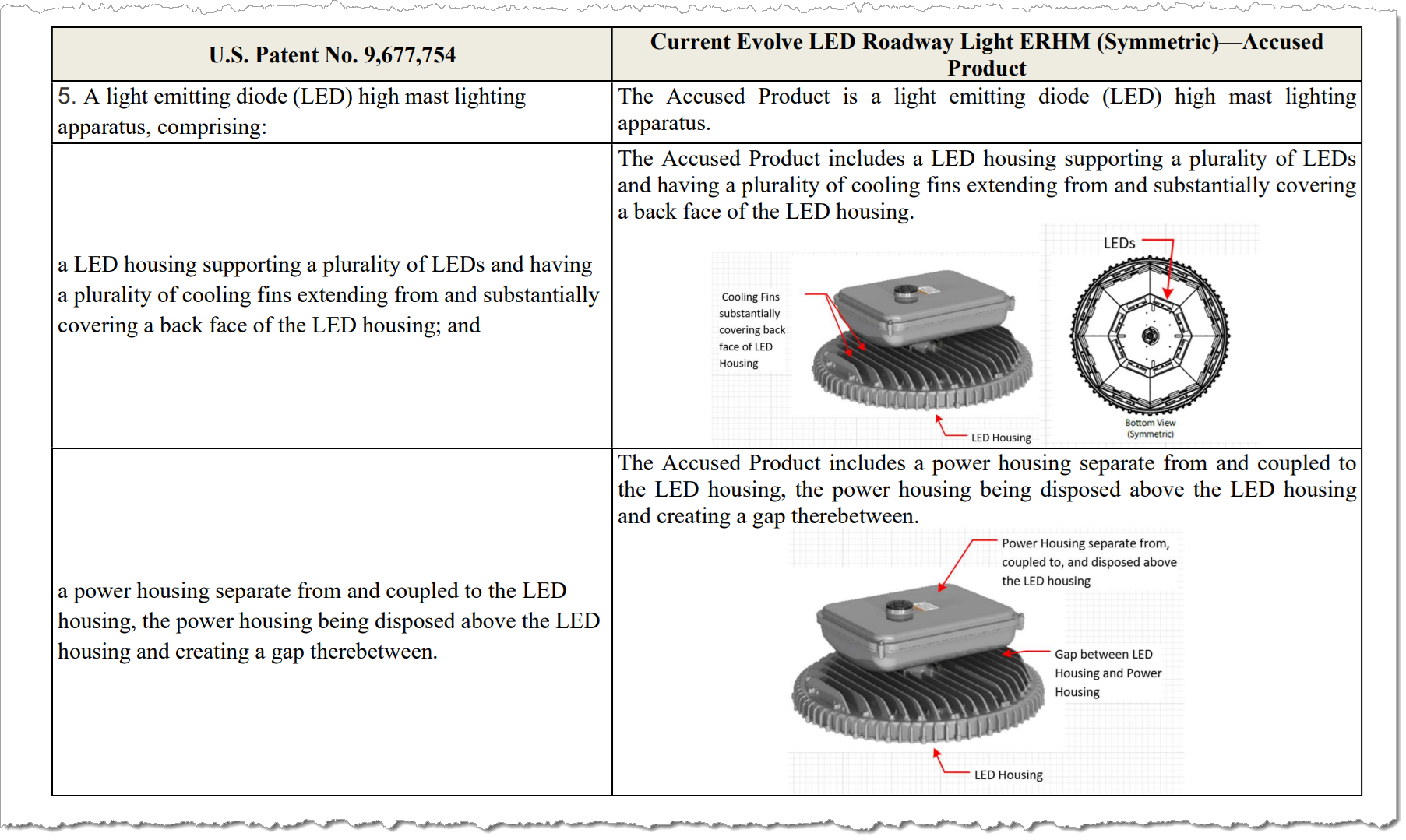
Above: Excerpt from CHM Lighting complaint vs. Current
CHM further alleges that in August 2019 it contacted Current regarding unpaid royalties for ERHM units using Type V optics, specifically those with optical distribution codes VS, VM, and VW. In a response dated the following month, Current reportedly stated that it had not, and would not, pay royalties on those configurations, asserting they were not covered by the license. CHM disputes that interpretation, claiming that sales continued despite the absence of payment and that these products remain materially unchanged from the versions initially licensed.
Claims of Willfulness and Legal Ramifications
CHM’s complaint includes allegations of willful infringement, citing both the 2017 notice of patent rights and the 2018 license agreement as evidence that Current had prior knowledge of the relevant intellectual property. The lawsuit asserts that Current’s continued sales following its own refusal to remit royalties are grounds for enhanced damages under federal patent law.
- U.S. Patent No. 9,677,754: This patent covers the basic architecture of a high-mast LED fixture, separating the LED light engine from the power components to improve cooling and performance.
- U.S. Patent No. 9,903,581: This patent builds on that design by allowing the LED portion of the fixture to rotate independently from the power housing, making aiming and heat management easier on tall poles.
- U.S. Patent No. 10,571,112: This patent further refines the system by linking the power and LED housings with an extension member, maintaining thermal separation while supporting rotation.
- U.S. Patent No. 11,473,767: This patent covers later-generation high-mast fixtures that keep the same separated-housing concept, focusing on panel-based LED mounting with a defined gap from the power unit.
CHM is seeking damages, injunctive relief, and — if the court finds willfulness — treble damages. The complaint also requests that Current be ordered to destroy any infringing products remaining in inventory and to cancel outstanding orders.
The complaint outlines an earlier chapter in the companies’ relationship. In 2014, CHM and Current’s predecessor reportedly executed a Non-Disclosure Agreement as part of a potential collaboration on a project for the North Carolina Department of Transportation. CHM claims it provided a sample of its Condor CLED luminaire under the NDA, and that Current later released its ERHM product line, which CHM alleges incorporated features of the sample design.
The lawsuit does not assert a trade secret claim, and the complaint’s language avoids attributing motive. Still, the timeline and the alleged overlap in product features are presented to bolster CHM’s broader case for patent infringement.
If CHM prevails, even in part, the result could affect not only Current’s sales strategy, but also future sourcing decisions of DOTs and other customers.