


October 2, 2026
Incandescent Comeback Clears Hurdle, Draws Pushback
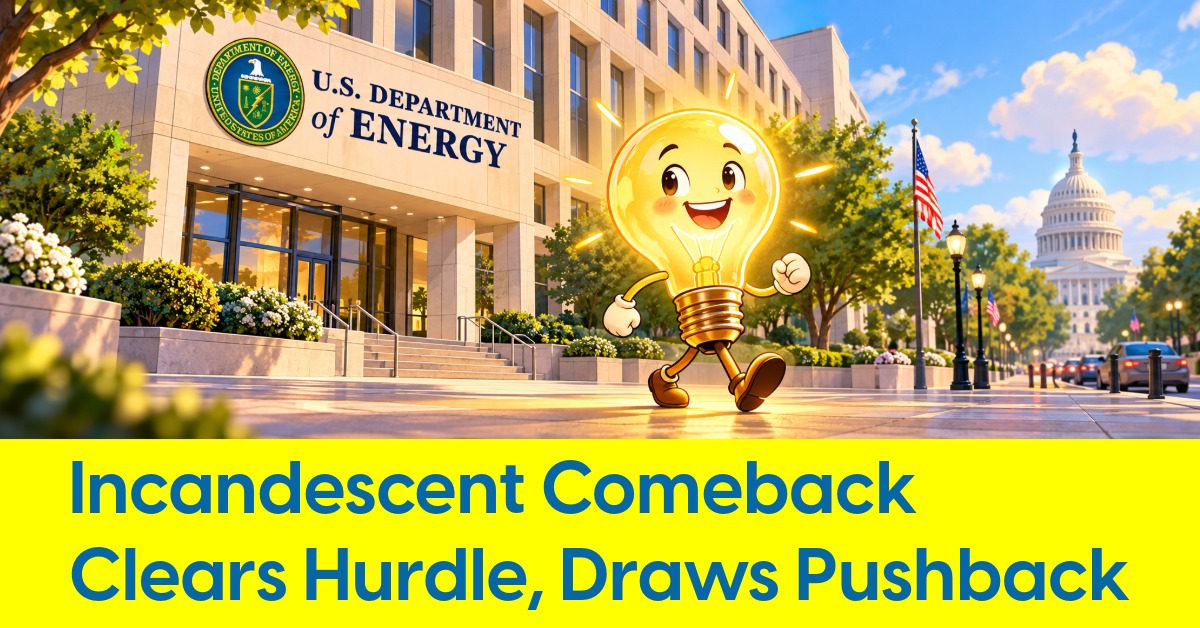
Even with DOE backing, the bill faces an uphill climb…and would factories actually make the bulbs again?
Senator Mike Lee (R-UT) has spent more than a year selling the Liberating Incandescent Technology (LIT) Act as a way to bring back the 60-watt bulb. Read the bill closely, though, and it reaches past the A-lamp into the linear fluorescents and reflector lamps still illuminating some less-modern offices, warehouses and strip malls.
On September 30, the Senate Energy and Natural Resources Committee, which Lee chairs, ordered S.1568 reported favorably without amendment. No vote tally has been posted, and no Democrat cosponsors the bill.
When we covered the bill's introduction in June 2025, we asked whether incandescent production lines would ever come back. What has changed is who supports it. At the committee's September 16 hearing, the U.S. Department of Energy (DOE) endorsed the bill. Associate Deputy Secretary Alex Fitzsimmons asked, "Why would we centrally plan which lighting technologies people can use?"
On January 21, 2025, one lighting trade outlet reported that with a stroke of his Sharpie, President Trump had single-handedly removed the incandescent ban. We reported that his "Unleashing American Energy" order did nothing of the sort. It encouraged consumer choice in lighting but repealed no lamp standard.
An executive order can't rewrite a statute, and federal anti-backsliding rules bar DOE from weakening a standard on its own. So DOE needs Congress. The LIT Act would void DOE's two May 2022 rules, which set the 45 lumens-per-watt floor and widened the general service lamp definition, and the April 2024 rule pushing that floor past 120 lm/W in 2028.

The Fine Print Reaches Commercial Lamps, Too
Lee's summary describes a general service lamp bill, but the text goes further. It strikes Section 325(i) of the Energy Policy and Conservation Act entirely. It also deletes the line that lists general service fluorescent lamps and incandescent reflector lamps as covered products.
That subsection holds the efficacy minimums Congress set in 1992 for linear fluorescents and reflector lamps. Those floors have governed 4-foot T8s, 8-foot slimlines and U-bends since 1994, and DOE reaffirmed them in 2023. By our reading, the LIT Act erases their statutory basis too. Neither the sponsors' materials nor the hearing record addresses that point.
Mercury bans in about a dozen states are already retiring linear fluorescents, so a T12 revival seems unlikely. Halogen PARs and BRs are another matter. They can still be spotted in some aging retail and hospitality installations, and without the reflector standards or the 2022 definitions rule, low-efficacy imports would face no federal floor. The bill also loosens federal preemption, which our June 2025 analysis said would give states more room to write their own lamp rules. For manufacturers shipping nationally, that points toward a patchwork.
Industry Lines Up Against It
No manufacturer testified on September 16, so the industry's position arrived on paper. Ranking member Martin Heinrich (D-NM) entered into the record a September 15 letter from the National Electrical Manufacturers Association (NEMA) and the American Lighting Association (ALA). The letter warned that the "sole beneficiaries of the LIT Act would be foreign companies positioned to flood American markets with low performance, low-quality, and potentially unsafe products."
"Families in New Mexico are not clamoring for incandescent light bulbs," Heinrich said. "Most people just want to be able to afford their energy bills." He credited the current rule with roughly $3 billion in consumer savings.
After the vote, NEMA's Will Hupman warned that repeal "would trigger significant business uncertainty." A day before the vote, a coalition including Consumer Reports and U.S. PIRG urged senators to vote no. The coalition estimated that a typical home's LEDs save about $370 a year.
What Comes Next
Getting the bill through the Senate would likely require 60 votes to overcome a filibuster, a long reach for a bill without Democratic support. The likelier route is a rider. Congress used an appropriations bill in 2011 to defund enforcement of the original bulb standards, and a lame-duck package offers the same opening. The House companion, H.R. 3341, hasn't moved since May 2025.
If the midterms flip either chamber, the bill likely dies with this Congress. Until then, lighting people who sell fluorescent and reflector lamps have a fair question for the sponsors: did they mean to repeal those standards, or did they just reach for the whole subsection?