


October 1, 2026
Acuity’s Lighting Segment Posts $3.6 Billion for Third Straight Year
Steady Lighting cash generation increasingly supports Acuity’s M&A ambitions elsewhere
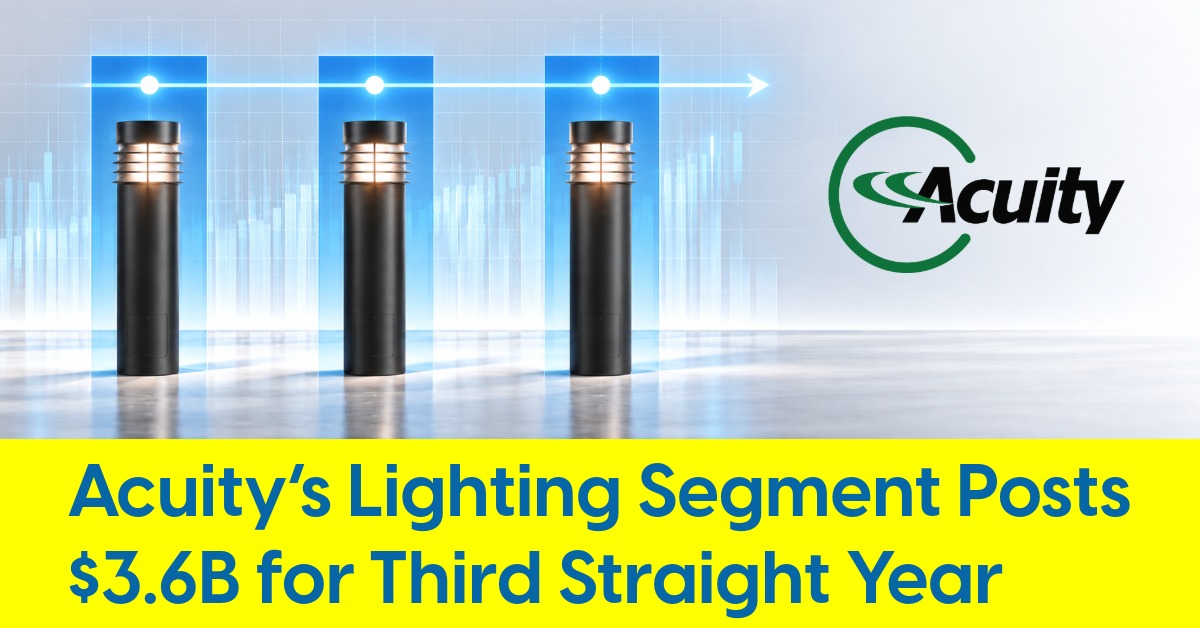
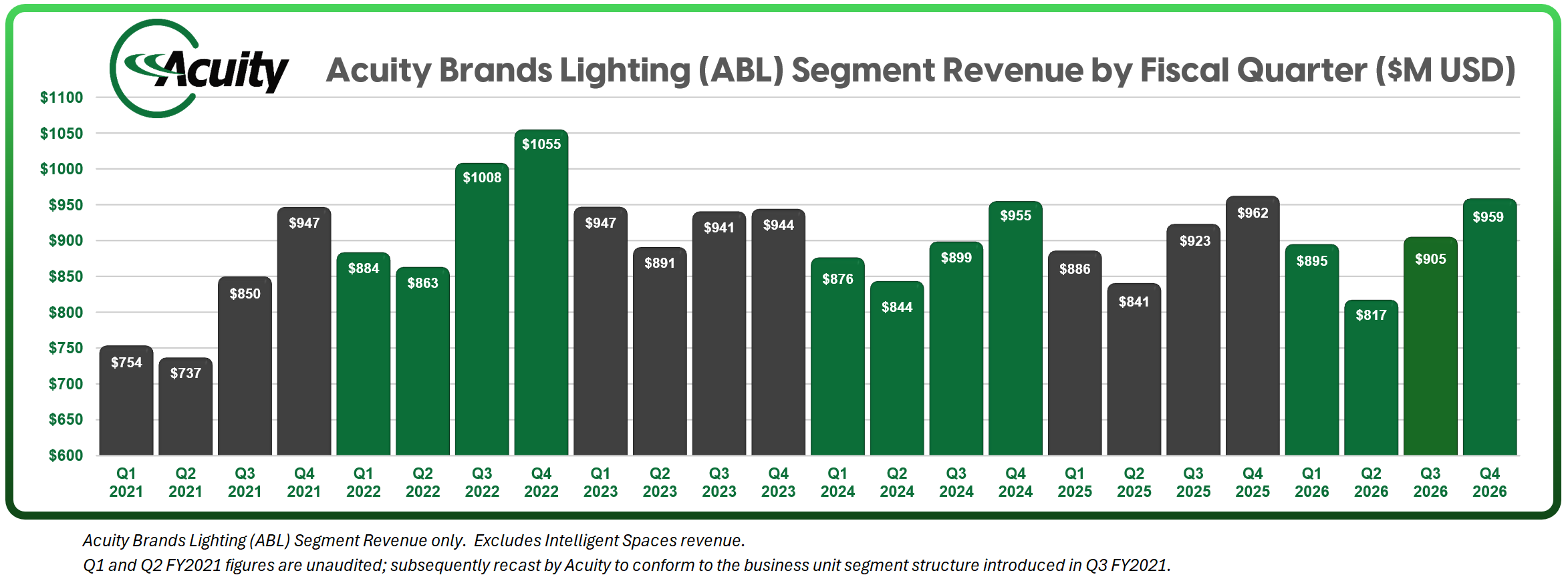
For three straight years, Acuity Brands Lighting (ABL) has been a $3.6 billion business unit of Acuity, Inc.
Fiscal 2024 segment sales came in at $3.573 billion. Fiscal 2026, which closed August 31, came in at $3.576 billion. In between, Acuity managed a tariff roller coaster, raised prices, pruned brands, closed a plant and named a new segment president, and the top line barely registered any of it.
CEO Neil Ashe's case, repeated on Thursday's fourth-quarter call, is that ABL can keep widening margins without help from the market because the gains come from structural changes rather than volume. The fiscal 2026 results put that argument under some strain. On an adjusted basis, lighting margins went backward this year, and they slipped faster in the fourth quarter than in the third.

Total company sales for Acuity Inc. rose 6.8% to $4.64 billion for the year, with all of the growth coming from Acuity Intelligent Spaces segment. For fiscal 2027, Acuity guided net sales of $4.7 billion to $4.9 billion and adjusted diluted earnings per share of $20.50 to $22.00, compared with $19.90 this year.
Acuity shares fell $12.19, or 3.9%, to $297.62 in early trading Thursday.
Lighting’s Top Line Holds Its Ground
ABL posted fourth-quarter sales of $958.7 million, down 0.4%, while total company sales rose 2.9% to $1.24 billion. Full-year lighting sales fell 1.0% to $3.58 billion, roughly 6% below the $3.81 billion the segment booked in fiscal 2022. The fourth quarter is the seasonal high, and it has landed between $944 million and $962 million every year since fiscal 2023, about 9% below the $1.055 billion peak of fiscal 2022.
The channel mix shifted underneath. Sales through the independent sales network rose 3.8% to $729.2 million after two flat quarters, which Ashe called "an indication of us taking share" across the 80 independent markets the agency network covers. The direct sales network fell 24.2%, a $25.5 million drop that more than accounts for the segment's entire decline. For the year, direct sales fell from $411.4 million to $314.2 million, and Acuity has yet to explain the slide in any detail.
OEM sales fell 9.6%. Corporate accounts grew 4.3%, a sharp slowdown from 30% in the third quarter, even as management lists corporate accounts among its fiscal 2027 drivers. CFO Karen Holcom noted the year-ago quarter was inflated by backlog from orders placed ahead of price increases, and Ashe said order rates and the business climate had "firmed."
Where the Margin Went
Gross margin is where Acuity's story holds up. ABL's adjusted gross margin rose 50 basis points to 46.2% in the quarter, which Holcom attributed to product and productivity improvements. Ashe said the segment has moved from high-30s gross margins to the upper-middle 40s over five or six years, a real accomplishment in a business that sells a lot of commodity-adjacent hardware.
The trouble shows up one line lower. Adjusted operating profit fell 7.1% to $179.8 million, and adjusted operating margin dropped 130 basis points to 18.8%. Adjusted operating costs rose about $17 million, roughly 7%, on flat sales. Holcom attributed the decline to technology investment "which supported the stronger gross profit margin." In the third quarter, the same margin fell 60 basis points.
For the full year, ABL's adjusted gross margin slipped ever so slightly to 45.7% from 45.8%, and adjusted operating margin fell 20 basis points to 18.1%. On Thursday, Ashe reiterated the goal of adding 50 to 100 basis points of adjusted operating margin per year. Fiscal 2026 moved in the opposite direction, though Ashe said the company isn't counting on growth to deliver the improvement in 2027.
The Pruning Continues
ABL took a $14.7 million special charge tied to its product portfolio, supply chain and operating footprint. On the call, Ashe said Acuity closed one facility and consolidated it into another, and eliminated smaller brands and product lines it did not expect to contribute over the long term. He did not name the facility. In June, we reported that Acuity was closing its Winona, Minnesota plant and moving production to Crawfordsville, Indiana, with a wind-down set for the end of August.
Ashe said more is coming: "we don't need the whole footprint anymore, even as we grow." For agents, specifiers and distributors, discontinued product lines can mean specifications and project quotes to rewrite.
Acuity also announced a price increase in September, effective in December. Ashe said the company prices to the value its products deliver rather than marking up for inflation, though he acknowledged pressure from steel and freight. Acuity does not disclose unit volume, but flat dollar sales across several years of price increases suggest the segment is shipping fewer units. That is our reading, not a company figure.
Tariff Refunds Provide Lift
Acuity collected $44.9 million in tariff refunds in the quarter, $31.8 million at ABL and $13.1 million in Acuity Intelligent Spaces, and $51.3 million for the year. All are excluded from adjusted results. ABL's GAAP operating profit rose 3.2% only because of its refund.
The refunds, plus lapping last year's $30.9 million pension settlement loss, explain most of the 56% jump in GAAP earnings per share to $5.63. Adjusted EPS rose 11% to $5.77, beating the $5.53 consensus compiled by Zacks, while revenue came in just below the $1.25 billion analysts expected. Adjusted EPS grew faster than adjusted operating profit (up 3.4%) partly because of share count. Holcom said Acuity has repurchased nearly 11 million shares since late fiscal 2020, about 28% of the shares then outstanding.
The Rest of Acuity
Intelligent Spaces generated 23.8% of fiscal 2026 sales. Its fourth-quarter growth of 16.6% is a cleaner read than the full-year 44.8%, which reflects QSC's first full year inside Acuity. Management expects memory costs to cut roughly 200 basis points from AIS gross margin in fiscal 2027, starting late in the first quarter.
Data centers produced the newest specifics. Lithonia expanded its BLT family with a luminaire built around the ceiling grids used in those facilities, and Ashe said Acuity had "a very strong year in data centers" and would keep taking its "unfair share." Distech added a PLC controller to its DDC lineup to reach more hyperscalers.
Operating cash flow reached $825.6 million, helped by the refunds, lower tax payments and a $76 million drop in inventory. Net debt fell from about $474 million to about $61 million, and Holcom said the QSC borrowings were fully repaid after year-end. ABL produced 72% of segment adjusted operating profit, yet the acquisition pipeline Ashe described points at Intelligent Spaces. Lighting's cash is increasingly funding the business next door.
What Lighting People Should Watch
Ruth Gratzke, who just arrived at Acuity from Siemens, now runs ABL. She inherits the margin target and a market Acuity expects to be flat to down low single digits in fiscal 2027, with ABL guided to flat to low-single-digit growth through share gains, new verticals and corporate accounts. Ashe used the call to push back on the long-running idea that lighting must become something else. "The lighting business is incredibly durable," he said. "It's essential to every built space."
The next two quarters will show whether the recent changes reach the operating line, where Acuity says they will. Ashe's thesis is that a flat lighting business can still grow steadily more profitable. Fiscal 2026 was supposed to be evidence of that. For now, it carries forward as a promise, arriving alongside the updated December price list.