


September 24, 2026
Ex-GE Unit Argues the Industry Is Measuring Color Wrong
A phosphor maker argues familiar color metrics can miss what people actually see
Most companies bury their failures. Current Chemicals published one. A new phosphor worked in small lab batches, then kept missing its performance targets once the company tried to make it in production equipment. After repeated attempts, the project was shelved. "The business decision was that the continued effort to enable a production furnace was not viable," the authors write.
The admission appears in a new paper published in Optical Materials by W.W. Beers and W.E. Cohen of Current Chemicals Inc. (CCI). Cohen is the company's CEO. CCI is the former GE Lighting chemical division, spun off from Current Lighting with backing from Amsterdam-based Momentum Global Ventures and launched as an independent company in February from a 250,000-square-foot plant in Cleveland.
Read alongside CCI's marketing materials, the paper looks like the company's pitch in science journal form. In a 2026 press release, Cohen called CCI "a scale-up partner" whose team has decades of experience in the gap between discovery and production, "where ideas often stall." The paper makes the same case, cataloging the problems that appear only when lab recipes meet factory volumes.

The Case Against CRI
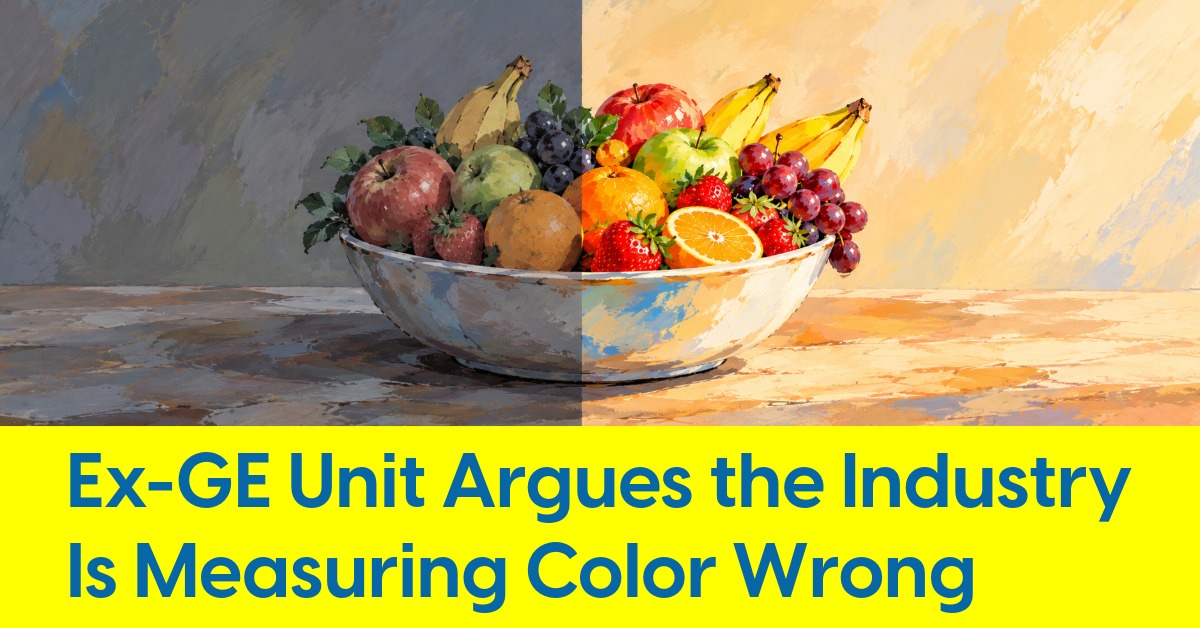
Specifiers will linger on the color argument. The authors model two hypothetical 2700 K blends that differ only in their red. With a red peak at 620 nm, CRI calculates to 86 and R9 to 80. Shift the red to 630 nm and CRI drops to 69, R9 to 6. The reds, the authors argue, will look better anyway. "The metric does not match the visual perception."
They are candid about the price. Deeper red costs brightness fast, because the eye grows less sensitive toward the red end of the spectrum. Their advice is to pick the metric by market: lumens for consumer buyers, color for the clothing rack and the butcher case. Red-rich light, they note, makes meat look better in the grocery store than in your kitchen, a rare laugh line in a materials journal.
Their proof is GE's Reveal lamps, which filtered out yellow light. Internal testers reported "whiter whites" despite lower lumens and CRI, a result the authors say a Penn State evaluation supported. That success is the authors' own history. Beers is a named inventor on two cited patents, and a third reference is a Cohen and Beers patent application. The paper declares no competing interests, a common practice when employment appears in the affiliation line.
What the Paper Leaves Out
The alternative the authors promote is the Color Quality System developed by the National Institute of Standards and Technology. The paper never mentions the Illuminating Engineering Society's TM-30, the method many North American specifiers actually use. In a 2026 argument for judging light by better metrics, that absence is conspicuous, and it would be our first question for Cohen.
The authors also state that the color comparisons rest on idealized spectra rather than measured products. It argues from experience and offers no new study.
What to Watch
CCI's launch release leaned toward rare earths, EV motors, wind turbines and defense-adjacent supply chains, with lighting mostly cast as heritage. The paper suggests lighting remains the company's calling card. Momentum also backs Seaborough, a Dutch phosphor developer that already partners with CCI on scaling.
For lighting people, the most persuasive evidence in the paper is the project that failed. A supplier willing to publish its own dead end is asking to be trusted with someone else's. Whether manufacturers accept that offer may depend less on CRI than on how many ideas CCI can carry from the lab to the loading dock.