


September 21, 2026
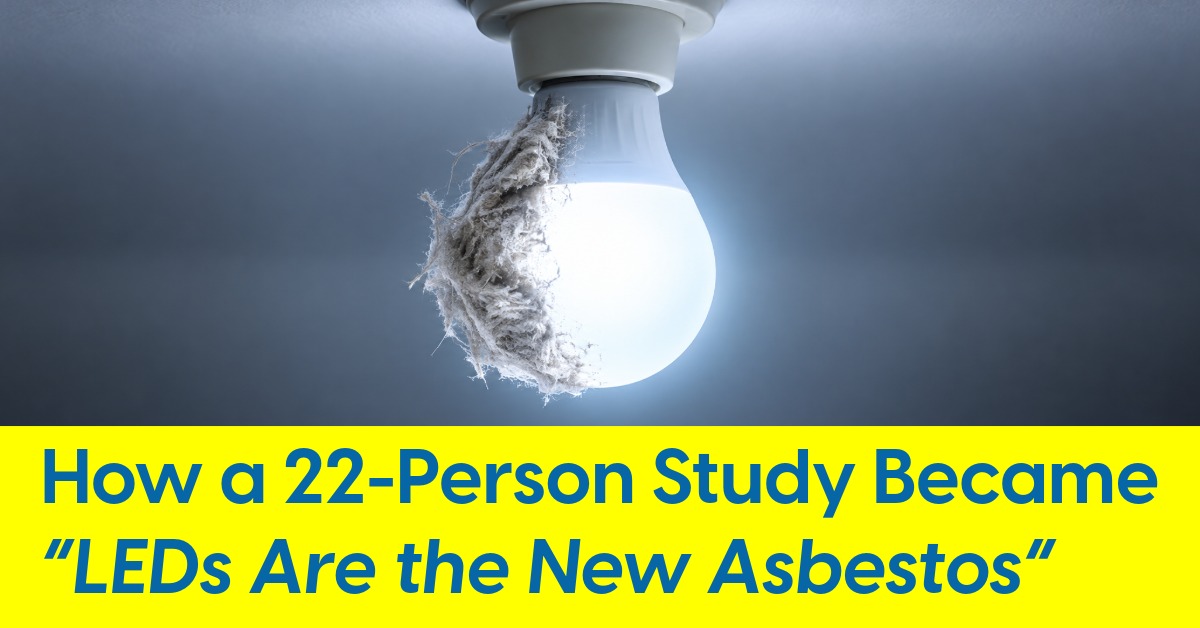
How a 22-Person Study Became “LEDs Are the New Asbestos”
The science raises real questions, but the public narrative may have outrun the data
Nine months ago, a British neuroscientist compared ordinary LED lighting to asbestos on a popular podcast. The comparison metastasized fast: mitochondrial starvation, twenty-first-century scurvy, a public health crisis hiding in office ceilings. It also outran the data that supposedly supported it.
The scientist is Dr. Glen Jeffery of University College London, and he is not a crank. The field he works in rests on a real biological premise: mitochondria absorb light, and different wavelengths appear to speed or slow their production of cellular energy. A 2025 review of 204 randomized trials involving more than 9,000 participants found statistically significant benefits across several outcomes, though the certainty of that evidence was mostly low. None of that is nothing. None of it is asbestos, either.

What The New Study Actually Measured
Jeffery and coauthor Dr. Edward Barrett published a study in Scientific Reports in January examining twenty-two office workers at UCL's Here East campus, a windowless building whose glazing blocks infrared light almost entirely. Eleven subjects had incandescent desk lamps added to their LED-lit workspace for two weeks. Their color contrast sensitivity, tested on both blue and red visual axes, improved by roughly a quarter and stayed improved for six weeks after the lamps came out, longer than earlier experiments using narrow red light bands alone.
Inside Lighting covered this study in May, when it first crossed our desk, treating it as exactly what it was: an interesting, small, real-world finding worth watching rather than a verdict on LED lighting itself. That framing holds up. What has changed since is not the underlying science so much as what happened to it after it left the lab.
The Evidence Has Moved, Just Not Toward Asbestos
A newer, unpublished Jeffery-group preprint, posted in this month, is more directly relevant to the metabolic claims that made headlines. It reports lower blood glucose in windowless offices using LED desk lamps supplemented with 850 nanometer light, measured through both an oral glucose tolerance test and continuous monitoring. That is closer to the mitochondrial story than the January vision study. It is also a preprint from the same research group, not an independent replication, and has not cleared peer review.
Sorting the evidence into what is demonstrated, plausible, and speculative is more useful than treating every claim as equally solid.
- Demonstrated: photobiomodulation produces measurable effects in some human and animal experiments.
- Plausible: an office lit only by restricted-spectrum LEDs may meaningfully alter metabolism over time.
- Speculative: that this amounts to a population-level health crisis comparable to a substance the World Health Organization links to more than 200,000 occupational deaths a year, backed by decades of epidemiology. Nothing published so far establishes that ordinary LED lighting causes disease at anything resembling that scale.
How A Vision Study Became A Headline About Scurvy
The asbestos framing did not stay confined to one podcast. It traveled through a science journalist, a critic, and a lighting consultant, each adding a different layer to how the public came to understand the claim.
- Dr. Andrew Huberman and Dr. Glen Jeffery, Huberman Lab podcast. Jeffery is the one who introduced the asbestos comparison, on an episode of Huberman's podcast devoted to red light and the effects of LEDs on metabolism. Huberman, who hosted the conversation, restated the comparison back to Jeffery while questioning him further, which is part of how the framing reached a much larger audience than a UCL press release ever would.
- Graham Lawton, New Scientist. Lawton's August feature pushed the framing further into the language of deprivation, describing modern interiors as effectively starving occupants of a nutrient. The phrase invoking twenty-first-century scurvy in the piece is attributed to physicist Bob Fosbury rather than to Lawton himself.
- Jonathan Jarry, McGill Office for Science and Society. Jarry's June critique is the sharpest pushback in general circulation on this "new asbestos health crisis", and his central point is a methodological one: the twenty-two-person UCL study measured color discrimination, not mitochondrial activity directly, and the leap from one to the other is doing more work than the data can support.
- Dr. Shelley James, lighting consultant. James took the science seriously without adopting the asbestos framing, and her LinkedIn post lays out why: infrared covers an enormous range of wavelengths and doses, LEDs were never engineered to deliver it, and the more defensible concern may be daylight-starved interiors generally rather than LED lighting as a category.
That distinction, between an interior missing daylight and an LED bulb being inherently harmful, matters for an industry audience. Deep-plan offices, hospitals, schools, and eldercare facilities with infrared-blocking glazing look like far more defensible places to investigate than the category of LED lighting writ large.
What The Industry Should Actually Watch
The honest position sits between two overreactions. There is enough here that manufacturers, specifiers, and standards bodies should be paying attention. There is not enough to tell the public that LED lighting constitutes a health emergency on the order of a known carcinogen.
For lighting people, that leaves real homework: whether photometric standards need a spectral dimension beyond CCT and color fidelity, how a market already selling vaguely labeled "infrared" and "full-spectrum" products should be scrutinized, and whether the metabolic preprint survives peer review and independent replication. The mitochondrial question is not settled science or settled nonsense. It is an open one, and the industry that lit the buildings in question has more reason than most to get the answer right before the internet decides it for them.