October 29, 2026
A.I. Could Rewrite the Rules of Lighting Control
Author: Craig DiLouie, LC, CLCP is education director for the Lighting Controls Association
From predictive maintenance to adaptive illumination, intelligent systems promise smarter building performance
The artificial intelligence revolution saw quick adoption in business, credited with improving productivity, generating process efficiencies, and enabling businesses to more flexibly scale operations. In the next five years, AI promises to be even more disruptive and transformative. In the lighting industry, there is strong early potential to augment practitioners to better discover and compare products, produce specifications and drawings, and ensure quality. Longer term, AI could make lighting control systems even smarter and more adaptable while supporting owners wishing to leverage data for operational insights, energy efficiency optimization, and proactive maintenance.
To better understand what manufacturers are thinking in terms of how AI might impact the lighting controls category, the Lighting Controls Academy conducted an industry sentiment survey targeting its members and other manufacturers. As an informal survey heavy on speculation about the future impact of a rapidly developing technology, the results are not projectable to the industry as a whole nor a firm prediction. They are, however, a useful pulse reading and conversation starter for the industry as it considers AI adoption.
Survey Results
Key survey results are shared below:
AI is expected to be significant in lighting controls. Seventy-one percent of respondents said AI will be “very significant,” while 29 percent said it will be “moderately significant.” None selected “slightly significant” or “not significant” as answers.

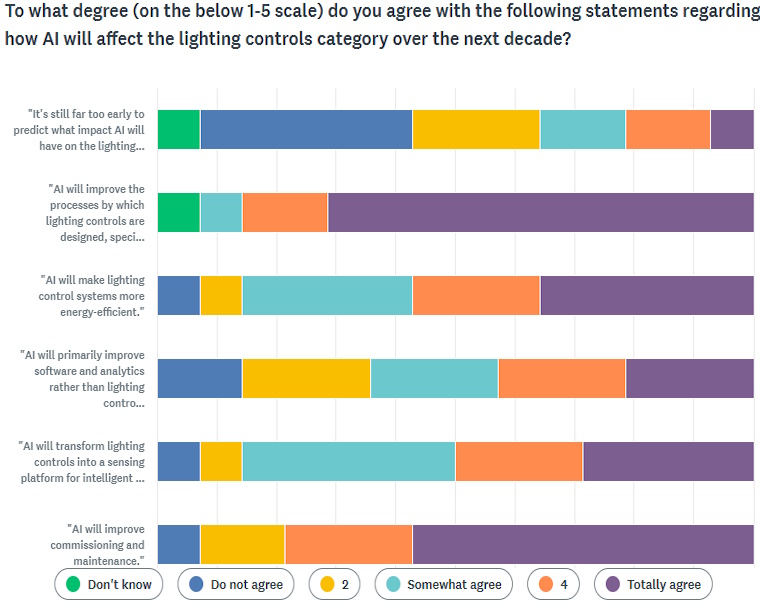
Respondents most strongly agreed that AI will improve the processes by which lighting controls are designed, specified, and/or installed, while improving commissioning and maintenance. For the first statement, 93 percent agreed, with 71 percent saying they “totally agreed.” For the second, again 93 percent agreed, with 57 percent totally agreeing.
Assertions that AI will make lighting control systems more energy-efficient, improve commissioning and maintenance, and transform lighting controls into a sensing platform for intelligent buildings also received significant agreement.
Continuous energy optimization is considered the area of lighting controls most likely to benefit from AI, followed by predictive maintenance and fault detection and diagnostics. Continuous energy optimization earned a top ranking at more than 93 percent, with predictive maintenance and fault detection and diagnostics tying in second place at 86 percent. Automatic tuning of control settings (71 percent) and autonomous commissioning (64 percent) also ranked as fairly important in terms of areas likely to benefit from the technology.

Respondents were fairly divided on how much autonomy they expect AI-enabled lighting control systems to predominantly have in the future. Forty-six percent said they believe AI will autonomously adjust control settings within limits predefined by humans. The next most popular response (31 percent) was that AI will automatically optimize control settings with human approval. Fifteen percent said AI will continuously optimize lighting with minimal human intervention, and 8 percent said it will primarily provide recommendations to operators.
AI is expected to be important for analyzing building data. Eighty-six percent of respondents said AI will be “very important” for this purpose, while 14 percent said it will be “moderately important.” None chose “slightly important” or “not important” as responses.
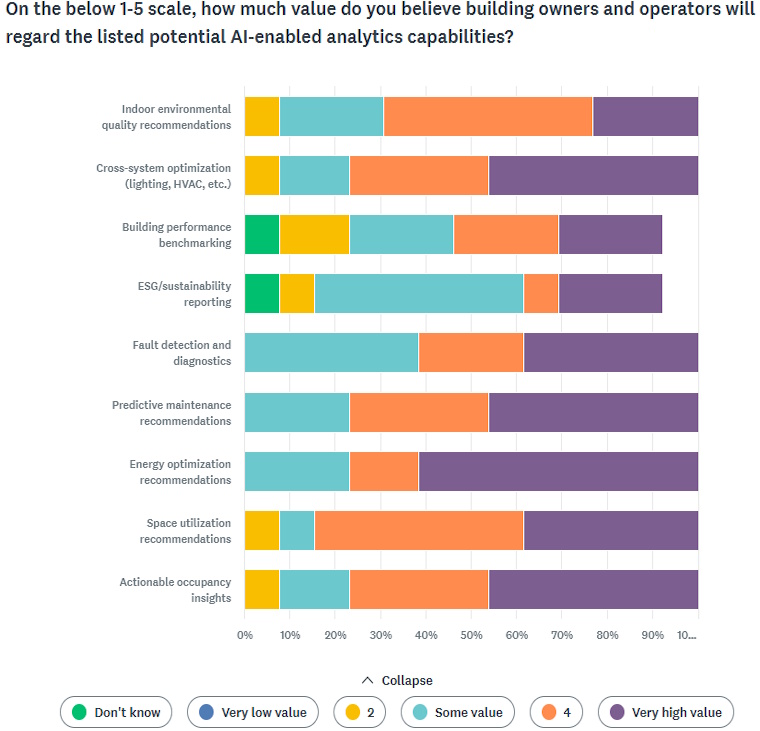
Respondents believe building owners and operators will most value energy optimization recommendations and predictive maintenance recommendations as potential AI-enabled analytics capabilities. All respondents rated energy optimization recommendations as having at least some value, with 61 percent stating owners and operators would see this as “very high value.” Similarly, all rated predictive maintenance recommendations as having at least some value, with 46 percent stating owners and operators would see this as very high value.
All potential benefits leaned toward a fair to high degree of value with the respondents, however: indoor environmental quality recommendations, cross-system optimization (lighting/HVAC/etc.), building performance benchmarking, ESG/sustainability reporting, fault detection and diagnostics, space utilization recommendations, and actionable occupancy insights.
Respondent responses were fairly mixed regarding how they expect users will predominantly interact with building analytics software in the future. Six out of 10 (62 percent) predicted users will mainly interact with dashboards enhanced with AI-generated insights, while 15 percent said it would be conversational AI assistants (chat interfaces) and the same percentage said AI agents that recommend actions.
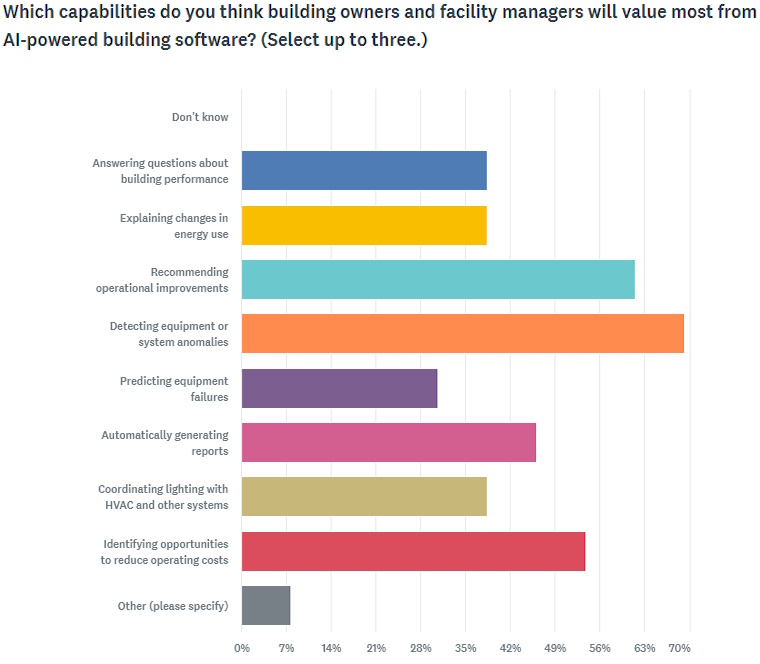
Detecting equipment or system anomalies and recommending operational improvements are expected to be capabilities that building owners and facility managers value most from AI-powered building software. Anomaly detection, which could serve as an important maintenance tool, was rated at 69 percent, while operational improvement recommendations were rated at 62 percent. Identifying opportunities to reduce operating costs came in third at 54 percent, followed by the ability to automatically generate reports (46 percent).
Respondents were fairly divided over where they expect most AI processing to occur. The majority believed it would occur in a hybrid edge/cloud architecture (46 percent) or primarily in the cloud (38 percent). Eight percent said it would occur primarily in gateways and eight percent primarily in field devices or controllers (edge AI integration).
Analysis and Conclusions
The survey results suggest several key conclusions:
The strongest short-term opportunity for AI is for practitioner augmentation. Respondents expect AI will improve the processes by which lighting controls are specified, designed, and/or installed. This matched the insights generated from the National Lighting Bureau’s April 13, 2026 Think Tank evaluating the potential impact of AI on the lighting industry.
Representing a cross-section of the industry, the NLB Think Tank concluded AI is an immediate issue, not a future one, and its greatest value will come from “improving communication, reducing friction, accelerating decisions, preserving expertise, and increasing transparency across a fragmented industry.” Designers in particular were identified as a primary AI opportunity, with the technology facilitating specification writing, drawings, product comparison, documentation, and the quality assurance review.
AI is regarded as potentially existing lighting control capabilities more robust. Lighting control systems have the ability to save energy, integrate with other building systems for increased flexibility and energy savings, and provide a network of sensors generating data related to system operation and occupancy. The average respondent regarded AI as an intelligence layer enhancing these capabilities—deeper energy savings, active integration, maintenance information and alerts, and more actionable insights into space utilization—while also augmenting professionals specifying, documenting, and quoting projects.
Energy efficiency is the key benefit. While flexibility and other lighting control benefits are valued, energy efficiency has historically served as the centerpiece in its value proposition. This benefit is most tangible to building owners and operators. If AI can demonstrably enhance energy savings without negatively impacting spaces and users, its value for lighting controls will be strengthened. Of interest is lighting controls that feature onboard AI processing for autonomous self-commissioning and optimization. System integration has strong potential here, where lighting control systems share data and interact with other systems like HVAC to optimize building, not just lighting, energy consumption.
Maintenance potentially has a strong value proposition. Keeping building equipment functional and operating in accordance with the design intent is a core responsibility and interest for building owners and operators. They were expected by the average respondent to value the ability to identify system anomalies, receive diagnostic information, and be told an appropriate means of correction.
As a result, predictive and enhanced reactive maintenance may emerge as benefits nearly as important as energy optimization. This is a strong potential area where AI might offer utility, transforming lighting control systems from energy management systems into operational management systems.
Longer-term, AI offers intriguing potential to pay off on the promise of the Internet of Things. One challenge with the IoT vision has been that operators were often delivered large amounts of data on dashboards without an obvious way to translate it into routine actionable outcomes. If AI can interpret the data, make recommendations, and possibly even independently execute operational decisions within human-defined limits, the capability may reinvigorate the value of lighting control systems as a sensor backbone enabling intelligent buildings. With AI, the IoT has the potential to become far more actionable and beneficial.
Respondents largely agreed on the big picture but differed on the details. The respondents largely agreed AI would offer a force multiplier to existing lighting control capabilities, benefits, and value but differed on how AI would primarily be implemented in the future—such as where AI processing would occur, how users will interact with building analytics software, and how much autonomy AI-enabled lighting control systems will have. This is not surprising given the respondents were largely speculating on future implementation, but it suggests that should adoption develop, the industry will agree on the destination but possibly choose different routes to get there.
Cost is expected to be an inhibitor to adoption by both users and manufacturers. While barriers to adoption were not formally addressed with a question, the survey invited its participants to share their thoughts on the subject via open-ended responses. Cost was a common refrain, along with privacy concerns, the learning curve, the risk of obsolescence should the technology continue rapidly developing, and gaining and ensuring trust that AI results are reliable.
As is common with lighting and lighting controls, the key to successful AI adoption will be demand for its benefits among end-users. As a result, AI may be adopted incrementally where it can be proven to reliably and cost-effectively accentuate certain lighting control features for a strong tangible benefit.
AI offers value for lighting control. AI is likely to first augment the people and processes surrounding lighting controls; then it has the potential to make the controls themselves more autonomous and useful; and ultimately its biggest value may be turning the enormous amount of data generated by connected lighting systems into actionable building-operations intelligence.
Respondents see the greatest potential in using AI to continuously optimize energy performance, identify anomalies and maintenance needs, interpret building data, and recommend operational improvements. At the same time, most expect humans to remain involved in setting limits, approving actions, or overseeing autonomous optimization. The larger opportunity may therefore be an intelligence layer that turns the data already generated by networked lighting controls into actionable information—and increasingly coordinates lighting with other building systems.
Exactly how that intelligence will be delivered, where processing will occur, and how users will interact with it remain unsettled, while cost, privacy, learning curves, and technology turnover could slow adoption. But the direction of the survey is clear: manufacturers regard AI as offering potential to enhance existing capabilities, moving the category from a system that controls light and collects data to one that actively helps owners operate their buildings.
The Lighting Controls Association is a council of the National Electrical Manufacturers Association that provides education about lighting control technology and application, including articles, videos, design awards, news, resources, and Education Express, a free, 24/7 series of online courses covering everything from technology to design to commissioning.