November 9, 2026
5½ Things LSI Told Investors About Lighting Demand
Budget squeezes, value engineering and a missing fall rush explain weakened demand
Earnings releases tell you what happened. Earnings calls, if you stay through the analyst questions, sometimes tell you why.
Our November 5 report on LSI Industries’ fiscal first quarter relied on the company’s release and call deck: Lighting sales down 6% to $64.8 million, Lighting orders up 1%, and quotes taking longer to become purchase orders.
That decline follows a strong run. Lighting grew for four straight quarters through the third quarter of fiscal 2026, including three consecutive double-digit gains, and finished the fiscal year up 7%. This quarter’s 6% dip was measured against an 18% gain a year earlier, the strongest quarter in that stretch. It is also the second straight decline, after a 3% slip in the fourth quarter, which is why the explanations on the call matter.

The conference call filled in much of the detail. CEO James Clark and CFO James Galeese described a seasonal buying pattern that never appeared, customer budgets that buy less than they did in January, and a December announcement that will extend the company’s strategic plan to 2032.
As with our September review of LSI’s 10-K, here are five things worth knowing, plus one that counts as half because the rest arrives next month.
1. The Lighting Season That Didn’t Show Up
Oppenheimer analyst Brent Thielman asked whether the lighting market was stabilizing or getting worse. Clark’s answer included something the release never mentioned. LSI normally sees a burst of activity in late summer and early fall, when building owners realize that lighting upgrades and maintenance work need to be done before cold weather arrives. Internally, he said, the company calls this “our lighting season.” This year the increase did not happen.
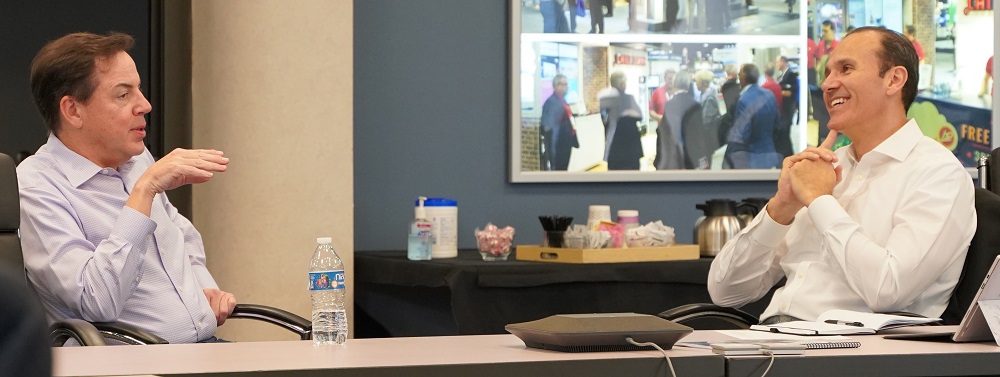
Above: LSI CEO James Clark and Inside Lighting’s Al Uszynski at LSI’s Cincinnati headquarters, 2022. (File photo)
The logic is familiar to anyone who has scheduled site lighting work: once the ground freezes, augering pole bases and pouring concrete around anchor bolts for new area lights gets much harder.
Rep agencies and contractors who handle exterior and maintenance projects know this seasonal push well, and its absence is a more concrete signal than a general reference to soft non-residential demand. Clark said some customers who set aside capital for improvements at the start of the year decided to move that work into early next year.
He described the shift as a delay rather than a cancellation. “I don’t see any of the projects going away,” he said, “but I do see an increased amount of customers kicking things down the road.” That is management’s read of its own customer conversations, and nobody outside the company can check it yet. It does give lighting people a specific benchmark to compare against their own fall bookings.
2. Quotes Are Growing Faster Than Orders
Our earlier report described Lighting quote activity as steady, which is how LSI’s release and deck characterized it. On the call, Galeese gave a sharper number. Lighting quotes for the most recent three months were up 5% from a year earlier, while orders rose 1%. “Steady” understated the gap. The pipeline is filling faster than customers are releasing work from it.
Galeese also described what happens inside that gap. When projects come in over budget, customers go back and “reengineer some things,” he said, and the rework affects other finishing elements as well as lighting. Specifiers and rep agencies will recognize that as value engineering. Much of the cost of that gap falls outside LSI. Every quote that does not convert still needed a layout, a takeoff and a price, usually from an independent rep agency that gets paid only when product ships. A value-engineering round can mean doing that work twice.
Galeese called the pattern frustrating but said “that pipeline is there. It’s just backing up.” A 5% rise in quotes against a 1% rise in orders supports two readings. It could be real demand waiting on budgets, or it could be a growing pile of jobs that will be bid, rebid and only partly built. Management offered the first reading. The next two quarters of order data will test it.
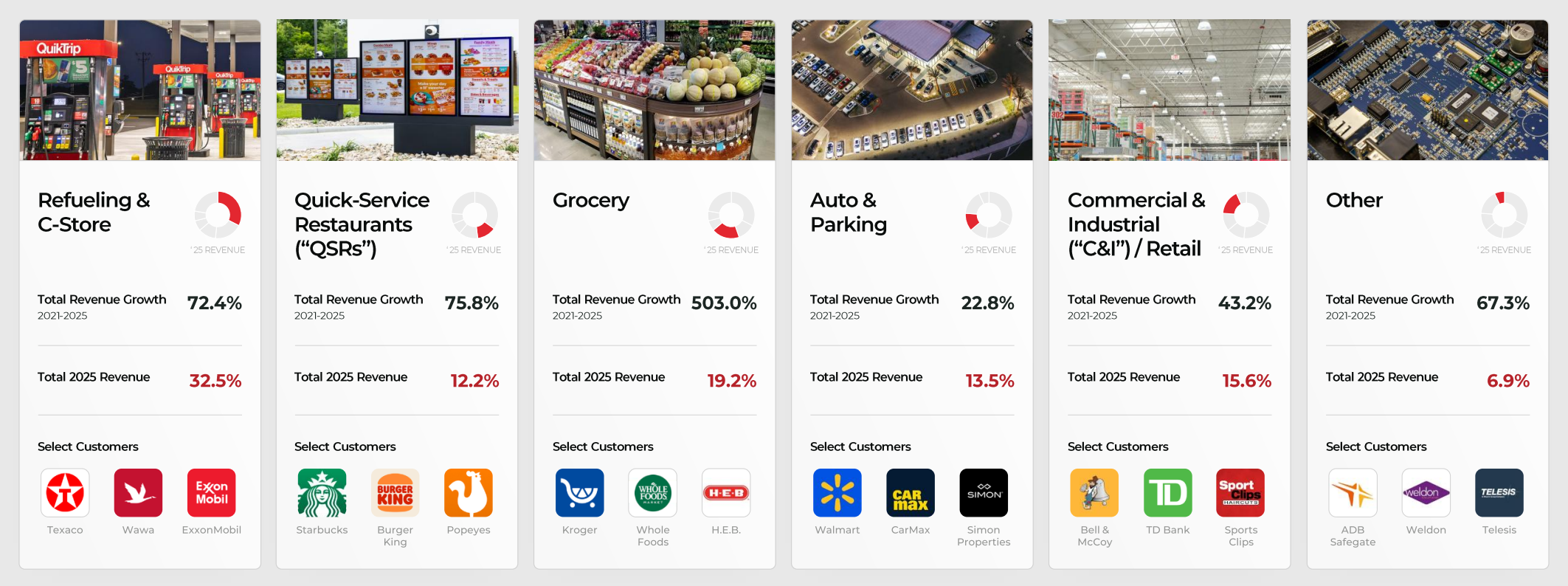
Above: LSI Industries’ September 2026 vertical market overview, showing each market’s share of fiscal 2025 revenue and growth since 2021. (Source: LSI Industries)
3. Ten Stores Budgeted, Seven Stores Built
The clearest explanation came when H.C. Wainwright’s Amit Dayal asked how exposed LSI’s quarterly results are to customer schedule changes. Clark said the disruptions after COVID came from slow permitting offices. Today, he said, “it is almost 100% budgeting.”
He gave an example. A customer plans to renovate 10 stores at $100,000 each, a $1 million program. By August or September, the same $1 million covers seven stores, and the other three get pushed out. Clark said most customers are not adding capital to cover the difference. Inflation across the whole build-out is doing the damage, rather than the price of any one product category.
Two caveats apply. Clark was answering a question about scheduling across all of LSI, including its retail display programs, so it should not be read as a lighting-only diagnosis. And “almost 100%” is his estimate, not a measured figure. Still, it fits what Galeese described in Display Solutions, where reschedules now range from several weeks to several months because of year-end budgets, job sites running behind and shortages of skilled labor. Clark’s reassurance was that rebranding programs rarely stop halfway: a chain does not remodel 10 stores and leave 40 in the old format.
4. The Restaurant Win Is a Legacy LSI Deal
The 3,000-store interior renovation program for an unnamed quick-service restaurant chain was the quarter’s biggest customer win. Our earlier report noted that LSI had not said whether lighting is in scope, and the call did not answer that. It did answer other questions. In response to Min Cho of Texas Capital Securities, Clark said the award includes no Royston products. LSI has pursued the project for nearly three years, through design discussions, material selection, samples and test stores, all before it acquired Royston.
Clark said the two other selected suppliers offer the same product category LSI is providing, so the customer is splitting volume among comparable vendors. LSI is also supplying project management, which is where it hopes to separate itself. Clark said it is common for LSI to start a multi-supplier program with about a third of the work and win more as it proves it can execute. He was direct about the goal: “I want more.”
5. The Business of Managing the Rollout
The project management work Clark mentioned runs through LSI’s ADAPT Services group, which he said has grown from about $10 million three years ago to more than $30 million today. ADAPT does not send out its own crews. It manages the parts of a national rollout that chain customers tend to dread: permits, insurance, scheduling and coordinating locally licensed contractors in jurisdictions whose electrical rules vary by state, county and city. Clark said Royston has a similar, less mature service operation, and LSI has started combining the two.
Clark was modest about ADAPT’s standalone importance. He compared it to ketchup with fries: it doesn’t sell the meal by itself, but it helps sell the order. The bigger value is strategic. LSI’s pitch to convenience store, grocery and restaurant chains is that one supplier can design, manufacture and coordinate installation across hundreds of sites, taking that burden off the customer’s facilities team. Our interpretation is that once a manufacturer is managing permits and contractor schedules across a chain’s store base, replacing that manufacturer means replacing the coordinator, too. That kind of switching cost may explain why LSI is confident it can grow from a third of a program to more, based on execution rather than price alone.
The moat is still being built. On an annualized basis, ADAPT is roughly 3% of a company now running at about $900 million in sales. Clark acknowledged that target customers already buy from incumbents that may be doing a good job, and he said LSI’s installation partnership with Carter has produced some early wins but no real new-business momentum yet, given project cycles of 12 to 18 months.
5½ . The Half That Arrives in December
The last item came almost as an aside in Clark’s closing remarks. LSI will present an updated Fast Forward strategic plan in mid-December, somewhere around December 12 to 16, and will give investors advance notice. The update extends the plan to 2032. Clark said it does not abandon the 2028 plan but puts “a fine point on it.”
The current plan target mentioned on the call was a 12.5% EBITDA margin, a common measure of operating profitability, and Clark tied it directly to the efficiency work. By our math, LSI’s adjusted EBITDA of $22.2 million on $225.9 million in sales was a margin of about 9.8% for the quarter, so there is real ground to cover. Separately, Galeese reaffirmed that net debt, now 2.6 times trailing pro forma adjusted EBITDA after more than $23 million in reductions since the Royston deal, should fall to 2.0 times or lower within 12 to 18 months. The call did not say whether the 2032 plan will change either target. It also did not say whether Lighting, now less than 30% of sales, will get growth goals of its own or be folded into the broader vertical-market story. That is the half we still have to wait for.
For lighting people, the nearer calendar matters more than 2032. If Clark is right that customers moved this fall’s lighting work into next year’s capital budgets, and those budgets reset with the calendar, the first test comes in January, during LSI’s fiscal third quarter. If orders start to catch up with quotes, that supports management’s story of delayed demand. Another quarter of quotes up 5% and orders up 1% would suggest the budgets that shrank this year have not recovered. Customers told LSI to wait until next year. Next year starts in about eight weeks.