November 3, 2026
Lutron Wins Patent Fight. Signify and Legrand Are Next.
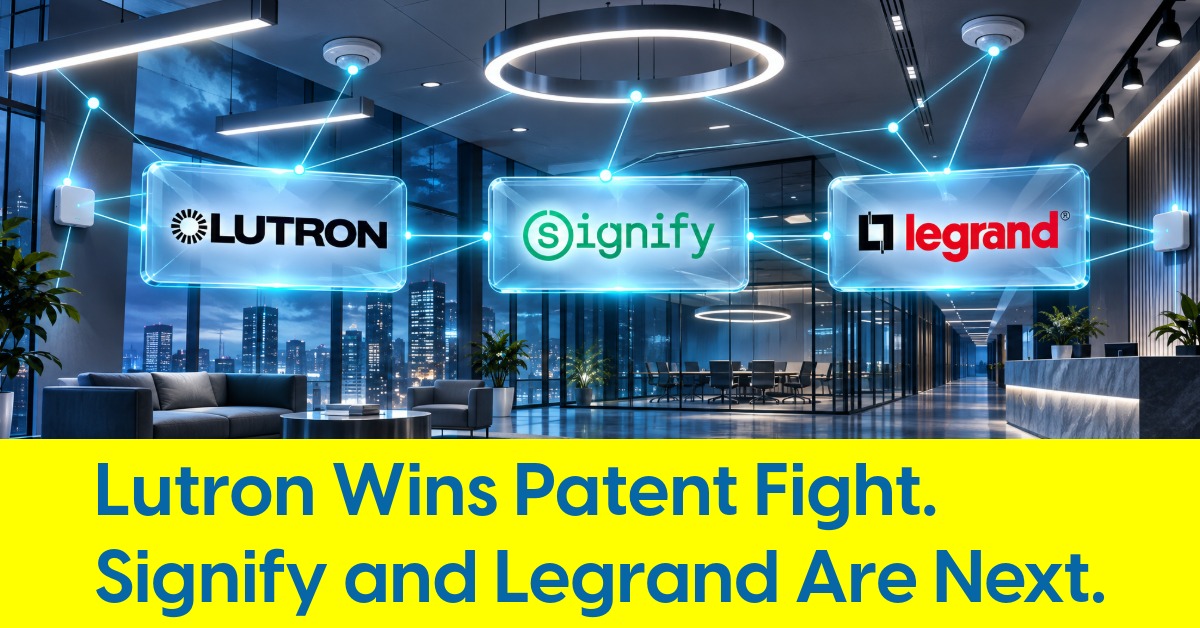
Patent holder, IoT Innovations, presses new lawsuits despite a $3 million courtroom defeat and potential sanctions.
Lutron Electronics told a federal court it has spent about $3 million on outside lawyers proving that seven patents asserted against its lighting controls did not deserve protection. A judge agreed and threw out the case. She then found that the plaintiff had sued over four of those patents without a factual basis for doing so.
The plaintiff, IoT Innovations LLC, has not slowed down. On Halloween, it sued Legrand North America in federal court in Marshall, Texas, over two DALI multisensor detectors along with cameras and a networked EV charger. The complaint lists Wattstopper, Legrand’s lighting controls brand, among the brands behind the accused products. Ten weeks earlier, IoT sued Signify over its Interact commercial lighting controls, Philips Hue and WiZ.

Lutron Chose to Fight
IoT first sued Lutron in Los Angeles in November 2024. It accused the controls leader’s Caséta, RadioRA 3 and Athena systems of infringing patents on ideas such as mobile phone security and predictive web caching. The worldwide leader did not settle. Last November, U.S. District Judge Serena Murillo ruled that all seven patents claimed abstract ideas any generic computer could carry out. IoT has appealed, and the briefs in that appeal were all filed by September.
In March, the judge found that sanctions were warranted on four of the patents. IoT, she wrote, never bought the products it accused. It relied instead on screenshots of Lutron’s website, its app and a YouTube video, and its lawyers offered no account of any investigation before filing. She left the penalty for later and asked Lutron to name a figure. Lutron asked for $2.06 million, to be paid jointly by IoT, its law firm Rozier Hardt McDonough, and the two men who run the company. IoT asked her to reconsider the sanctions finding itself. She heard arguments in May, and the docket shows no ruling yet on either the reconsideration request or the amount. The law firm has since hired lawyers of its own.
A second IoT suit against Lutron, filed in Florida, was sent to Los Angeles in March. The Florida judge noted it was “not altogether clear why IoT chose to file this action here.” IoT dropped the case on April 2, the day it arrived. No court has ruled on the patents in that case. Four of them now reappear in the Signify and Legrand complaints.
The Economics of Fighting Back
IoT makes nothing. Its managing members, patent attorneys Daniel Mitry and Timothy Salmon, are principals of a patent monetization firm called Empire IP. Lutron told the court that 65 of Rozier Hardt McDonough’s 79 open federal cases are for LLCs the two men manage. IoT’s patents came from the patent-holding company Intellectual Ventures and originated at firms including AT&T and Nokia, according to the patent risk firm RPX.
Court records list 18 earlier suits over the seven patents Lutron defeated, and none produced a ruling on whether the patents were valid. Most of those that closed ended in agreed dismissals. Such dismissals don’t reveal what, if anything, changed hands, but they commonly follow settlements.
Leviton Manufacturing and Savant Systems, which owns the GE Lighting brand, were sued in 2023, and ABB and Schneider Electric USA are among IoT’s many other defendants. For any defendant, the math is simple to state and hard to ignore. A defense through dismissal can run into the millions, and a license usually costs far less.
Lutron’s numbers show what the other path costs. It told the court it had run up about $3.08 million in outside legal fees. Its $2.06 million sanctions request covers the share tied to the four sanctioned patents plus the cost of the sanctions fight itself. A separate request to recover its full bill is on hold until the appeal is decided. No money has been awarded. Meanwhile, the Signify and Legrand complaints contain the same sentence, word for word, claiming IoT has suffered “loss of market share and goodwill.” That is an unusual injury for a company with nothing to sell.
Why the Light Switch Became a Target
Every connected luminaire, sensor and gateway is now a small networked computer. That puts lighting controls within reach of networking patents written for phones and servers two decades ago. Against Legrand, IoT aims a 2001 wireless scheduling patent at the DALI multisensor detectors. Against Signify, it aims a 2001 patent on classifying internet data at the Interact System Gateway (LCN1840/05). It aims a 2002 patent on answering natural-language questions at Bulbi, the AI chatbot inside Signify’s Interact Builder app. That application predates the first iPhone by more than four years.
None of the seven patents struck down in the Lutron case are asserted against Signify or Legrand, so that ruling gives them no direct protection. The judge’s findings about how IoT builds its cases are now public record, though. Signify calls itself the world leader in lighting and runs one of the industry’s best-known patent licensing programs, so it is accustomed to being the one sending patent claims. This time it is receiving them.
The next moves belong to the courts and the defendants. The Federal Circuit’s decision on the Lutron appeal could carry weight well beyond one company, depending on how the court reasons. The sanctions ruling will show whether a plaintiff in this business pays a real price for a weak case. Every company on IoT’s list now knows what winning costs. Lutron’s case will show whether losing now costs plaintiffs anything.