October 26, 2026
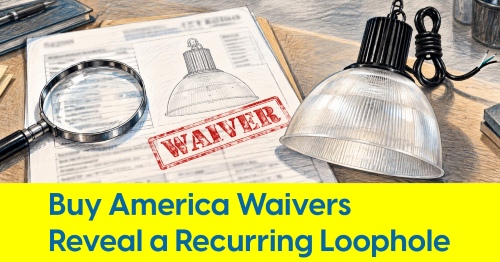
Buy America Waivers Reveal a Recurring Loophole
Six school projects seek domestic-content exemptions using similar sourcing justifications
Richmond Public Schools has federal permission to buy LED fixtures and building controls that don’t meet Build America, Buy America (BABA) domestic-content rules, covering energy upgrades at 22 schools.
The Department of Energy’s waiver, BABA WAV 2026-28, rests its lighting case on one sentence from DOE’s own 2020 LED Manufacturing Supply Chain study: “virtually no LED lamp manufacturing is taking place in the United States today.”
Richmond is buying fixtures, not lamps. It is also the latest in a run. Our review of DOE waiver documents found at least six school energy projects since early 2024 cleared, or proposed for clearance, to buy non-compliant LED lighting: Berlin, N.H.; Porterville, Calif.; White River, S.D.; Clinton, Ark.; Greenup County, Ky.; and Richmond. Every finalized waiver we read reported the same public response during its comment window. None.

The Products Behind Richmond’s Waiver
The $19.7 million project is funded through DOE’s Renew America’s Schools program. Per the waiver, an unnamed general contractor contacted LED manufacturers and distributors from February through June 2025, and none could comply with BABA for the full scope, with the waiver pointing to limited domestic content in diodes, polycarbonate lenses, drivers and sensors.
Two brands appear by name. RAB is listed on low-profile drum flush mounts, an ALED5S area light and an SMS bullet flood. One flood is labeled “Keystone,” and the CLED canopy, FLED flood and WPLED wall pack families across the list are consistent with Keystone Technologies’ catalog. The controls part numbers, including CPO-PC410 plant controllers and XF82x I/O modules, match Honeywell’s ComfortPoint Open line, though Honeywell is never named.
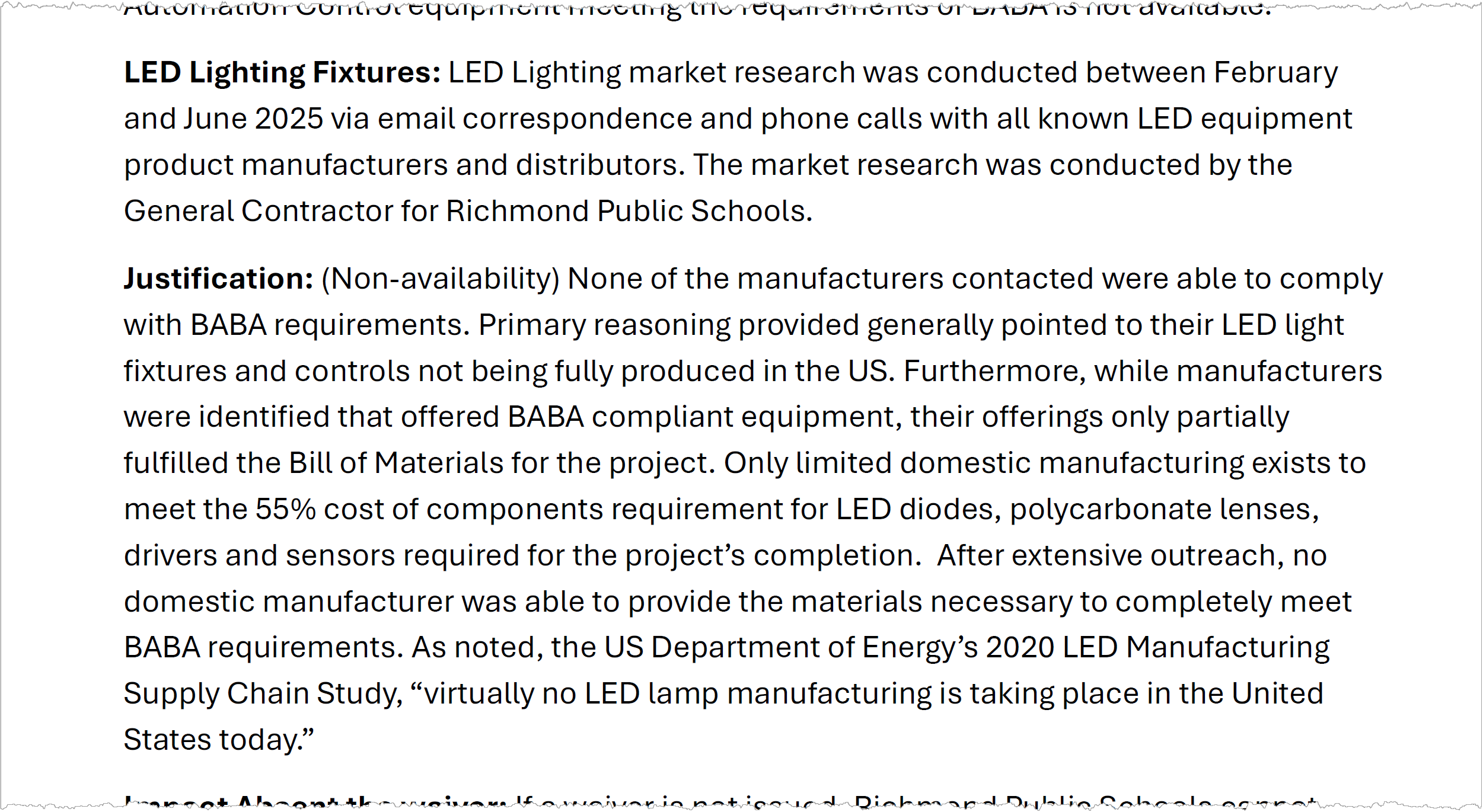
Above: Richmond’s DOE waiver acknowledges some BABA-compliant lighting equipment was available, then cites a study about LED lamps to justify exemptions.
The district’s case for urgency is real. The waiver describes aging pneumatic controls and lighting that in many places does not work, including outdoor areas tied to community safety, all under a capped grant with no room for pricier product. But it also concedes something the other waivers don’t: manufacturers were found offering BABA-compliant equipment, just not enough to cover the full bill of materials.
That concession is the story’s sharpest question. The waiver doesn’t say whether DOE judged availability product by product under the federal BABA rules at 2 CFR Part 184, or across the project’s entire bill of materials. If compliant fixtures existed for some line items, why was the whole list waived rather than only the gaps? That is a question for DOE and for BABA counsel, and the document offers no answer.
What the LED Supply Chain Study Actually Says
The quoted line sits in a bullet about lamps, beside the finding that China made 94% of US LED lamp imports by value in 2019. The next bullet separates luminaires, noting their production is still spread around the world. The report estimated the 2019 US luminaire market at about $8.14 billion in manufacturer value against $4.7 billion in imports, concluding domestic plants supplied the rest, and it named high-bay and stadium lighting among the categories where the US competes globally. Its 2019 roster of prominent North American luminaire makers included Acuity Brands, Hubbell Lighting, Cree Lighting, Eaton and Finelite.
Fairness cuts both ways. The study also says high-volume, low-variation commodity fixtures are often made in China, and these project lists lean commodity. It warns that area lights and high bays can carry more overseas content, such as LED packages and drivers. Compliant product may genuinely be scarce. The lamp sentence just doesn’t establish it.
Six Districts, One Playbook
Berlin’s waiver, issued in 2024, for a $236,240 project, set the template. Its market research took four days in February 2023, and it quoted the same lamp sentence. It also acknowledged the fixtures were assembled in the United States with foreign components. Clinton’s waiver made a similar concession. In both cases the obstacle was the 55% component test, not missing American factories.
Clinton went further, crediting the study to the National Renewable Energy Laboratory and claiming it found all available LED lighting is made in Asia. Guidehouse prepared the report for DOE’s Lighting R&D Program, and it found nothing of the kind. Clinton’s waived lighting replaced fluorescents in a high school stadium and auditorium, the very category the study flags as a domestic strength.
Later waivers lean on precedent. Porterville, whose $1.83 million waiver covers lamps, retrofit kits and sensors, relied on two earlier DOE waivers for its controls and heat pumps and describes no lighting-specific market research at all. White River relied on the conditions of waiver 2024-01. Greenup County’s proposed waiver, covering field-adjustable flat panels, retrofit cans and a DLC 5.1 Premium high bay, drops the study and cites a subcontractor’s research on other grant-funded jobs.
The Window Nobody Uses
Proposed waivers are posted on DOE’s website and the federal Made in America site with roughly 15 days for public comment, and each notice names a DOE contact. Berlin, Porterville, Clinton and Richmond drew zero comments, and those windows have closed. Greenup’s notice, like others, asked manufacturers outright to weigh in on whether the products are available.
More projects are coming. On Aug. 28, DOE cleared environmental review for Cass Lake-Bena schools in Minnesota, where planned upgrades include LED lighting in buildings and parking lots plus two wood poles replaced to carry LED fixtures. We have not seen a lighting waiver posted for that project. When one appears, a manufacturer or rep with documented, commercially available BABA-compliant product for a listed item can send that evidence to the named contact before the window closes.
DOE’s 2020 report makes the case for building luminaires in the United States. Its waivers keep quoting the line about lamps.