


July 17, 2026
Industry Voices Doubt Space-Based Streetlight Vision
Critics argue the proposal ignores light pollution, public health and real-world lighting practice
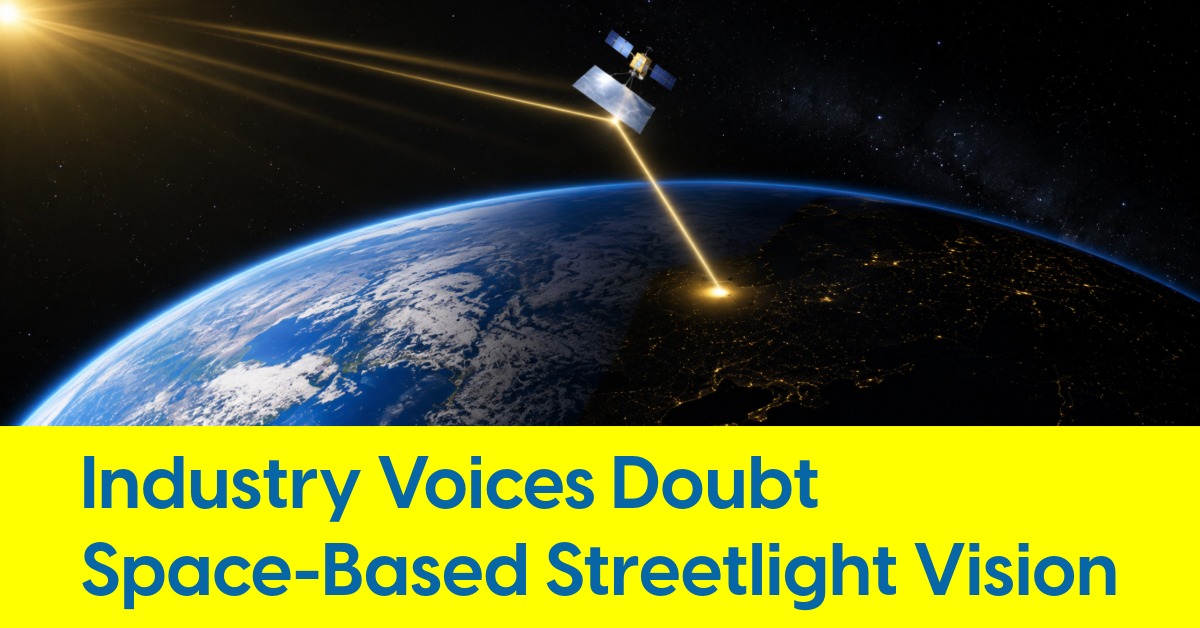
The FCC cleared Reflect Orbital's first test satellite this month on narrow grounds: radio interference, orbital debris, nothing more. The reaction from everyone else has been considerably less narrow.
As we reported Tuesday, the Space Bureau's approval of Reflect Orbital's test satellite explicitly declined to weigh the environmental, safety or nuisance questions the satellite's mirror was built to raise. Lighting professionals filled that gap themselves. When Inside Lighting posted the news on LinkedIn, specification sales professional, James Morgan of Hossley Lighting & Power Solutions, ran the numbers: reaching one foot-candle over a 100-meter city block from low Earth orbit would require roughly 900 to 1,200 square meters of effective mirror area, a reflector some 34 to 39 meters across.

Alex Pappas-Kalber of WE-EF Lighting USA followed with a pointed observation: Reflect Orbital's own website lists eventual targets of 100 lux across a five-kilometer footprint, described by the company as comparable to indoor work areas, and bursts up to 36,000 lux compared to daylight, all without a single lighting or environmental specialist on staff.
The tenor of the comment thread ran from technical skepticism to open derision. One director of specification sales compared the concept to a magnifying glass aimed at a dry leaf. Others called it idiotic, vapid, an idea better suited to a Simpsons plot than a regulatory docket. A recurring, more practical question went unanswered: what happens on a cloudy night.
Public Concern Meets Company Boosters
Reflect Orbital's mentions on X read even less like a regulatory filing and more like a referendum. Replies accused the company of stealing darkness and selling sunlight, demanded the FCC license be revoked, and raised the same debris and rocket-emissions concerns lighting professionals had. A handful of accounts, including some tied to the spaceflight industry, cheered the launch on.
We're grateful to the @FCC for granting our application to fly our test mission!
— Reflect Orbital (@reflectorbital) July 10, 2026
This ruling is hugely validating for our company and reflects America's leadership in testing innovative space technology.
We're excited to validate the guardrails we have built into our technology… pic.twitter.com/6CldTDfDHh
Dr. Martin Moore-Ede, whose Circadian Light Research Center helped organize opposition to the FCC application, used his Light Doctor Substack newsletter to argue the agency ignored the science entirely, citing research linking nighttime light exposure to diabetes, cardiovascular disease, and certain cancers.
DarkSky International, which organized formal comments against the application, has signaled the fight is not over. The organization has separately challenged SpaceX's proposed constellation of reflective satellites on similar grounds, suggesting Reflect Orbital's single test satellite is a preview of a larger regulatory battle rather than its conclusion.
The satellite has drawn attention beyond astronomy, environmental circles and lighting people as well. Time, WIRED and The New York Times have all published pieces on it since the FCC's approval.
For lighting people, the noise around Reflect Orbital is a reminder that the FCC's silence on light pollution was not the end of scrutiny. It was an invitation for everyone else to supply it.