



July 14, 2026
Plan to Replace Streetlights with Reflected Sunlight Advances
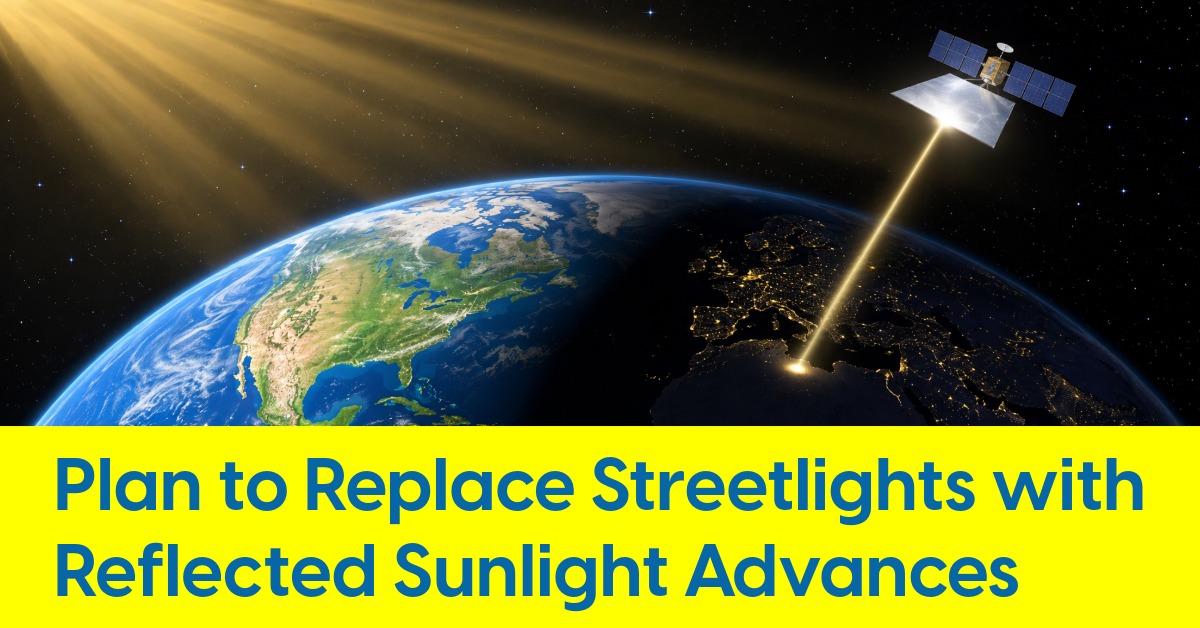
FCC grants approval for test satellite despite objections from astronomy and dark-sky groups
The Federal Communications Commission has cleared Reflect Orbital to put a mirror in space, and the mirror is coming for the streetlight.
On July 9, the Space Bureau granted Reflect Orbital authority to launch Earendil-1, a single demonstration satellite carrying a deployable, steerable thin-film reflector designed to bounce sunlight onto targeted patches of Earth at night. The order, released the same day it was adopted, grants the license with conditions tied to frequency use, orbital debris mitigation and coordination with federal earth stations. It does not evaluate what Reflect Orbital ultimately wants to build.
That distinction matters for readers watching the lighting market from the ground. The Commission was explicit: its jurisdiction covers radiofrequency spectrum and debris risk, not the environmental, safety or nuisance questions raised by a satellite whose entire purpose is to project light. The Bureau denied a petition to deny filed by the American Astronomical Society and declined to impose conditions requested by the International Astronomical Union, finding those requests redundant with commitments Reflect Orbital had already made.

What the Company Says It's Building Toward
Reflect Orbital's public materials describe Earendil-1 as a testbed inside a far larger ambition. The company's own roadmap calls for 36 satellites by 2027, more than 1,000 by 2028, over 5,000 by 2030 and 50,000 by 2035. Its stated lighting targets escalate accordingly: roughly 0.1 lux for a few minutes this year, climbing to 2 lux for two and a half hours by 2027, and eventually a 24/7 service at street-lighting brightness alongside daylight-equivalent bursts of up to 36,000 lux by the mid-2030s.
The company has marketed the concept directly at the industry's turf, describing a service that could "replace streetlights" and "reduce light pollution" even as it introduces an entirely new light source into the nighttime environment.
The funding and government interest behind that roadmap are real. Reflect Orbital raised a $20 million Series A in May 2025 led by Lux Capital, and in June of that year won a $1.25 million Phase II SBIR contract from AFWERX to develop the reflector technology for Air Force energy resilience and lighting applications. The company says it has fielded more than 260,000 applications for satellite-reflected sunlight from 157 countries.
The Regulatory Gap Everyone Is Watching
The FCC's order draws a sharp line: it licenses the radio station, not the reflector attached to it. The Bureau found that questions about skyglow, eye safety for telescope users, wildlife disruption and light trespass fall outside its statutory authority, and declined to require environmental review under NEPA, finding commenters had not shown the single-satellite test would cause significant impact.
DarkSky, which organized public comments opposing the application, has called for independent environmental review before any further deployment and has separately petitioned against SpaceX's proposed million-satellite constellation on similar grounds.
For lighting people, the immediate stakes are narrow: one test satellite, limited duration, a license that expires if Earendil-1 isn't launched and operating within strict timelines. The larger stakes are not. A company with federal defense funding and a published intent to compete with street lighting has now cleared its first regulatory hurdle, on a record that explicitly refused to weigh in on the questions the industry will eventually have to answer itself.