


July 28, 2026
Public Health Group Wants Health-Focused Lighting Labels
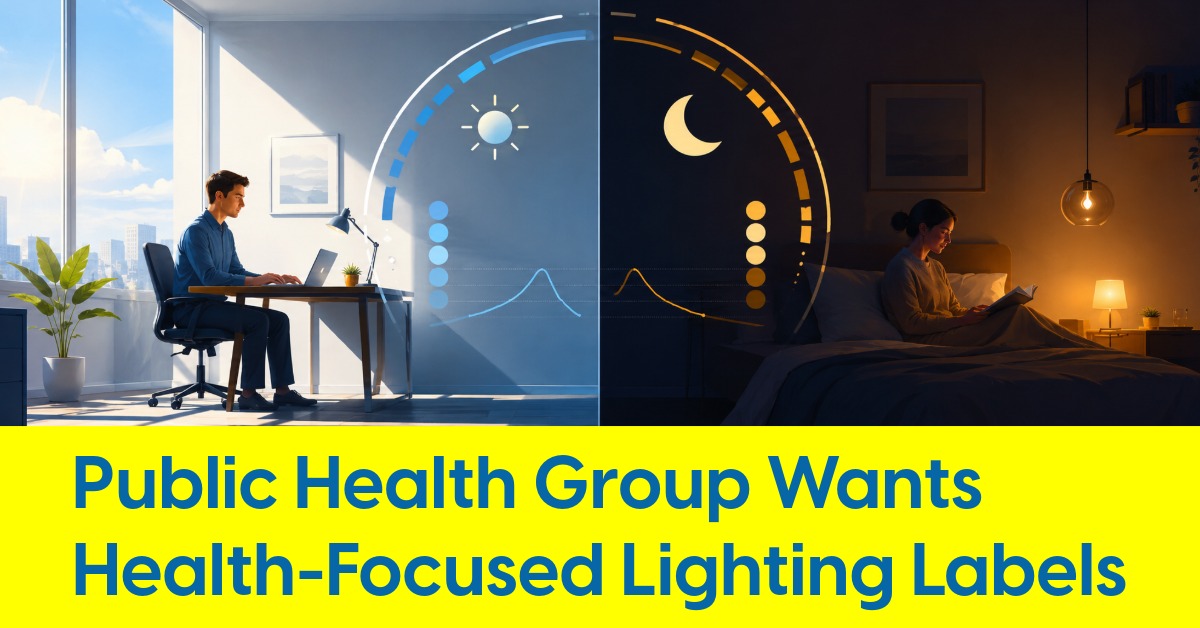
New recommendations aim to shift procurement from lumens and CCT to circadian metrics
For decades, lighting-related public health warnings began and ended with ultraviolet radiation. Wear the right glasses, watch your exposure, don't stare at the sun. Everything else about light and the human body was left to specialty conferences and human-centric lighting pitch decks.
An international consortium wants to change that. In a policy brief published July 7 in Public Health Reviews, the Light for Public Health Consortium, a group spanning circadian researchers, occupational health agencies and the UK Health Security Agency, argues that public health organizations should start treating daily light exposure the way they treat sleep, exercise or nutrition: as a modifiable behavior worth formal guidance.

Not a Discovery, a Translation
The brief breaks no new scientific ground. It consolidates existing evidence, much of it years old, into a single practical message: bright light in the morning and daytime, dim light in the evening, darkness during sleep. The authors are explicit that this is guidance, not a dosage chart, since responses vary by age, geography and work schedule.
What makes the document notable for lighting people is its intended audience. This isn't written for sleep clinics. It's addressed to public health agencies deciding what to tell schools, employers and elder care facilities to do with their light fixtures.
A Metric Manufacturers Haven't Adopted
The brief leans on melanopic equivalent daylight illuminance, or melanopic EDI, the metric CIE formalized in 2018 to quantify how light stimulates the eye's non-visual pathway. Expert targets cited in the brief call for above 250 lux during the day, below 10 in the evening, below 1 during sleep.
Almost no consumer lighting product currently reports melanopic values. The brief calls for that to change, describing wider melanopic labeling as a policy goal alongside daylight access in workplaces and housing.
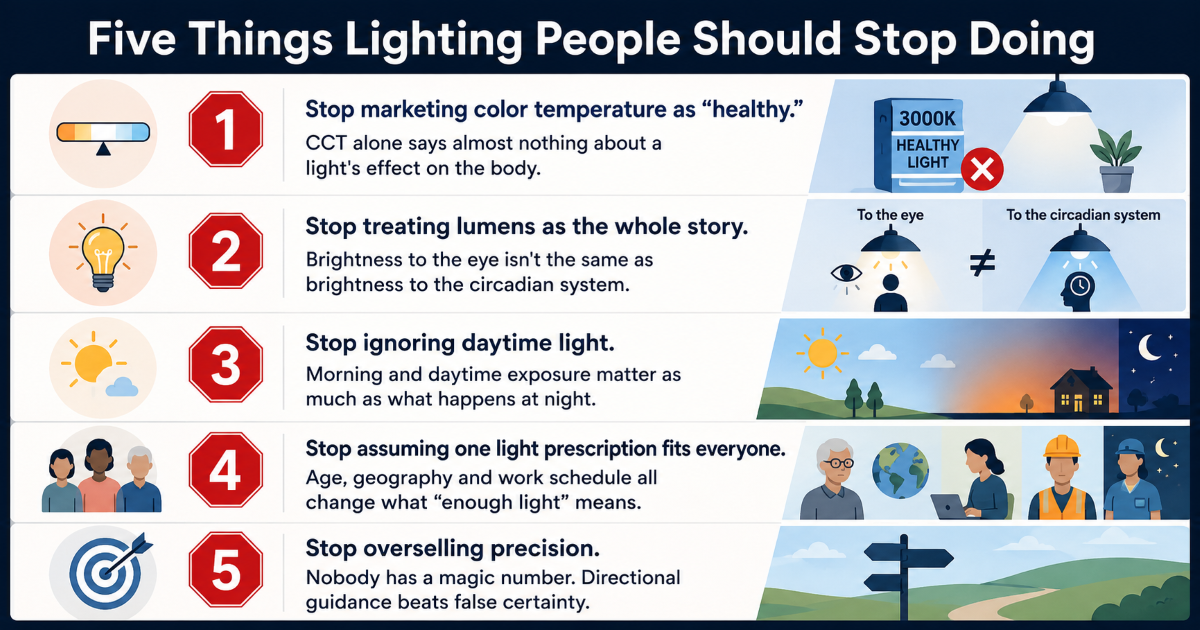
Above: New public health guidance challenges how lighting gets marketed and measured. Image: Inside Lighting; Research source: Piper et al., Public Health Reviews, 2026.
That single recommendation is the real story for manufacturers, specifiers and standards bodies. If melanopic labeling gains traction the way nutrition labels once did, DLC and ENERGY STAR face a decision about whether to fold the metric into their own listings, and product teams face a decision about whether to get ahead of it.
Warm Versus Cool, Undermined
The brief also takes a quiet swing at conventional lamp marketing. It argues that correlated color temperature and lumen output don't reliably indicate the non-visual stimulus reaching the eye, meaning a "3000K equals cozy and healthy" pitch has never rested on much science.
For manufacturers, agents and distributors who have spent years selling on CCT and lumens, that's not an immediate problem. It's a preview of the vocabulary specifiers may start asking for.
The brief doesn't set a deadline, and public health agencies move slowly. But the consortium includes the same researchers who wrote the CIE's ipRGC measurement standard, and standards bodies tend to eventually follow the people who wrote the standards. For lighting people, the open question isn't whether melanopic metrics enter procurement conversations. It's who in the supply chain gets there first.